Uncategorized
“Rainbows and Rain” based on Genesis 9:8-17 and Mark…
When
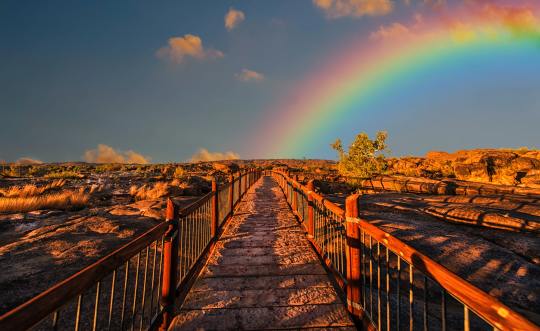
do you look for rainbows? After it rains, right? The Genesis story
connects the rainbow with God’s promise not to flood the earth –
again. It is an oddly timed symbol for such a promise, because by
the time it stops raining and the rainbow shows up … it has stopped
raining and the fear of flooding is likely already relieved.
Or,
maybe that’s the beauty of it.
Because
during a rainstorm we can anticipate it. “When this is over, we
can look for a rainbow!” So, even during the storm, we anticipate
it’s ending and the reminder that all will be well.
Of
course, in these days of climate changed by humans, rain can be
rather scary at times. Floods come more often, and more destructive
than usual. But that actually fits. The ancient Israelites were
desert people and deserts have weird relationships with rain. That
is, they need water for life, and have less of it than most, but
because the earth is so parched most of the time, and water tends to
come in deluges rather than sprinkles, heavy rainstorms quickly lead
to flash flooding.
The
ancient Israelites may have had some of our current misgivings about
torrential rain, and this story may have been a way to center in the
midst of their fears. While it rains, you can anticipate God’s
promise. When it is pouring, you start preparing for God’s sign of
hope.
While
I believe that the rainbow became a symbol for LGBTQIA pride because
of the diversity of colors representing celebrating the diverse ways
of being, I have always appreciated this anticipatory hope aspect of
it as well. The choice of the rainbow symbol, to those aware of this
Genesis story, is a choice to say, “things aren’t good now, but
they’re gonna be.”
Or,
in the language of the African American church tradition, “God is
the one who makes a way out of no way.” (I’m so thankful for the
creation of pride flags that intentionally include people of color as
well as the trans community in the beauty of human diversity.)
Dear
ones, the rainbow feels like a good symbol in the midst of our
current “Rainstorm”, doesn’t it? Or perhaps you want to call it
a monsoon. Your choice. 😉
Which,
come to think of it, is also the Jesus narrative, and our gospel
lesson today. So much of what happens in the story assumes a greater
knowledge of the time of Mark and Jesus than we generally have, so
let me retell the story with some context put in:
“In those days, Jesus came
from Nazareth (Nowhereville) of Galilee (sketchy!) – leaving behind
his family, friends, and village – everything he knew, everything
he was. He was baptized by John – a rural Holy Man, in the River
Jordan, the traditional waters for the Ancient Jewish People.
Baptism marked Jesus as a student of John’s, it also symbolized his
choice to leave behind his society and culture and obligations, and
follow only the Divine.
As he was coming out of the
water, he had a God-experience, a rather beautiful one. It was as if
the heavens were torn open and God was more accessible, and the
Spirit came right there to be with him. Jesus heard a voice offering
a blessing, claiming him! “You are my Son, the Beloved; with
you I am well pleased.” In such a way, he who had left his kin
was adopted into God’s family.
After such a profound blessing
though, the Spirit of God send Jesus into the wilderness. Jesus did
not choose it, the wilderness is the place where it is hard to
sustain life, and he was alone, and he struggled, and he was tempted,
and he had to figure out what it would mean for his life to be a
Holy Man too. He was there for 40 days, like Moses was awaiting an
audience with God. With God’s help – again proving Jesus as God’s
kin – Jesus made it through.When he came back out of the
wilderness, his teacher John had been arrested. He was on his own as
a Holy Man. He went back to Galilee, that suspicious place he was
from, and started speaking God’s ‘good news.’ Which didn’t sound
exactly like people expected it to. He said, ‘The time is fulfilled,
and the kingdom of God has come near; repent, and believe in the good
news.’”1
That
“good news” seems to require a little bit more examination. One
scholar points out, “’Gospel’ was most commonly used in antiquity
to announce benefits to the populace.”2
Another summarizes what Jesus says with, “He boldly announces that
the reign of God – with its dreams of justice and love, equality
and abundance, wholeness and unity- is dawning.”3
Jesus
is a rainbow.
He
is a sign of hope, in the midst of the storm. He comes out of
nowhere, is claimed by God, and offers a message of hope and promise.
The world with its power hierarchies, the world that counts some
people as “disposable”, the world where economies exist to let
rich people get richer on the labor of the poor, the world that wants
to appropriate religion to support the powerful, the world that tells
the 99% to fight each other for the scraps left over after the 1%
have been fed, the world which says to take care of yourself and your
own first and let other’s fend for themselves – the WORLD’s powers
are at an end. A new reign is coming, and it will look entirely
different.
In
God’s kindom, there is no hierarchy, everyone is working toward for
the common good. In God’s kindom there are no disposable people, all
are treated as beloved children of God. In God’s kindom, there are
neither rich nor poor. Instead, each person offers their gifts and
labor for the betterment of the whole, and resources are distributed
according to need. In God’s kindom, we all treat each other as
“insiders” and work for each other’s well-being as well as our
own.
To
repent is to let go of the fear, the competitiveness, and the
judgements of the WORLD, and allow the love, the hope, and the
compassion of the kindom to take root.
This
isn’t easy. It never has been. Nor is it now. Judgements are hard
to let go of, including judgements of ourselves. They’re extra hard
in matters of life and death, like vaccines, and access to health
care, and decisions about masking and distancing and schooling and
childcare and caution vs. risk these days. Right? The issue is that
these judgments slip far too easily into shame, including self-shame
from people who have gotten COVID, which IS blaming victims.
I
don’t claim the authority to know about the best vaccine distribution
plan, but I do think it is useful to take a kindom look at our
pandemic lives. What does it look like when we look from love, hope,
and compassion?
From
that angle, I see a lot of gratitude: for the ways people have
adapted to make all of us healthier, for creativity and hard work in
trying to keep things going as they need to, for those offering care
or services even when there is risk to self involved.
I
also see more clearly the injustices of the moment: that not all
“frontline workers” have had a choice about if they want to be in
the frontlines at all, and that far too many people are forced by
economic circumstances to take risks they don’t want to take. That
people of color have been impacted in a multiplicity of ways: with
less access to adequate housing, with more people doing “essential
work”, with less access to protective gear, with higher poverty
rates that require taking greater risks, with less access to health
care, and with less responsive health care when it is accessed. (To
name a few.) Each of these systemic pieces of racism in our society
are highlighted by the higher infection rates and higher death rates
among people of color, and show us yet again the impact of disparity
on people’s very lives. Lack of equity kills, and movements from the
world-as-it-is to the World-as-God-would-have-it-be are movements
from death to life.
Looking
at the pandemic from the kindom view, mostly, I’m overwhelmed with
compassion: for the impossible decisions everyone is making to the
best of their ability; for the dehumanizing isolation so many are
living with; to the life-draining balancing acts being asked of
mothers, fathers, and caregivers. From this view, judgements
lighten, and love grows.
Finally,
the kindom view reminds us that we are no stronger than our “weakest
link.” That is, we are unable to be healthy in isolation. Until
the WORLD is vaccinated, all of us are at risk. And that’s always
been true, but now we can see it clearly.
We’re
all in this together. We’re all in this storm together (although it
impacts us differently.) And from the midst of this storm, we’re all
reminded that at the end of the storm, the rainbow comes. God
doesn’t abandon us in the storm, hope doesn’t die, the kindom is at
hand, repent and believe. Entering into the kindom’s values will
help kindom come. Remembering the rainbow helps us live through the
storm. Thanks be to God. Amen
1Summary
influenced by:
Ched Myers, Binding the Strong Man
(Maryknoll, NY: Orbis Books, 1998 and 2008, ~128.
Bruce J. Malina and Richard L.
Rohrbaugh Social-Science Commentary on the Synoptic Gospels
(Minneapolis: Fortress Press, 2003) 146-7.
Debie
Thomas, “Beasts and Angels”
https://www.journeywithjesus.net/essays/2924-beasts-and-angels
2-14-21, accessed 2-18-21.
2Malina
and Rohrbaugh, 148.
3Myers,
91.
February 21, 2021
Rev. Sara E. Baron
First United Methodist Church of Schenectady
603 State St. Schenectady, NY 12305
Pronouns: she/her/hers
http://fumcschenectady.org/
https://www.facebook.com/FUMCSchenectady