Skip to content
First United Methodist Church Schenectady
  • Lenten Photo Show
  • About Us
    • Meet the Pastor
    • Committees
    • Contact Us
    • Calendar
    • Our Building
    • The Pipe Organ
    • FAQs
    • Wedding Guidelines
  • Worship
    • Sermons
    • Online Worship
  • Ministries
    • Music Ministries
    • Children’s Ministries
    • Volunteer In Mission
    • Carl Lecture Series
  • Give Back
    • Electronic Giving
  • Events
    • Family Faith Formation
Sermons

“A Defiant Aunt” based on 2 Kings 11:1-3 or…

  • January 22, 2017February 15, 2020
  • by Sara Baron

To explain this soap opera to all of you required a lot of remedial scholarship on my part. I think I have it now. The monarchy period lasted for just under 300 years in Israel and just over 400 in Judea, and I found a handy-dandy chart on Wikipedia that helps.
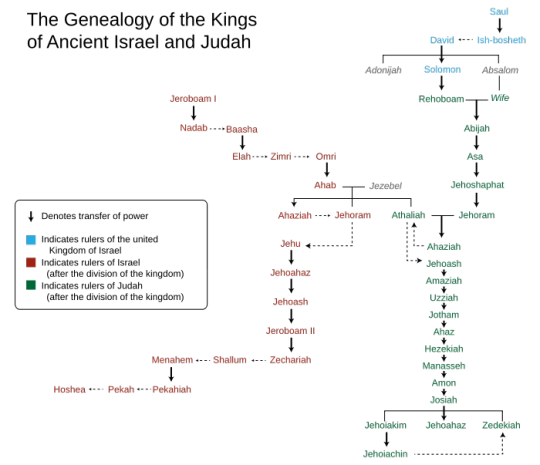
Let’s start with the so-called great King named David (you may have heard of him). His son Solomon became king after him. After the death of Solomon the kingdom divided into two parts: a Northern Part called Israel and a Southern Part called Judea. That is, there was a civil war and the North, which wanted to become a separate nation did so. The Southern succession was SUPER linear, passing directly from father to son with only two exceptions: the one we read about today and the very end of the dynasty. The Northern one is much less linear and way more confusing, and we’re going to ignore most of it today.

The story we read about today is SOUTHERN, it is about Judea, but to understand it we have to start in the North. There was a Northern/Israelite King named Omri, who had been a general of another King and ended up the victor after a coup. The Bible says he was the worst king yet. His son Ahab married Jezebel. You may have heard of her. She is in the running for being the worst woman in the Bible. Jezebel was a princess of the Phoenician Empire, from which you should take that she was not a follower of YHWH.

King Ahab was a selfish, petty, and mean man who tended to follow his wife’s lead. She went on an offensive against the prophets of YHWH and tried to kill them all off so the prophets of rival god Baal could be in power.

If you take nothing else from this introduction, take this: Ahab and Jezebel were rulers who cared only about themselves and power. The Bible calls them unfaithful to YHWH, but I want us to hear that with nuance. The Bible calls leaders unfaithful when they don’t follow the laws of the Torah, and the laws of the Torah were designed to protect the poor and the powerless from the unquenchable thirst for more power and more money of the rich and powerful. Thus, any ruler who cared more for their own power than for the well-being of the people was called unfaithful to YHWH, because being faithful to God MEANT following the rules that cared for the people. Ahab and Jezebel deviated further from God’s vision for a just society than any other rulers before them. Thus they are the standard bearers of evil rulers in Kings and Chronicles. It isn’t just about believing in YHWH or not, it is about being self-serving or caring for the people AS the standard of faith.

Ahab and Jezebel, the power couple of epic evilness, had at least a daughter and two sons. Those sons also became Kings of Israel after their father, and the second of them to take the Kingship was Jehoram (of Israel). Their daughter was named Athaliah. She was married to King Jeroham of Judea. Two men, same name; Athaliah had a brother King Jeroham AND a husband King Jeroham. Eventually Queen Athaliah also the mother of the successor King, Ahaziah.

Just before we get to this little story, King Ahaziah, like several Judean kings before him, was leading military campaigns alongside the Northern Israelite King. The two separate countries were pretty well tied in together at this time (including by marriages), and the Bible seems to think that the evil influence of Jezebel was spreading widely. While King Ahaziah of Judea and his uncle King Jehoram of Israel were off fighting to keep control over vassal states, King Jehoram of Israel was injured.

The great northern prophet Elisha stepped in and anointed the general Jehu as king, to take over for the injured king!! Meanwhile, King Jehoram (of Israel) has gone off to heal in another city and his nephew King Ahaziah (of Judea) comes to visit him. Then the newly minted King Jehu (of Israel) comes and kills them both, and proceeds to go on a killing rampage to ensure that none of Ahab’s 70 other male descendants can take over for him. He also has Jezebel killed, and all the Baal worshippers. I’m telling you, they don’t make soap operas as violent as Biblical history for a reason.

Now, the deceased Jezebel and Ahab have one remaining child in power, their daughter Athaliah who has been Queen Mother to her son Ahaziah. Their male decedents in the north and all of their allies have been murdered. In the grand tradition of seeking power at any cost, the Queen Mother Athaliah has all of the other male royal descendants killed off and claims the throne for herself. This action would have completely eliminated the rest of Ahab and Jezebel’s line as well as the Southern succession. It is unclear if this mass murder involved any of her other sons (there may not have been any), but it certainly includes HER OWN GRANDCHILDREN, the princes of the kingdom.

Now, originally my goal was to discuss the subversiveness of Jehosheba, a daughter of King Jehoham and sister of King Ahaziah, but at this point I’m having trouble with clarity over which woman is more subversive: is it the woman who claims the throne for herself for seven years and is the ONLY break in the Davidic dynasty in 438 years OR the woman who subversively hid her nephew away so he could restore the dynasty?? This leads me to wonder how much are we supposed to care about the dynasty, which I really think is propaganda more than it was God’s will? In their own ways, both of these women were exceptionally subversive, although one seems significantly more evil than the other. While I admit that subversiveness can come in good or evil forms, we are going to keep our attention on the defiant aunt.

Before I started the research for this sermon series, this little story was not one I’d noticed before. It does show up twice, 3 verses each in the standard history of Kings and nearly the same verses in the alternative history of Chronicles. They tell us that there was a ruling queen of Judea, and she was the only one to sit on the throne who was not a descendant of David! She was taken down by the subversive action of another woman, one who was either her daughter or her step-daughter. The historian Josephus claims that Jehosheba was a HALF sister to King Ahaziah which means she wasn’t Athaliah’s daughter, but the text seems to imply the opposite. Generally in these stories a woman is only called a sister that clearly if she is a full blooded sister. It doesn’t really matter, but it is curious.

The Bible struggles with Queen Athaliah’s rule MOSTLY because she was not a descendant of David, and it seems to call her reign illegitimate. The New Interpreter’s Bible puts it this way, “Although Athaliah rules for seven years, the typical regal summaries are omitted in the report, for the narrator does not consider her to have been a legitimate ruler.”1Apparently, questions of the legitimacy of rulers is not new in human history. Similarly, we can tell from this entire narrative that people in power using their power to do harm to the vulnerable is a long standing tradition and that the prophetic voice exists for the sake of calling power to accountability.

Anyway, to get back to the story, this sister Jehosheba of the newly dead King Ahaziah is ALSO married to the High Priest (which is sketchy in its own right, the power is clearly shared very tightly in that society). She hides her baby nephew and his wet-nurse away in a unused room in the palace to keep him from being murdered. Later she sneaks them both out of the palace and hides them in the Temple for SIX YEARS. For all of those years, his grandmother ruled the southern kingdom of Judea under the assumption that there was no one left with a more legitimate claim to power than the one she had.

Now, its hard to tell from story itself who the mastermind was: Jehosheba or her husband the high priest (we’re going to skip over his name so that no one gets more confused and just call him the high priest). They seem DEEPLY in cahoots. Jehosheba is the one who is said to have stolen away the prince and hidden him for years, but at the end of that time it is her husband who enacts a plan to overthrow Queen Athaliah’s rule by convincing the military that the rightful son of King Ahaziah still lived and should be king instead. Perhaps it was the high priest that asked his wife to protect the baby to begin with. Perhaps it was the Jehosheba who convinced her husband to overthrow the Queen for the sake of her nephew. Perhaps they had a really great relationship and shared in both the planning and the execution of the plan. The text doesn’t tell us. But within the royal family, a princess who was married to the high priest risked her own life and that of her husband and family as well for the sake of overthrowing the Queen.

The Biblical narrative claims that the baby nephew who became King, Joash, was a good king. It seems that his high priest uncle kept in line for as long as the high priest lived, and he even oversaw a restoration of the Temple. He had a 40 year reign of following the ways of YHWH, although in the end he decided to use the Temple’s treasury to pay off a foreign king who wanted to sack Jerusalem and his servants killed him off in response. You can’t make this stuff up. I do not find it clear to what degree Joash really was in charge and to what degree his uncle (and aunt?) pulled the strings after having saved his life, but the gist seems to be that Jehosheba did a good thing for the people of Judea and for the worship of YHWH by saving that baby. Of course, she maintained the royal lineage, but she also helped provide a ruler who cared for the people.

The real question, of course, is what we can draw from these ancient stories of long dead battles for seats of power that matters to us today? Of course there is the timely reminder that the Biblical standard for good leadership is the care given to the people, with particular attention to the poor, the powerless, and the marginalized. I think there is also in Jehosheba’s story the reality that standing up to power can require great personal risk.

The book “Lest Innocent Blood Be Shed” by Phillip Hallie tells the story of a little village in France, Le Chambon, full of Huguenots who truly believed in the Biblical call to take care of all of God’s children. Those French Protestants were responsible for saving the lives of thousand of Jewish children (and adults) during the German occupation of France. They did so while taking their own lives at risk, and indeed pastor’s son was killed for being part of the resistance.  The faith of the people propelled them to take care of all God’s people.

The acts of Jehosheba, like the acts of the people of Le Chambon, were extraordinarily courageous because the power structures above them were willing to kill people in order to maintain their power. To be in the resistance sometimes requires acts of great courage and personal risk. Loving God, if and when it becomes necessary for us to take risks to take care of your people, may we prove worthy like Jehosheba and the people of Le Chambon. Amen

1Choon-Leong Seow “The First and Second Book of Kings” in The New Interpreter’s Study Bible Volume III edited by Leander Kirk et al (Abingdon Press: Nashville, 1999), 227

–

Rev. Sara E. Baron

First United Methodist Church of Schenectady

603 State St. Schenectady, NY 12305

Pronouns: she/her/hers

http://fumcschenectady.org/

https://www.facebook.com/FUMCSchenectady

January 22, 2017

Sermons

“Wanting Knowledge”based on  Genesis 2:15-3:7

  • November 30, 2016February 15, 2020
  • by Sara Baron

Here
we are.  Again.  It is the beginning of the church year.  Again.  We
start anew with the stories.  Again.  For those among us who have not
attended to the church’s liturgical calendar before, I apologize.  It
is a wonderful rhythm of life, and I hope you will be enriched by
living into it.  Personally, I’ve been attending to the church’s
liturgical calendar for decades, and been leading worship in the
liturgical seasons for more than a decade and this is a year where
starting over again takes some energy.

The
last year hasn’t been easy AND there is fear of what will come in
this coming year.  Often I’m frustrated with the rather depressing
texts that accompany Advent, I don’t want to start in the darkness.
This year I’m ready and willing to admit that there is much darkness
in the world and that I, too, yearn for the light of God to break in.
Ironic, isn’t it?  This is the year I’m forgoing those depressing
Advent texts to continue the Subversive Women sermon series?

The
Subversive Women chosen for Advent are intentional though.  I’ve
always loved the idea that we start the Christian year in unity with
our shared history with Jewish people, reliving the period in our
shared history when we waited for God’s messiah to change the course
of human history.  I also love that we do this in a season of
darkness (for the Northern Hemisphere – I’m quite sad about how
poorly all the metaphors of the liturgical year work in the Southern
Hemisphere and struck that this is yet another experience we have of
privilege).  Anyway, I love that we start the year in darkness, and
in the waiting, and in our shared history.  I love that the quietness
of Advent contrasts with the frenetic pace of consumer culture around
us; creating a pause, a pregnant pause.  Along with waiting with the
Jews, we also wait with Mary in the last month of her pregnancy.

That
is, I really love Advent.  And it is with delight that I offer you
this text for us to play with today.  What better way to start the
Christian year and re-start the telling of our faith story than to go
back to one of the stories of creation?  And, what  better place to
start than the woman called “life” itself, Eve?  (Yes.  Eve means
“life.”  Subtle, huh?)  After all, she has been accused of
ruining human life on this planet in multiple ways, so she MUST be at
least a little subversive.

This
is an old, old story.  It is in the voice of the Yahwehist, the
oldest of the four voices found in the Torah.  It is a story trying
to make sense of the world as it is, and there are a lot of
explanations going on.  It is trying to make sense of the human need
for interpersonal relationships.  It is trying to make sense of human
capabilities exceeding that of other creatures.  It is trying to make
sense of the labor necessary to stay alive.  It is trying to make
sense of the experience of separation from God.  It is trying to make
sense of the power of love.  It is trying to make sense of the human
desire for knowledge.

I’m
not sure it succeeds at any of these tasks, but I appreciate noticing
that these huge questions of why things are the way they are was
already bugging people thousands of years ago, and they were
struggling to find answers just as we are today.  The existence of
the questions they were trying to answer makes me feel more united
with the tellers of this story than the story itself does.  Which
isn’t the story’s fault.  It could be a perfectly adorable myth if it
hadn’t been used to support the subjugation of women and the
Christian obsession with “sin.”  However, it has been, which
makes me squirm all over again when I read it.

Two
and a half years ago I preached on this text and explained in detail
a theory of it that had changed everything for me.  To my delight,
when we got to this text in our Bible Study, people remembered that
theory – it changed everything for them too!  Some of you were here
then to hear it, and some weren’t, so I’m going to split the
difference and briefly share the theory again.1

In
the Ancient Near Eastern people believed that you could either be
immortal or reproductive.  Furthermore, sexuality was linked to
reproduction, THUS it was linked to mortality.  If you are going to
live forever, you don’t need to have children as your legacy, and you
don’t need to be a sexual being.  If you are mortal, and you are
going to die, you get to have children.  This was a common motif in
Ancient Near East stories (this is the area that the ancient Jews
were from).  None of the garden narratives in the Ancient Near East
have any children in them.  Gardens are places for IMMORTAL, ASEXUAL
beings.  Eating from the tree of the knowledge of good and evil
transformed Adam and Eve from being immortal, asexual beings into
mortal, sexual beings.  

You
might notice that the text says directly, they were naked but “not
ashamed,” which indicates they didn’t have sexual awareness of
their own bodies to begin with.  As the wise Catholic priest who
pointed this out said, before eating, Eve and Adam seem to be “zero
on the passion meter.”  Sexuality is activated ONLY when they ate
of the tree.  The tree of the knowledge of good and evil is really
the center of it all.  What do we know of it?

  1. Forbidden
    for some reason
  2. It
    makes one like God (3:5) “like one of us” (3:22)
  3. Eyes
    are opened and see nakedness (sexual awareness)
  4. makes
    one wise (3:6)
  5. connects
    with punishment
  6. It
    produces a concern that the one possessing it not live forever.

What
else do we know about the phrase “knowledge of good and evil”
from the Bible?   Deuteronomy 1:39 teaches us it is something that
children lack, Isaiah 7 calls it a sign of maturity.  From 1 Q
Samuel 1:9-11 (Dead Sea Scrolls) “He will not approach a woman to
have intercourse with her until he has attained the age of twenty
when he knows good and evil.”  Hmm, this is clearly about sex.  In
2 Samuel 19:36  An old man is being invited in for wine, women, and
song.  He responds “I’m 80…. and no longer potent, deaf, and not
experiencing the joy of food.” …. also “knowledge of good and
evil” as something an old man loses.

So,
sexual potency, sexual maturity, sexual appetite seem to be implied
here!  Then, the tree is an aphrodisiac.  The premier aphrodisiac in
fact, as it brought the humans from zero sexual appetite to “normal”
rather than from weak appetite to stronger appetite.  This is a story
of awakening to normal sexuality.  In that case,  the serpent is a
fertility symbol offering this knowledge.  After this story, Eve
called mother of all things!  It is because of the eating of the
fruit of the tree that all other humans exist, within the framework
of this story.  And all hearers of the story in all times should be
grateful to her for eating it!  So, then, why was the tree forbidden?
Because immortals do not beget.  

Given
this new understanding of the tree, the
punishments about pain in childbirth, and man lording over woman,
FIT.  There is no fall, as much as Paul and others have made of it,
and there is no original sin.  The couple is making a journey UPWARD:
they become aware, wise, and mature in full adult human stature.  

They
started off like children and come into full adult status.

Isn’t
that an interesting creation story?  It is a story that tells how we
became reproductively capable, sexually aware, adult humans.  This
creation story includes the creation of future generations of humans.
It is a much more interesting story than it initially appears,
right?  Personally, I’m rather grateful that they ate of the fruit
and gained sexual maturity because within the constructs of the
story, NO OTHER HUMANS would otherwise exist, and I rather like
existing.

A
few other notes on this story, particularly for those who have heard
it used in other ways.  Adam (whose name means both “human” and
“dirt”) and Eve (whose name means “life” and “life-bearer”)
were in the garden together and the serpent speaks to Eve while
Adam is also present
.
Only Adam is told NOT to eat of the tree, and yet when Eve responds
to the serpent she assumes that it applies to her as well AND she
strengthens the command.  The first version was “of
the tree of the knowledge of good and evil you shall not eat, for in
the day that you eat of it you shall die”.  Eve tells it like this,
“God said, ‘You shall not eat of the fruit of the tree that is in
the middle of the garden, nor shall you touch it, or you shall die.’”
She adds the touch.  Isn’t that how humans work?  When we really
want to keep a rule, we make rules around the rule in order to make
keeping the rule easier.

Eve
is aware of the risk, but the serpent tells her, “You will not die;
for God knows that when you eat of it your eyes will be opened, and
you will be like God, knowing good and evil,” AND she looks with
her own eyes.  She sees that “the tree was good for food, and that
it was a delight to the eyes, and that the tree was to be desired to
make one wise.”  She listens to the serpent AND she takes in
awareness from her surroundings, and she decides that risking death
is worth having knowledge (and sexual maturity, let’s be clear). It
is almost as if she is a prepubescent girl choosing to become a
woman: there are big trade offs in that choice, but there is goodness
in being an adult.

In
this week that we celebrated Thanksgiving, taking days apart to be
grateful, and remembering a shared meal between generous native
people and overwhelmed frightened immigrants, it is worth remembering
this ancient story being grateful to Eve who is said to have chosen
knowing, and growing up, so we all can exist.  We can also be
grateful to Eve and her choice throughout Advent as we wait for
Mary’s baby to come.  All of the babies who have been born, within
the constructs of this story, exist because Eve chose knowledge and
maturity over staying in the dark.  We take her light into these dark
days.  Amen

Sermon
Talkback Questions

How
else do you think about Advent?

Where
else do you notice the contrasts of light and darkness, and what
meaning do you make out of them?

What
do you do to avoid being pulled into the frenetic pace of consumer
Christmas, and back into the quiet reflection of Advent?

Whether
you heard this theory before or not, how does it change your
relationship to this story – and to Adam and Eve?

Personally
I like the idea of Eve considering the serpents ideas, taking in
awareness of her surroundings, and deciding for herself that
knowledge was worth it.  How does her thoughtful consideration
change the story?

What
does it mean to be grateful for sexual maturity, and to consider our
creation myth to be about that?

How
does God’s love get reflected in this story?

—

1 What
follows is reworked from “The Garden: We Have it ALL Wrong”
preached on 3/9/2014.  That knowledge came from Father Addison
Wright during a lecture series at “Ecumenical Scripture Institute”
at Sky Lake in 2011 on the first 11 Chapters of Genesis.  

Rev. Sara E. Baron

First United Methodist Church of Schenectady

603 State St. Schenectady, NY 12305Pronouns: she/her/hers

http://fumcschenectady.org/
https://www.facebook.com/FUMCSchenectady

November 27, 2016

Sermons

“Pure Courage” based on Esther 4

  • November 21, 2016February 15, 2020
  • by Sara Baron

In the beginning of the book of Esther we get the story of Vashti, Queen of Persia, who simply refused. She’d been told to show up in the midst of a drunken party wearing only her crown, and she didn’t. The king and his advisors recoiled in horror that a woman could use her power to say no, thus she was banished and a decree went out to the entire empire letting them know that men were in charge. She scared them, a lot.

The story continues, and at some point after that, the king got lonely and regretted over-reacting. His advisors then suggested that he’d be less sad if he rounded up all of the beautiful women in his empire, put them into a harem, and enjoyed them while deciding who the next queen should be. Wow. Aren’t those great advisors? It really is terrifying what ideas advisors can come up with that weak-minded kings decided to implement.

So, within the story of the book of Esther, they did. This serves as your reminder that the book of Esther was written as historical fiction for the sake of building up the Jews living in exile, and it was never meant to be taken as real history. We can mine this story for metaphor and hope, but not for historical facts.

In this story, Esther is one of the beautiful maidens chosen for the king’s harem. She is a Jewish woman, an orphan, who has been raised by her cousin Mordecai. At Mordecai’s suggestion, she does not reveal her Jewishness within the harem. After a year of beauty treatments, she gets her night with the king and he happens to like her best. She becomes the new queen! It is a precarious position: she is queen to a king who disposed her predecessor on a whim, who also has a back-up harem for both sexual pleasure and a queen “bull pen.” (<–Intentional decision not to gender-neutralize made here.)

Meanwhile, her cousin Mordecai has been spending most of his time standing outside the palace gates, trying to glean information about Esther and determine if she is being treated well. In his station there, he overhears a plot to murder the king. He lets the authorities know, they investigate, it is founded, and the king is pleased (to be alive). During this time, the king also appoints a man named Haman to be his right-hand guy, and Haman is given so much authority that others are expected to bow down to him whenever they see him.

Mordecai does not bow down. For a story that doesn’t mention God, the book of Esther has a lot of implied Jewish theology. Jews through the ages have refused to bow down to foreign rulers, claiming God alone is their king. Haman, the king’s favored advisor, is just as much of a narcissistic, ill-tempered, short-sighted xenophobe as his king. He FREAKS OUT when Mordecai refuses to bow down, and he decides to execute all the Jews in the empire because of it.

Haman brings up his plan to the king, nuancing it just so – pointing out that there are a bunch of people in their country who aren’t fully assimilated. They have different customs, values, and rituals. They did not follow (only) the laws of the empire. Therefore, he said, let’s kill them. He even offers the king money for the honor of killing all the Jews. The king, being presented as a weak leader, immediately agrees, but declines the money. A decree goes out that on one particular day all the people of the empire are to kill any Jews in their midst.

That’s what it took to get us to this chapter. Mordecai knows about this plan, as do the Jews around the empire, but Esther does not. Mordecai has moved into mourning, perhaps in the tradition of the Ninevahites trying to change God’s mind, perhaps in mourning for a country where they believed themselves to be safe, perhaps in mourning for himself and his people at their imminent death with fear that no one would be left to mourn them. His mourning is sort of a problem though, because it means he can’t enter the palace and that means he can’t easily get word to Esther.

Her servants know that he is her family though, even if the palace doesn’t know the connection nor her heritage. They see him in mourning and tell her. She sends him clothes, presumably so that he’d wear them and come tell her what’s wrong. He refuses them, which means they have to have their whole conversation via messenger, and with Mordecai at the gate for lots of people to overhear!

Mordecai has a plan, and he sends it to Esther through her eunuch: she should go before the king and beg him for mercy for her people. Esther’s first response is… less than enthusiastic. She is queen, but she is in a precarious position as queen, there is a harem waiting to take her position, her predecessor got deposed, and the king hasn’t called for her for a month, meaning she’s not particularly in favor. She doesn’t think she’s likely to be able to change his mind, and anyway, even showing up before him without being called held an automatic death sentence – unless he absolved it. That is, Esther appears to like being alive, and suggests they work on another plan. She isn’t suicidal.

Many a preacher and scholar have condemned her for this response. They’ve called her weak and self-serving. They’ve called her privileged and prissy. I think she’s wise. If there had been another way, it would have been wiser to go with it. The likelihood of success in this plan was LOW. Mordecai thinks Esther is their best chance, and he pushes her – HARD- to go forward with it. He points out that if this law is followed they’ll both die. He says the now-famous words, “Who knows? Perhaps you have come to royal dignity for just such a time as this.” Those words have haunted anyone with any power or privilege since this story was written. They refuse any excuse we throw at them, and make real the importance of using power for good.

With that, Esther decides. She wasn’t suicidal, but she was courageous and willing to act. She wasn’t impetuous either though! She asked for prayer support, for the community to fast and pray on her behalf for 3 days and she offers that she and her servants will too. She wants to be prepared, to have a plan, to do it right, to give it her best shot. And she says words as famous as Mordecai’s in response to him. Her final words to him are, “If I perish, I perish.” I’m not clear how anyone could accuse Esther of lacking courage.

Now, I particularly love something about Esther’s courage. Esther got to the position she was in because she was PRETTY and PLEASING, which likely means that she was compliant. Her access to power came through traditionally feminine means. However, her use of her power came through her pure courage – which hasn’t always been attributed to the feminine. I love this because often women are told that either they can pretty or they can be smart and courageous. Esther is all of the above, and no one can take any of it away from her.

If you aren’t familiar with the story, after this chapter Esther goes before the king, and he does ofter her the pardon of the golden scepter. She uses his good will to invite him to a banquet in his honor, along with Haman. He comes. He has a great time. She uses his good will to invite him to ANOTHER banquet, just the three of them again. In the meantime the king OUT OF THE BLUE remembers that Mordecai had saved his life and decides to honor him, and does so. This manages to infuriate Haman all the more, which is fun. The second night the king asks Esther what she wants again, and she finally tells him. She says that someone has been trying to kill her people, and she’s terribly sad. The king is horrified, she accuses Haman, and the tide turns. The people are saved, Haman and their oppressors are not, and the Jews survive.

In The Interpreter’s Bible, White Crawford says, “Lacking public power, women have historically been able to gain individual or private strength only by successfully exploiting the male power structure around them, as Esther does so well, ”1 and “Esther is a human heroine for a human situation and, as such, speaks powerfully to all oppressed people through the centuries.”2 Esther’s power, and her subversiveness are profoundly different from Vashti’s. Esther shows up to gain power, Vashti refuses to show up for the same reason. Vashti’s powerful “no, I won’t” stands in contrast to Esther’s powerful “yes, I will.” Esther is, perhaps, not a traditional feminist heroine in that her beauty gains her access to power. Yet, she is a perfect subversive heroine in that she uses WHATEVER SHE HAS for the sake of what is necessary. What she needs is justice for her people.

Esther’s story exists to motivate people: to stand up for what is right, no matter the cost; to have courage; to use what we have for the sake of good; and to call each other to account. It reminds us that the work of building God’s kin-dom requires courage, and sometimes risk – and I appreciate that it doesn’t celebrate risk for risk’s own sake nor call on us to be suicidal. Esther doesn’t JUMP at the chance to risk her life for the sake of her people, she only does it when she is convinced it is strictly necessary. Sacrifice isn’t celebrated for its own sake, only for its strategic usefulness in achieving worthwhile ends.

It is not terribly common to face a situation like Esther’s, where the needs of the world require putting our own lives directly on the line. It is much more common to face little tiny decisions where our instincts for peace and being well-liked compete with our desires to speak truths and protect people in vulnerable situations. Courage isn’t just about facing external oppressors and those who can do us bodily harm, first and foremost it is about facing our innermost fears of who we “should” be and how we “should” act. It is often as much about being who we are as anything else!  “For such a time as this” indicates using all that we are, all that we have become, and the fullness of our experiences to face the present. It speaks to becoming our fullest selfs, as an exercise in developing our “courage muscles.”

Or, as the author Marianne Williams puts it,

“Our deepest fear is not that we are inadequate. Our deepest fear is that we are powerful beyond measure. It is our light, not our darkness that most frightens us. We ask ourselves, Who am I to be brilliant, gorgeous, talented, fabulous? Actually, who are you not to be? You are a child of God. Your playing small does not serve the world. There is nothing enlightened about shrinking so that other people won’t feel insecure around you. We are all meant to shine, as children do. We were born to make manifest the glory of God that is within us. It’s not just in some of us; it’s in everyone. And as we let our own light shine, we unconsciously give other people permission to do the same. As we are liberated from our own fear, our presence automatically liberates others.”3

Esther walked into that throne room beautiful, courageous, centered, and as a beloved child of God. She knew who she was, what she was about, and what she cared about enough to risk herself. She became liberated from fear, and in doing so has liberated others from fear into courage as long as the story has been told. May we follow in her footsteps. Amen

1Sidnie White Crawford “The Book of Esther,” in The New Interpreter’s Bible Vol. 3 (Nashville: Abingdon Press, 1999): p. 872

2Ibid, 872.

3Marianne Williamson, A Return to Love: Reflections on the Principles of “A Course in Miracles.”

–

Rev. Sara E. Baron

First United Methodist Church of Schenectady

603 State St. Schenectady, NY 12305

Pronouns: she/her/hers

http://fumcschenectady.org/

https://www.facebook.com/FUMCSchenectady

November 20, 2016

Sermons

“Infuriating Plumb-Lines” based on  Amos 7:7-17

  • July 10, 2016February 15, 2020
  • by Sara Baron

This poem is entitled “Allowables” and it is by Nikki Giovanni:  

	I killed a spider
Not a murderous brown recluse
Nor even a black widow
And if the truth were told this
Was only a small
Sort of papery spider
Who should have run
When I picked up the book
But she didn't
And she scared me
And I smashed her

I don't think
I'm allowed

To kill something

Because I am

Frightened1

And yet, so many people are dead because others were afraid. We, as a country, are frightened.

The fear lives in us in many ways. We have anxiety for our own futures and for the futures of those we love, particularly of younger generations. We are afraid of the world that is becoming, particularly with regard to: Global Climate Change and the ways it is destabilizing the world; the global refugee crisis and the millions of humans left without a place to call home; and the global economy, still slumped in many ways and still biased to producing wealth for the rich by continuing to devalue the lives of the poor.

We are afraid, as well, of the prevalence of violence. Violence also comes in many different forms to keep us afraid. Around us there is domestic violence (emotional, physical, and sexual), violent crime, mass shootings, bombings, terrorism, and of course war – both declared and undeclared. Violence is terrifyingly common!

We a country that lives in fear of violence and death for ourselves and our loved ones. Most of us are afraid of not having enough to survive – no matter how much we have right now. We are afraid that we too could become refugees.  We are afraid that our government and way of life could collapse under us (or is collapsing under us.) We are afraid of what another single person could do out of their fear or anger.

I watched the videos of the shootings that were perpetrated by police this week. I didn’t want to, but I did because it didn’t feel responsible to stick my head in the sand. It was clear that the officers were responding to their fear, and not to the actual events occurring around them. It is not yet clear what motived the police shootings in Dallas, and what we hear indicates that it was motivated by hatred. Yet, I suspect there is fear under that as well.

The fear itself is not the problem, although it is nearly epidemic. The problem is how the fear gets dealt with. It get denied, repressed, and projected – rather than admitted to and faced. That makes it stronger and less rational. Furthermore, the projection usually means that fear gets placed on people perceived to be “other”. That’s when fear gets dangerous. This, however, isn’t a new phenomenon.

In fact, I think what we see in our society today is also reflected in what Amos was calling out in his society in the 750’s BCE. Amos’s life as a prophet occurred during the reign of King Jeroboam II, who was the most “successful” king in the history of Israel. He was successful militarily, economically, and politically. He restored the kingdom to its largest known boundaries, brokered deals with other leaders, and the nation prospered. Well, like it goes, the wealthy prospered. Amos was from Judah, so the other country from whom Israel had succeeded in a civil war. Amos describes himself as a simple farmer, called by God to speak what others would not.

As Rev. Dr. Thomas Mann eloquently put it in my reading this week, “Prophesy is the gifted ability to see what other people cannot or will not see. Prophets focus primarily on the moral and spiritual conditions of a nation; they do not simply predict future events but warn of consequences to injustice.”2 The nation of Israel was “successful” but as we’ll hear next week, Amos accuses the wealthy and the king of “buying the poor for silver, and the needy for a pair of sandals.” (Amos 8:6) The cost of “success” was oppression. Amos was calling out the upper class for what they did to the lower class – and if you are patient, I’ll get to how that has to do with fear.

When people are oppressing others there are two interconnecting ways that they have to dehumanize the people they are oppressing. First of all, to choose to oppress someone requires creating a narrative that says that the other person or people matter less than you do. That can be done lots of ways: via race or gender or age or economic status or SAT score or position or whatever. Secondly though, to choose to oppress another person or people is an inherently terrifying act. When you are an oppressor, you have to be aware (at least subconsciously) that YOU could be the oppressed instead of the oppressor. Given that reality, it becomes imperative to continue to dehumanize the other, to oppress them further, to keep as much separation as possible between your full humanity and their partial humanity. Also, you have to make sure that they will never rise up and oppress you.

This was a significant piece of our history as a nation that engaged in racially “justified” slavery. There was a narrative – the race theory- created to justify dehumanizing people. There was a constant fear of slave rebellion, and there was a terror of slaves wanting to do harm to their masters like the harm done to them. The cycles of violence against people of color were deep, as was the fear of white people of being treated the way they treated their slaves. Both the violence and the fear live on. At the Schenectady Black Lives Matter march on Thursday someone made a sign that said “This is the new genocide of Black People.”

Race, of course, is not the only marker used to justify oppression. Any “otherness” will do – real or imagined. Often the marker has been economic – although the definitions of who gets to be wealthy and who doesn’t has changed with place and time. In Amos’s time, some of the poor in that society were poor by position: widows because they had no male protection nor access to land, orphans because they had no male protection nor access to land, and foreigners because they no male protection that counted nor access to land. Some would have been poor by circumstance – because of bad harvests or because there were too many male children in a generation or because they were the youngest sons of youngest sons.

There were people living in poverty, and the policies of those in power was to add to their struggle with oppression, rather than to lighten their load with policies of support. The vision of the Torah is of a nation where the widows, orphans, and foreigners are provided for, and where it is not possible to slip into generational poverty. By this time though, the people who claimed the vision of the Torah were acting more “normally.” They were participating in systems that used the labor of the poor to enrich the wealthy and strengthen the power of the already empowered. As Mann says, “For Amos, the primary failure is injustice,”3 and injustice is prevalent.

Amos doesn’t think God likes the injustice of Israel, nor the way it found its “success,” one little bit. He expresses it by suggesting that justice is not found in the nation, and God is so upset as to abandon the people. That’s the role of a prophet. The role of “those in power” is played in this story by Amaziah, the priest of Bethel. According to Mann, “Bethel is something like northern Israel’s ‘national cathedral.’ The collusion of religious and political institutions is blatant when Amaziah says to Amos, ’[Bethel] is the king’s sanctuary.’ One would have thought it was God’s.”4 In particular, the name “Beth-el” means “house of God” so the suggestion here is not overly subtle.

Amaziah wants Amos to GO AWAY, because he is upsetting the kingdom by speaking the truth. Then Amos basically predicts the exile of the Israel, which will happen Assyria in a single generation. The important pieces of this passage for me today are: that the role of the prophet was to speak uncomfortable truths, that the man understood to be speaking for God was calling for justice for the least empowered, and that those in power desperately wanted the one calling for justice to HUSH.

Often prophets, however, have to point out not only what injustice looks like but what consequences it has. Amos pointed out that the “success” of Israel was unstable and could lead to its demise. As people of God, prophecy is some of our work. We end up having to say that unless this country turns itself around and faces its own racism as well as its ridiculous gun laws, the violence we experience now will only continue to escalate.

There is such fear in our society because there is such oppression, and those of us who benefit from it live in fear that it will turn around and oppress us. (Because life and society are complicated, almost of us benefit from it in some ways and are oppressed by it in others.) Injustice anywhere is not ONLY a threat to justice everywhere, is it a source of our anxiety and fear, and thus a piece of the violence of our society itself.

There are many intersecting issues in our country today, and I’m expecting that many of you who are listening have already done many of the things that can make a difference. I’m going to remind us all of them again though, because in the midst of fear it is a good reminder that we can do things that matter.

We take courage from each other and from the God we know so that we can acknowledge our fears without repressing them nor letting them rule our lives.

We continue to educate ourselves about our past and present as a nation with racial oppression, to destabilize the myths of racism and thereby change them.

We can speak up about gun access.

We name injustice and oppression wherever we see it, and we participate in actions to change them. We do this even when it infuriates others.

We love all of God’s people as much as we can as often as we can and as well as we can, and trust that God will use our love to build the world as God would have it be.

We trust that if we work together, and act out of faith, hope, and love, even the brokenness of our country can be fixed.

May it be so, and may the God of justice use us to help heal our country, even if it means infuriating others with our calls for justice. Amen

1“Allowables” a poem by Nicki Giovanni, in her book  Chasing Utopia: A Hybrid, page 109.

2Thomas W. Mann in “Exegetical Perspective on Amos 7:7-17” found on page 221 of “Feasting on the Word Year C Volume 3” edited by Barbara Brown Taylor and David Bartlett (Westminster John Knox Press: Louisville Kentucky, 2010).

3Mann, 221.

4Mann, 225.

–

Rev. Sara E. BaronFirst United Methodist Church of Schenectady603 State St. Schenectady, NY 12305

http://fumcschenectady.org/

https://www.facebook.com/FUMCSchenectady

  • First United Methodist Church
  • 603 State Street
  • Schenectady, NY 12305
  • phone: 518-374-4403
  • alt: 518-374-4404
  • email: fumcschenectady@yahoo.com
  • facebook: https://www.facebook.com/FUMCSchenectady
  • bluesky: @fumcschenectady.bluesky.social
Theme by Colorlib Powered by WordPress