Skip to content
First United Methodist Church Schenectady
  • Lenten Photo Show
  • About Us
    • Meet the Pastor
    • Committees
    • Contact Us
    • Calendar
    • Our Building
    • The Pipe Organ
    • FAQs
    • Wedding Guidelines
  • Worship
    • Sermons
    • Online Worship
  • Ministries
    • Music Ministries
    • Children’s Ministries
    • Volunteer In Mission
    • Carl Lecture Series
  • Give Back
    • Electronic Giving
  • Events
    • Family Faith Formation
Uncategorized

Untitled

  • November 3, 2024
  • by Sara Baron

“The Saints Sheltering Us” based on Isaiah 25:6-9 and Revelation 21:16a

Our guts are clenched

We aren’t sure what comes next

Terrible options abound

It would be nice

to be on that mountain

or in the new Jerusalem

To be past the fears

to be assured of life

for things to be as God would wish

To be beyond sadness

to know no more grief

to be together in joy

Though the prayer echoes through the ages

thy kingdom come

on earth as it is in heaven

it isn’t

yet

Instead we gather

to remember the Saints

Bob who loved his wife too much to let her go

Harold who enjoyed absolutely everyone

Lois whose pure goodness flowed everywhere she went

Nancy who thirsted for knowledge and connection

Pat who loved kids to her core

Beryl whose devotion cared for many generations

June whose personality was its own source of gravity

We loved them

They formed us

They taught us

They loved us

These, the newest of our saints

now form the great cloud of witnesses

with those who where already there

So many we’ve loved and lost

and been formed by

So many saints

So much wisdom

resilience

humor

faith

care

love

joy

hope

Enough, it might seem

to make it through today

and tomorrow

This week

this month

this year

Enough to shelter this storm

Enough

There is love enough.

In them.

In us.

In God.

Thanks be.

Nov. 3, 2024

All Saints Sunday

Rev. Sara E. Baron 
First United Methodist Church of Schenectady 
603 State St. Schenectady, NY 12305 
Pronouns: she/her/hers 
http://fumcschenectady.org/ 
https://www.facebook.com/FUMCSchenectady

Uncategorized

Untitled

  • May 26, 2024
  • by Sara Baron

“Starting With Care” based on Genesis 2:1-3 and Matthew 6:26-34

We’re going to start with the bad news: you can’t control anything.

Or, at least you can’t control anything important.

You can’t control how long you’ll live, what the quality of that living will be, what illnesses or injuries you will endure, how long your loved ones will live, if or when traumatic events will occur, nor how they’ll be responded to.

I was recently a part of a conversation about suffering led by a medical professional who – rather appropriately I thought – was worried about the fact that patients sometimes assume their suffering is God’s punishment. I agreed with him that this is just not TRUE, and it is awful to think that you are both in pain and that you deserve it. But, I am also aware that if pain and suffering aren’t a punishment from God, another option is that life is a crapshoot and there isn’t any meaning to be found in it – and for a whole lot of people that’s MORE uncomfortable than thinking God wills it. Because if God’s punishing them, or teaching them a lesson, then the suffering AT LEAST means something and maybe even has redemptive value. But if it was just a random thing, and it could have happened to anyone and just happened to happen to them – well, for a lot of people that’s WORSE.

Because then it is entirely out of their control. If God is punishing them, then IF ONLY they’d acted differently, then they could have prevented this from happening.

Right? It is an awful theology, but the human desire to pretend we have control is really quite powerful.

And, let’s be honest, we can’t control things but we can …. impact probabilities, right? Cancer is MORE likely if you smoke, if you don’t exercise, if you don’t eat well. Even better, you aren’t likely to get hurt falling off a rock wall if you don’t attempt to climb a rock wall. Right?

That said, once I broke a toe because a container of chili fell out of my freezer and landed on it. No rockwalls involved. Another time I sprained an ankle horribly – at the ski mountain – on the INDOOR stairs when I was grabbing lunch. Probabilities aren’t guarantees.

I find some comfort in the Matthew passage that tells us that worrying and trying to control the uncontrollable is in human nature. This one isn’t a modern day problem and we don’t have to blame the 24 hour news cycle, smartphones, or social media. This is a human problem. We are aware enough of the uncertainties of life to worry about what may happen.

Jesus seems to recommend not worrying about the little things – about eating and drinking and finding clothes. Which, funnily enough, were exactly things that most of his audience was worried about most of the time because he was speaking to people who often didn’t enough enough food, or drink, or a change of clothes.

In the face of their daily struggle for survival, Jesus says,

“Look at the birds of the air; they neither sow nor reap nor gather into barns, and yet your heavenly Father feeds them. Are you not of more value than they? And can any of you by worrying add a single hour to your span of life? And why do you worry about clothing? Consider the lilies of the field, how they grow; they neither toil nor spin, yet I tell you, even Solomon in all his glory was not clothed like one of these. But if God so clothes the grass of the field, which is alive today and tomorrow is thrown into the oven, will he not much more clothe you—you of little faith?”

And I get his point. Life is vivacious, nature takes care of itself, hoarding is unnecessary, and truly no one is as beautiful as a flower. But also, I don’t get his point. Because it sounds a whole lot like saying, “Sure, there is a system of oppression out there that took away your family’s land and livelihood, and now you are hoping every day to get hired back to work the land so that you can afford to eat tonight, and sure you are likely to die soon of malnutrition, but don’t worry about it, God will take care of you.” And, while I TRULY believe that God does want to take care of everyone… well, deaths from malnutrition HAPPEN so it seems like that “promise” isn’t one that often works out.

Compassionate people don’t say to starving people, “don’t worry about food.”

So, what the heck is Jesus doing?

I think I did a bad job in picking this passage, particularly that I didn’t look at the verses PRECEEDING these ones. Namely, “No one can serve two masters for a slave will either hate one and love the other, or be devoted to one and despise the other. You cannot serve God and wealth.” These lines are a big deal in the Bible. For a world in which people thought being wealthy was a sign of God’s favor, it really turns the tables. This passage encourages the poor while challenging the wealthy. And it is placed before the bit about the lilies of the field.

And I wonder if Jesus is at this point talking to wealthy people. The ones who DO have enough to eat, but are worried about it anyway. The ones who do have clothes, but fret that they’re not enough.

And I wonder, too, if Jesus is doing one of those really deep teaching things where he is saying to the poor – if you work together you’ll have enough, but when you have enough don’t worry about getting more like the rich people do. Trust in each other and God, don’t horde.

Furthermore, I think maybe Jesus wants those who are oppressed to look up long enough to see they system that is oppressing them, and that it isn’t God’s will. God made a world of abundance, PEOPLE are keeping each other from accessing it. Part of the problem of trying to survive is that you can be so pre-occupied with it that you don’t notice you shouldn’t have to fight that hard.

God made enough. It was true then, and it is true now, just as it is true that people died of not having enough then and people die of not having enough now. God made enough, people have distribution problems. And I think it’s OK to worry about the distribution problems.

I really appreciated this week’s essay from We Cry Justice. I’d like to read a little more of it to you:

God creates human partnerships. In short, God created a system whereby all material and emotional life is tended to. So if we are to be fruitful and multiply – if we are to add to creation – the systems we create must extend the provision of care.

…

Within us lies the potential to create and re-create a system that revolves around and produces care, a system where needs are met. We will need each other to do so. We will need to be in partnership, working together to be fruitful and multiply.1

We can’t CONTROL anything, although we can do a lot of damage trying. We can, however, be in partnership with each other and God and seek to “extend the provision of care.” We can choose to notice that care is inherent in creation, and that God’s care hasn’t changed. We can remind ourselves that there is ENOUGH, and that’s good. We can remember the lilies of the field – when they’re useful – that creation is beautiful and awe-inspiring.

(Image of mutual care: Ellis Nurses with supporters picketing for better care for their patients, and for each other. Photo by Sara Baron)

We can remember that things aren’t now as they should be, but they CAN get better, that God is working with us to make them better, that we’re working together, that many people are in this together. That we want a world where no one has to worry about what they will eat or drink or wear, because the resources of the world are abundant there is enough for everyone – and in the kindom of God the resources are shared with the abundance of God.

It is a dream worth holding onto, and remembering, and seeking. We can start with care. And every little bit helps. We can’t control it, but we can shape it. Thanks be to God. Amen

1Solita Alexander Riley “In the Beginning, There Was Care” in We Cry Justice (Minneapolis, 2021), p. 145.

Rev. Sara E. Baron 
First United Methodist Church of Schenectady 
603 State St. Schenectady, NY 12305 
Pronouns: she/her/hers 
http://fumcschenectady.org/ 
https://www.facebook.com/FUMCSchenectady

May 26, 2024

Uncategorized

“Stay” based on Isaiah 6:1-8 and Luke 5:1-11

  • February 13, 2022
  • by Sara Baron

Once
upon a time, in an era that feels very long ago, I spent a lot of
time trying to listen to what I was supposed to be doing with my life
and the answer I discerned was “Clergy, United Methodist Church,
Elder, Wyoming Conference.”    

That’s
not the point today.  

Years
after that, I found that I wanted to check to see what I was supposed
to  be doing with my life.  I was, by that point, a clergy member of
the United Methodist Church, an elder in the Upper New York Annual
Conference that followed the existence of the Wyoming Conference.
So, in a similar time of prayer, discernment, and listening, I sought
to determine what I was supposed to be aimed at next.

The
answer I found was, “Stay.”

(I
suspect God is short-winded with me so I can’t wiggle new
interpretations.  Or, perhaps I stop listening too fast?  Who knows.)

The
stories for today reflect big changes.  Isaiah moves from being “not
a prophet” to “a prophet” and Simon Peter, James, and John
moved from being fishermen to Jesus’s disciples.  Those are some
significant changes in role,  identity, and life! They’re BIG answers
to the BIG questions of what each of them was “supposed to do with
their lives.”

Now,
I’ll admit, most of the time these stories aren’t seen as being about
change.  Even I have often preached these as invitations to consider
the possibility that God is calling you to do something radical and
new, and asking if you are willing to listen to the call.  I’ve made
it about CALL, and I think that was because I’m always aware of the
injustice of the world as it is, and the compassion of God, and I’m
all for people listening to God’s calls to make the world more just.
(I still am).

But…
to be a part of healing the world ALSO requires that we allow God’s
healing love to transform US.  And that also means paying attention
to when we are at or near breaking points, and then saying “NO
MORE” for now.  Or, perhaps, listening when God says “stay”
(however it is that God might say that to you.)

It
may be that God is saying “stay” and we are able to tell that
“stay” is what we need when we notice that we are grasping for
control …. and we then take seriously the idea that when we are
grasping for control it is because we are experiencing a lack of
stability and predictably.  (This assumes God wants good things for
us, which I am ok assuming.)

That’s
the most important thing I’m going to say today, so I’m going to say
it again.  One way of listening for God’s guidance in our lives IS
taking seriously the fact that when we are grasping for control it is
because we are experiencing a lack of stability and predictably.

Then,
we start noticing when we’re grasping for control, AND start figuring
out what we CAN do to create stability for ourselves (and others
around us.)  Another BIG clue is when we find ourselves wanting or
demanding COMPLIANCE.  (From kids, from partners, from employees,
from parents, from church committees….)  When we start demanding
compliance, it is probably a good clue that we don’t feel SAFE, and
we’re trying to re-create a sense of safety by establishing that we
have power in the world.  Even if we are doing it by trying to have
power over other people.

These
are coping mechanisms.  I’m actually all for coping mechanisms,
because we all need to COPE.  BUT, they can also do serious damage,
and we are at our best when we increase the number of coping
mechanisms we have on hand, and picking which one to use when.

(Just
as an aside, because I find it terribly interesting, sometimes in
faith people project onto God the desire for compliance.  And I’m
interested in the idea that this may be a way of projecting the lack
of our sense of safety onto God.)

So,
I’m taking these as two “call stories” as stories of change, and
noticing the impact of the calls on their lives.  It probably makes
sense, right now that these stories resonate as CHANGE.  After all,
we are 2 years into this pandemic, but also … maybe… at “the
end” of the pandemic, or at least a significant transition point in
it.  So we’re dealing with the changes of the past 2 years, and the
inconsistencies of the past 2 years, and NEW changes now, and changes
to come, and then on top of that the reality that the new stability
that may emerge is going to look different from the old one…

And
that’s JUST the pandemic.  Most of us have also experienced other
changes in the past two years.  And perhaps because of these past two
years, I think at this point “big changes” leaves a sour taste in
our mouths.

But,
this is not always how we see changes culturally.  Often we think of
changes as exciting, wonderful, things.  My go to fiction genre is
romance, and falling in love is actually a BIG life change.
Actually, the stories we tell, watch, and read are about change.  It
has been said (by a writer named John Gardner) that there are only
two plots in all of literature: You
go on a journey, or the stranger comes to town.  There isn’t much
plot in the status quo.

However,
because we tend to tell stories of change, and celebrate
accomplishments that bring change (graduations, etc), we aren’t
always good at attending to the STRESS created by changes.  The is a
measurement of the stress of changes: The Holmes – Rahe
Stress inventory.1
It is a method for evaluating how people are doing, and what
likelihood there is for an impending HEALTH BREAKDOWN.  Functionally,
it is a list of changes, ranked by level of impact, and people add up
the values of all the changes they’re living to see how BIG they are,
together.  

I’m
familiar with this from some clergy-transition work, because things
like moving and getting a new job are on the list, and the impact of
itineracy is… well, a lot of stress.  But, to get back to my point
about the CHANGE that is romance, according to this list the “social
readjustment” of getting married is the 7th most
stressful thing that could happen to you.  (If you wanted to know,
and you probably do:  Death of spouse, divorce, separation from
spouse” are top 3, although pastorally I think I disagree and death
of a child should be in that top 3.  In any case, if you’ve lived any
of these, please note that it wouldn’t take many other factors to
have you on the high side of this inventory.)  

Other
serious factors in stress that feel relevant to right now (and to our
stories) include:

Retirement

Major
change in health of a family member

Changing
to a different line of work

Change
in work responsibilities

“Spouse
beginning or ceasing work outside the home”

Revision
of personal habits (things like, say leaving the home or not)

Major
changes in work hours or conditions (NO, I’m NOT making this up)

34
Major change in usual type / amount of recreation

35
Major change in church activity (I AM NOT MAKING THIS UP.. its)

36
Major change in social activity

major
change in number of family get togethers

So,
perhaps we might note that the pandemic combined with life itself has
put ALL of us in much higher stress position than we’re used to, and
that means we are much more likely to feel unsafe and out of control
– and to be doing things (consciously or not) to try to gain
control, stability, and predictably in life.

And,
being me, I’d suggest you will be more like to be SUCCESSFUL and to
make HEALTHY choices about how to gain control, stability, and
predictably if you do it consciously.

But,
I am bringing all of this up in the context of the changes in our
stories from the Bible, and I think our lives right now may help us
be in a place to have some empathy for Isaiah and the disciples as
they went through major life changes and experienced the stress of
that.  We are likely able to see that even as they were being
faithful to God, it was hard.  We are able to see that even if the
disciples were moved by Jesus, connected to hope for the future,
prayerfully connected to the Divine, and finally finding their place
in the world …. IT WAS STILL HARD.

Maybe
we are ready, at this point, to let go of the myth that “if we’re
doing things right, it will all come together and be easy.”  I
think that’s likely a myth of capitalism, one that has been used to
keep compliance, and one that has bled into faith.  Following God
doesn’t make it all easy – even if it does make it all meaningful
and valuable and even good.  Doing the right thing is often HARD.
Dealing with the changes around us remains incredibly difficult EVEN
if they are the ones we choose.  Dealing with changes around us
remains incredibly difficult EVEN if they’re the right changes.

We’re
human.  

We
live in bodies, given to us by God, that tune into stress, and
respond with concern to changes.

AND,
we’re also capable of surviving and thriving after major changes.

Which
is really good news.  Because Isaiah became a prophet, and a good
one.  The disciples floundered for quite a while, but eventually
became the trusted leaders of the Jesus movement.

Perhaps
right now it feels unfortunate that we don’t get to skip the
experiences of change and just move on to the “good parts”
(DARN).   But life is a series of changes, big and small, and we
don’t get to skip them.  Here we are.  And God is with us.  And we
have difficult things to face – inside ourselves and outside of
ourselves, and God is with us.  

For
now, I hope you might just hear this:  sometimes God isn’t calling us
to anything new.  Sometimes God is calling us to stay the
course, and get settled where we are, and get some more stability.  

And
that is holy work too.  

Thanks
be to God.  Amen

1https://www.stress.org/holmes-rahe-stress-inventory-pdf

Rev. Sara E. Baron
First United Methodist Church of Schenectady
603 State St. Schenectady, NY 12305
Pronouns: she/her/hers
http://fumcschenectady.org/
https://www.facebook.com/FUMCSchenectady

February 13, 2022

Uncategorized

“Quiet Resurrections” based on Jeremiah 31:1-6 and Matthew 28:1-10

  • April 4, 2021
  • by Sara Baron

It is really easy to
miss the point of Easter by focusing too much on what happened ~2000
years ago.  There is extensive debate among people who debate such
things about what FORM Jesus’s body took after resurrection, which is
a clear indication that a lot of people miss the point.  However it
was that Jesus’s disciples transformed from the frightened men who
ran away from the cross to the leaders of the developing church who
faced their own persecution with courage, and continued Jesus’s
ministry in their own lives – that thing that happened was
resurrection. They talked about it as Jesus returning to them,
meeting with them, guiding them, explaining things to them.  I have
no idea where the line between metaphor and reality, memory and
presence was in that, nor do I think it matters.  

I think it matters
that they became convinced that not even the Empire’s power of death
– they greatest power the Empire had – held any sway over them.
I think it matters they moved from self-protection to courage.  I
think it matters they moved from scattering to consolidating their
relationships.  I think it matters they moved from the amygdala
response of “danger! Protect self!” to the pre-frontal cortex
questions of “how do we tell the stories of Jesus so others can
hear them?” and “how do we distribute food fairly despite
cultural differences?” and “how much do we take on and how much
do we train other people to do?”  They, themselves, moved from the
fear of death to the fullness of life.  That’s resurrection.  

And the key to all
of it, is that the power of resurrection that moves us from the fear
of death to the fullness of life is a CONTINUAL gift from God that
enriches ALL of our lives, and empowers us in our darkest moments.

Truth be told
though, given the rather hugeness of the original story, everything
else can pale in comparison.  And because of that, I think we
sometimes miss the power of resurrection in our lives, because we’re
looking for things that are bigger and flashier than how God mostly
ends up working.  So, I offer this example from my own life, of what
I’d like to call a “quiet resurrection.”

When I was a kid, in
gym class, we were expected to test for the “Presidential Fitness
Test” every year, and every year I failed the running portions.
Alas, I told myself, “I’m no good at running.”  As I got older, I
continued to fail every running test my physical education teachers
put in front of me.  Eventually my narrative switched to, “I’m just
not in good shape.”  Sure, I did lots of physical activity all the
time, but CLEARLY I was failing, and CLEARLY that was an indication
that I was “not in good shape.”

That story stuck
with me.  By seminary I jogged regularly, but since it was slowly,
and since I still got winded, I told myself “I’m just not in good
shape.”  Later, as I’d climb mountains with friends, I’d be
noticeably the most winded and make jokes about “being in bad
shape.”  It had become part of my identity.

Five years ago,
after Easter, I got a cold.  Truthfully, this is common enough for
pastors and church workers.  The intense work of trying to make Holy
Week and Easter meaningful experiences for our churches means a drop
in adrenaline at the end of it, and then people get sick.  That time,
the cold became a cough.  Normal enough.  A month later I went to the
doctor because the cough just wouldn’t subside.  Sure enough, I had
bronchitis.  But that wasn’t the whole story.  When the PA was
listening to my lungs, “something sounded wrong, more wrong than
just bronchitis.”  After a serious of tests, my doctor named what I
experienced as “exercised induced asthma” and gave me an inhaler
to use before cardio exercise.

At first, this just
felt like a new way of saying I was broken, because I was so deeply
in that frame.  But, what followed was, for me, miraculous.  Suddenly
my workouts were… productive.  I got BETTER.  Also, I could
breathe!  And ever so slowly it occurred to me that the issue hadn’t
been my own failure, a lack of exercise, or not trying hard enough –
even though I’d been telling myself that for decades.  It was simply
physiological.  In fact, it hadn’t even been that I’d been “out of
shape” for all those years.  Rather, I had an undiagnosed condition
that impaired me.

It has taken a
shockingly long time for all of this to penetrate my self talk.  I’d
gotten so used to thinking of myself as an utter athletic failure,
that I’d failed to notice that the goal of adult fitness is to have
ways to move your body that are FUN and also promote health.  When it
comes to that standard, I’m pretty good at being athletic. (Huh,
never said THAT before.)

I’ve heard from many
other people over the years about the impact of diagnosis that feel
similar to this, including in mental health.  Varieties on the theme
of “oh, it isn’t just because I wasn’t trying hard enough” or
“there is a NAME for what I’m struggling with” or “other people
find this hard too, I’m not alone.”  (Of course, not all diagnoses
feel this way, of course.  But some do, and that’s what I’m talking
about.)

So, maybe for some
of you, it will make sense when I say that for me, having a little
inhaler open my lungs so I can exercise, and having that experience
free me from a hurtful narrative about myself, was a significant
experience of resurrection.  It freed me to be try more things, be
more playful, enjoy life more!  Those things matter.

The stories we
tell ourselves about ourselves can be impediments to the rich full
lives that God wants us to live, and they can be impediments to our
responses to God’s calls on us to build the kindom.  Easter is
the story of resurrection, the story of God’s power of LIFE over
death.  We’re so busy telling ourselves and God that “I can’t”
based on stories that aren’t true, that we miss God responding, “Oh
honey, you CAN.”  (God may use different endearments with you.)

Many times in life a
skill or story is important to getting us through a moment – but
the SAME skill or story becomes an impediment to growth later on.
Switching around the way we see something can change our whole
experience of it.  Reframing an experience, or a story can make space
for God’s transforming work in our lives.  

The challenge quite
often is that we don’t see our own framing, which makes it hard to
notice it and consider adapting it.  This is one of the reasons that
therapists are so useful, they’re particularly trained to noticing
and pointing out dated framing.  This is also a reason why we talk to
friends and family – because outside perspective can make a huge
difference in helping us see!  And, I think this is a reason why
contemplative prayer is such a gift in people’s lives.  As we develop
the skills to be quietly present to God and ourselves, as we
disengage from the frantic pace of life, as we allow our thoughts to
slow down – we are MAKING SPACE for grace to move and show us new
ways.

These little, quiet
resurrections may not seem like enough, but that’s only from a human
perspective.  When God is part of one small thing, and another small
thing, those two small things together add up to more than their
parts.  (Aka, God is willing to override the rules of math in God’s
commitment to grace and the kindom.)  When many little resurrections
are added together, lives become more whole, and as lives become more
whole there is more and more space for that abundant life to expand
to more and more people, and more and more of the kindom is built.
What God is up to is definitely enough.

After all, it was
only one resurrection 2000 or so years ago, and we’re still seeing
the rippling effects.  Thanks be to God.  Amen

April 4, 2021

Rev. Sara E. Baron
First United Methodist Church of Schenectady
603 State St. Schenectady, NY 12305
Pronouns: she/her/hers
http://fumcschenectady.org/
https://www.facebook.com/FUMCSchenectady

Sermons

“Enough” based on Exodus 17:1-7 and Philippians 2:1-5

  • October 1, 2017February 15, 2020
  • by Sara Baron

Not
to give the answer away or anything, but I think both of these
passages try to prod us toward trust; trust in God and trust in each
other.  Exodus tells of God giving the people what they need,
Philippians instructs people to take care of each other (which is a
way of ensuring everyone’s needs are met, if it is done well).  When
people are paying attention to each other, and to the ones who are
most vulnerable, God’s abundant creation is able to care for all.  I
suspect that trusting in God requires two things of us:  trusting in
each other, and being trust worthy for each other.  Let’s take a
deeper look.  

The
Exodus story is about the people of God being quarrelsome, whiny, and
unfaithful.  Or, at least, it seems to be.  I’ve never quite
understood this passage though, because they’re said by the text
itself to be quarrelsome, whiny, and unfaithful BECAUSE they want
access to water, and are afraid that they are about to die of thirst.
Just as a reminder, they are wandering around a desert.  In fact, in
the Bible, the words desert and wilderness are functionally
interchangeable, and they both indicate that the land is not capable
of sustaining human life without God’s help.

The
people are in the desert without water, and they ask for water, and
that’s unfaithful?  I don’t follow.  It doesn’t seem unfaithful that
the people in Puerto Rico are asking for water, water is necessary
for life, and they don’t have water.  They need more than water, but
they desperately need water.  Just like the people in the desert.  In
both cases, asking for water doesn’t make them whiny, or quarrelsome.
It makes them alive, and wanting to stay alive!  Being without water
is dangerous to life!  Articulating that it is a problem and asking
for help finding a solution is reasonable, rational, and wise.  

Regarding
Exodus, I don’t think the people misbehave nearly as much as Moses
does.  The people notice there isn’t water and ask for water.   Now,
if we want to defend Moses we can say that they don’t ask terribly
politely (“Give us water to drink.”) but within the story itself
Moses has preformed a heck of a lot of miracles already and has
claimed to be leading the people.  They don’t know why he hasn’t
dealt with this already.  If the leader isn’t taking care of the
people’s needs, the people need not be POLITE in demanding what they
need to live.  

Moses
responds poorly.  He takes their request personally.  He asks why
they are quarreling with him and why they are testing God.  Clearly
we can now see whose perspective is dominating the interpretation of
the story!  (Maybe this is why the tradition has said Moses wrote
this book… 😉 )  His angry response and accusation quiet the people
momentarily, but they are still thirsty.  They still need water, for
life.  So they can’t be silenced.  The second time they ask for water
with significantly more drama, perhaps hoping that it will elicit a
different response.  They are desperate, indicating that dying of
dehydration in the desert is worse than slavery in Egypt.  

Moses,
again, mishears them.  He turns to God, but not to advocate for the
people, to advocate for himself!  He prays, crying out that he
doesn’t know how to handle the people and they’re so angry with him
he is afraid for his life.  #MissingThePoint  The story says that God
does NOT miss the point though, and responds with a way to provide
water.  Moses does as he’s told, and the people get water.  However,
the narrative ends with Moses naming the place “Quarreling” and
“Testing” as his interpretation of how the people behaved.  

According
to Deuteronomy, the entire story of the people wandering in the
desert is said to be so that they can learn to depend on God, and not
on their own capacities. Deuteronomy, in fact, spends a lot of time
worrying that once the people enter the land and have milk and honey
in abundance they will think this is because of their hard work,
rather than God’s good grace.  Thus, the Exodus narratives are meant
to teach that God can be depended on.

This
is both an imperative lesson for all people of faith, and a dangerous
one.  God can be depended on, this I believe.  Creation is abundant,
and there is enough food, water, shelter, and love for everyone.
However, I haven’t found human societies to be as dependable as God,
and while there is enough in the world, there is not enough if it is
hoarded, or wasted.  Abundant clean water is being destroyed by
fracking, sources of it are drying up with global climate change, and
various companies are seeking to glean profit from limiting people’s
water access except through their sales.  Analysis I’ve read about
the humanitarian crisis in Syria that has created a refugee crisis
around the world suggests that it started with years of drought that
kept people from being able to grow crops and sustain themselves.
Furthermore, our sisters, brothers, and siblings in Puerto Rico and
other Caribbean islands don’t have clean water, and that reality is
life threatening.  

God
created enough, but that doesn’t mean people have access to enough.
Simply claiming that God will take care of the vulnerable and thirsty
doesn’t do them any good if the mechanisms of human society prevent
them from having access to life giving water.  

And
yet God created enough, and works with us and through us to
connect resources to people in need.  In this church we seek to
connect food, water, coffee, soap, toilet paper, diapers, hygiene
products, home furnishings, flood buckets, hygiene kits, beauty,
music, and knowledge to those who need them!  (To name a few.)  We
are part of the work of redistributing so that God’s abundance can be
known.  We are seeking to live out the instructions in Philippians 2.

Did
any of the computer geeks notice that the Philippians text is
basically written in if/then code?  Just me?  That’s OK.  IF there is
any encouragement in Christ (implication here seems to be that anyone
hearing this would say “YES!  Of course there is), IF there is any
consolation in love (almost everyone would agree with this), IF there
is any sharing in the Spirit, IF you have experienced any compassion
and sympathy (so most people by this time are yearning to say yes),
THEN “make my joy complete.”  OK, how?  

With
connection.  Use your lives to take care of each other.  Let go of
ambition that is only about you and work towards helping others.  Be
together in love.  Actually, it says a lot more, but I think the
church and the world both abuse the idea of “unity” as a means of
controlling the vulnerable: that is they claim that those who call
for justice for all are disturbing the peace and should be silenced
in the name of unity.  This makes me squirm and I want to to skip
over the “same mind, same love” part.  However, I think more
nuance is called for!  (#whenindoubtmorenuance)

In
an article I read this week on NPR, they
talked about the form of Russian influence on US public opinion
saying, “Moscow’s
intelligence agencies not only used secret cyberattacks to steal and
leak information, as the U.S. intelligence community concluded. The
Russians also openly bought ads on Facebook aimed at amplifying the
most controversial issues in American political life — including
abortion, guns and LGBT issues — and used fake accounts to spread
disinformation and even organize real-life
rallies.”1

While
I have many strong opinions, most certainly including on the issues
that Russia is trying to use our society, I’m really struck by this
story.  Another country thinks that the best way to destabilize our
society and gain influence is by keeping us fighting with each other.
It is likely a great strategy, it leads to deep divisions, and could
even lead to the destruction of our country.  When issues divide us,
we can end up not seeing or hearing each other as people at all!  So,
while I don’t much like the instruction to be of the “same mind”
(ok, fine, I still hate it), I think perhaps it needs to be taken
very seriously.  We must work to humanize each other, even across
differences.

To
return to the stories, God created and created with abundance.  When
we trust in each other and are trustworthy for each other, there is
enough.  On this World Communion Sunday, where we are reminded that
God’s table extends around our globe, may we savor the abundance of
creation and seek to be people of trust in that “enough-ness.”
Amen

1 Philip
Ewing “As
Scrutiny Of Social Networks Grows, Influence Attacks Continue In
Real Time” published September
28, 2017 at 5:01AM ET
http://www.npr.org/2017/09/28/554024047/as-scrutiny-of-social-networks-grows-influence-attacks-continue-in-real-time

Rev. Sara E. Baron

First United Methodist Church of Schenectady

603 State St. Schenectady, NY 12305

Pronouns: she/her/hers

http://fumcschenectady.org/
https://www.facebook.com/FUMCSchenectady
October 1, 2017

Sermons

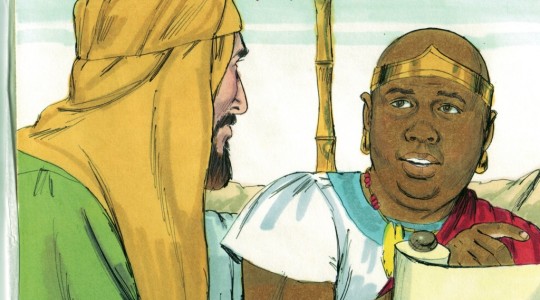
“Is There Anything To Stop Me?” based on Acts…

  • September 3, 2017February 15, 2020
  • by Sara Baron

If you pay attention to very early church history (and I mean, who doesn’t???) you may know that Paul was the great advocate of sharing the good news of Jesus with “the Gentiles”, aka people who weren’t Jewish. Much of the book of Acts reflects the tension between the apostles, whose focus remained in Jerusalem and with the Jews, and Paul who took the message “to the whole world.”

This has been the story I’ve been taught, the one I’ve then taught in return. Acts 8 argues with it, and I never noticed. In Acts 8, Phillip crosses most of the boundaries that anyone thought existed. He spends the chapter with a Samaritan magician and then an Ethiopian eunuch. This feels consistent with Jesus who kept on talking to Samaritans, Roman Senators, and anyone who wanted to talk to him, but the early church was already struggling with the questions of who was “in” and who was “out.” The people Phillip was with were supposed to be “out,” excluded from the community.

When it all started, Phillip was supposed to be in the 2nd team of leadership, he was one of the ones chosen to deal with the trivial matters that the apostles couldn’t be bothered with. Yet somehow, the message of grace keeps coming from him to unexpected people. And all of this happens BEFORE the conversion of Paul. Perhaps God, through the Spirit, was already shaking things up, well before Paul’s participation.

Today’s text centers on the interaction between Phillip and the unnamed Ethiopian eunuch. (Noticeably unnamed much like many of the women in the Bible and unlike most of them men.) We have rather a lot of details about the Ethiopian, for not having a name. However, we don’t have clarity on this person’s gender identity. The Bible uses male pronouns, but let’s be honest – the Bible uses male pronouns as a default position. The most defining characteristic of this person was their status as a eunuch. Peterson Toscano, who self describes as a Quaker and obsessive gardener, lives in Sunbury, PA with his husband, the writer, Glen Retief as well as a gay Biblical Scholar, wrote an excellent blog on this passage. In it, he seriously considers the experience of eunuchs in the Bible:

Then there are the eunuchs of the Bible–so many eunuchs. We must remember that in ancient times, eunuchs stood out. They typically had their testicles removed before puberty, sometimes with their consent, but usually not. As a result, they did not develop secondary sex characteristics that come during puberty. They retained high voices. They did not develop the body hair or the facial hair like men of their time. They looked and sounded different from the men and women around them.

Eunuchs could not produce offspring. While some did partner, most did not. They were often single and childless unless they adopted. In a world where everyone seemed to be part of a family unit of some sort, they stood out as loners.1

Some scholars have said, “In order to earn and to maintain identification as a man, a free adult male citizen or native had to be perceived as one who dominated unmen—women, foreigners, slaves, and children.”2Traditional gender identity didn’t entirely fit for this one.

I’m going to use “they/them/their” pronouns, and ask forgiveness to the one whose story is told if their preference would have been otherwise.

We do know a lot about this unnamed person, whose gender isn’t binary though! They were from Ethiopia, which would have seems really far away for those from Galilee and Judea, almost like the ends of the earth. Most likely, they also looked different than the Galileans and Judeans did, with darker skin and a different sort of dress. They were the queen’s treasurer, which means they were probably very wealthy. The first set of Jesus’s followers were predominantly poor, and someone with that much wealth was quite different in that way too. They were almost certainly not Jewish, although they are a worshipper of YHWH. They were literate, which most people and most disciples were not. And they were employed by a foreign government, which would have aroused some suspicion about priorities within the early church. Those are some big differences.

We’re told that they have just come from worship in Jerusalem. That would not have been an emotionally easy experience, perhaps particularly for this person. Being outside of the gender binary at that time, and in that place, meant a loss of power. For worshipers at the ancient Temple, only Jewish men with unharmed genitalia were permitted to enter the internal (and thereby more sacred) “Israelite Courtyard.” Women, Gentiles, and those with nontypical male genitalia were confined to the outer court. This individual was used to having significant power and influence, and might have particularly not enjoyed being treated as “second class.”

Yet, for the sake of the queen, the eunuch’s status was imperative. In their society, it gave them access to their role. At the same time, as Peterson Toscano says:

Likely as a child this one was taken from home and parents. This one was physically held down, likely without giving consent, and was operated on. Through a painful procedure with the real risk of infection and more pain, testicles were removed.

This one grew up but never went through puberty. As boys matured and changed, this one did not change in the same ways. This one was assigned a position in a royal court. This one could not start a family. This one was both respected and mocked, sometimes at the same time because of an elevated status in the palace and what was seen as a social deformity. This one may well have felt isolated, rejected, and even experienced physical challenges and disabilities because of the lack of testosterone in the system.

So, this person, with so very many identities that differed from the majority of Jesus followers, was reading a passage from Isaiah that might have had some resonance with his own life. They have questions about the passage’s meaning, which is particularly valid to have when one is reading scripture! In the midst of this, Phillip appears and asks if they know the meaning. My friend Michael Airgood wrote a paper on this passage. In it, Michael chooses to use the pronounces xe/xyr/xem for the eunuch. He says, “When Philip asks xym if xe understands what xe is reading, xyr response indicates strongly that xe has felt the exclusionary forces of religious bigotry. You can almost hear the rejection in xyr voice, ‘How can I understand unless someone guides me.’”3 Being excluded had included being excluded from religious education. Once Phillip shares what he knows, the Ethiopian-eunuch-officer-worshiper is convinced that the Jesus movement is something they wanted to be a part of. So, they ask, “Look, here is water! What is to prevent me from being baptized?”

We know the answers to this! Much of this person’s identity could have been used as a barrier to inclusion in the Body of Christ. They were already excluded from full participation in the Jewish Temple as well as from from family life. This person knew exclusion, and the early Christian community was more more self-similar than it is now. This person was different in a lot of ways, and it might have been thought, too many ways. Phillip could have told them that they needed to do more studying and that they should come back in a few years, or that they needed to work with mentor, or that only people with standard order genitalia were welcome, or that they had to pass some sort of purity test, or simply lied and said that the water they were nearby “wasn’t good enough.” I’ve heard of modern-day church folk coming up with many of those excuses, and more.

This is an intensely vulnerable question. The one who asked it knew that there were plenty of things that could have been seen as reasons to prevent them from being baptized. The one who asked it was JUST excluded. The one who asked it had been excluded in innumerable ways throughout their life. Yet, the one who asked it, asked directly, despite expecting a long list of reasons for exclusion, again.

That is, I don’t think the one who asked, “What is to prevent me from being baptized?” expected to be welcomed into the Body of Christ, much less without an argument. I also think that the apostles in Jerusalem had a conniption over this when they heard, but that may just be related to my experience of the institutional church 😉 Many commentators have wondered with me if Phillip and the Ethiopian-eunuch-officer-worshiper continued to read the scroll of Isaiah as they discussed things together. I hope they did. If they kept reading, three more chapters, they would have gotten to this passage:

“ Do not let the foreigner joined to the Lord say,
  ‘The Lord will surely separate me from his people’;
and do not let the eunuch say,
  ‘I am just a dry tree.’
 For thus says the Lord:
To the eunuchs who keep my sabbaths,
  who choose the things that please me
  and hold fast my covenant,
 I will give, in my house and within my walls,
  a monument and a name
  better than sons and daughters;
I will give them an everlasting name
  that shall not be cut off.” (Isaiah 56:3-5, NRSV)

There was also, Judaism that was already ancient in the eunuch’s time, an awareness that God doesn’t hold to human boundaries. In many ways this story feels like the this Isaiah passage brought to life. Did you notice that the eunuchs don’t stop being eunuchs, they’re accepted as they are and within the faith tradition given all the things that would otherwise be denied to them? The commentator in the New Interpreter’s Bible on this Acts passage intends to speak of Phillip, but also seems to speak of Isaiah when he says, “The essential task of the prophet, then, is to clarify membership requirements of those belonging to God, sometimes in ways that redraw Israel’s boundaries to include the exclude ones.”4

One of the oldest Christian communities in the world is the Ethiopian church. Their tradition says that faith was brought to them by this eunuch, and has been maintained ever since. It gives me chills to think that it is only because of the bravery of that one to ask that vulnerable question, that a church could exist.

So much of the world, and counter to the message of God and Jesus, so much of the church teaches people that they are not enough! According to those broken theories, there are standards to be met, barriers to overcome, behaviors that must be amended, and even people who can’t ever measure up. The message of God and Jesus is that we are already enough. This person, this eunuch, even without a name, trusted God enough to ask if they were welcome. Phillip, moved by the Spirit of Grace, knew enough to welcome in those who wanted to be part of the Body of Christ.

This is a story that has happened many times: human beings worry that they’re not enough and wonder if the people claiming to speak for God (the church) will welcome them. This is also a story that hasn’t happened enough: that the people who claim to speak for God (the church) welcome in God’s beloveds (any and all people). This is also a story that hasn’t happened often enough: that the people of God remember that God is enough, that we are enough, and that no one is fundamentally lacking. May we be people of this story, people who trust in God’s enough, in people’s enough, and in God’s unending and unbreakable grace. Amen

1Peterson Toscano, “Intersecting Identities – Queer Identity and the Ethiopian Eunuch” found athttps://petersontoscano.com/ethiopianeunuch/ on August 29, 2017.

2 Ken Stone and Teresa J. Hornsby, Bible Trouble: Queer Reading at the Boundaries of Biblical Scholarship. In “Atlanta; Society of Biblical Literature” (ebook, 2011), 177.

3 Michael Airgood, “WHAT IS TO PREVENT ME FROM BEING BAPTIZED?” THE GOSPEL’S QUEER JOURNEY TO THE ENDS OF THE EARTH. Turned in for seminary credit 8/18/2017.

4Robert W. Wall “Acts of the Apostles” in The New Interpreter’s Bible, Vol. X, edited by Leander Krik et al, (Abingdon Press: Nashville, 2002), 142

–

Rev. Sara E. Baron

First United Methodist Church of Schenectady

603 State St. Schenectady, NY 12305

Pronouns: she/her/hers

http://fumcschenectady.org/

https://www.facebook.com/FUMCSchenectady

  • First United Methodist Church
  • 603 State Street
  • Schenectady, NY 12305
  • phone: 518-374-4403
  • alt: 518-374-4404
  • email: fumcschenectady@yahoo.com
  • facebook: https://www.facebook.com/FUMCSchenectady
  • bluesky: @fumcschenectady.bluesky.social
Theme by Colorlib Powered by WordPress