Skip to content
First United Methodist Church Schenectady
  • Lenten Photo Show
  • About Us
    • Meet the Pastor
    • Committees
    • Contact Us
    • Calendar
    • Our Building
    • The Pipe Organ
    • FAQs
    • Wedding Guidelines
  • Worship
    • Sermons
    • Online Worship
  • Ministries
    • Music Ministries
    • Children’s Ministries
    • Volunteer In Mission
    • Carl Lecture Series
  • Give Back
    • Electronic Giving
  • Events
    • Family Faith Formation
Sermons

Untitled

  • September 8, 2019February 15, 2020
  • by Sara Baron

We’re
currently looking at 3 different worldviews: Moralistic Therapeutic
Deism, the Christian-Right, and (for lack of language that is better)
“Jesus-Following.”   “Moralistic
Therapeutic Deism” was identified by sociologist through a large
research project with US teens, and is the actual belief system of
most teens, despite any religious tradition they claim.  Furthermore,
as teens are most heavily influenced by their parents (No!  Really!)
when it comes to faith, we have reason to believe that a rather large
segment of the population actually believes “Moralistic Therapeutic
Deism.”  So, we are looking at it, and finding where it does and
doesn’t match our actual faith tradition.

“Moralistic
Therapeutic Deism” has 5 salient points:

  1. “A
    god exists who created and ordered the world and watches over human
    life on earth.”
  2. “God
    wants people to be good, nice, and fair to each other, as taught in
    the Bible and by most world religions.”
  3. “The
    central goal of life is to be happy and to feel good about oneself.”
  4. “God
    does not need to be particularly involved in one’s life except when
    God is needed to resolve a problem.”
  5. “Good people go to
    heaven when they die.”

This
week we are going to take a closer look at the second of the them:

“God
wants people to be good, nice, and fair to
each other, as taught in the Bible and by most world religions.”

Unlike
last week, where I directly contrasted Moralistic Therapeutic Deism
with the perspective of the Christian-Right and then both with
Jesus-following, in this case I think Moralistic Therapeutic Deism
and the Christian-Right largely overlap.  I don’t see a noticeable
difference, other than perhaps in the degree of openness to other
faith traditions.

The
difference from both is in how Jesus-followers see our tradition,
including in our Micah passage today.  That passage claims that what
God wants is for us “to
do justice, and to love kindness, and to walk humbly with your God.”

For
some people, what Micah says and “be good and nice” may look
similar at the outset.  That’s what makes it so dangerous!

Now,
obviously, I take no issue with the last bit, where the Bible is
conflated with other faiths.  When it comes to the basic moral
principles of the world’s religions, there is enough agreement to
speak in such terms.  The issue, rather, is what a moral life looks
like!

The
first statement is that God wants people to be “good.”  That’s
not particularly controversial at this point, but it is circular
logic!  What does it mean to be good?  Isn’t this a statement about
what being good means?  Then simply saying, “being good is being
good” doesn’t help us figure things out much does it?  That means
we have to decide from the next two words what this goodness looks
like.  

This
is where we get “nice.”   “God wants people to be nice.”  In
fact, if you take out some words, this statement could read, “God
wants people to be nice, as taught in the Bible.”

Here
is the problem.  It doesn’t.  The Bible doesn’t tell people to be
nice.  

Actually,
the Bible does not include the word NICE.  And I mean AT ALL.  Its
not there.  It doesn’t show up.  And I don’t think its an accident or
a mistranslation.  I think its not there ON PURPOSE.  What is nice
anyway?  We use the word so much that we easily lose its meaning.
Apple dictionary defines it this way:  “Nice”
pleasant;
agreeable; satisfactory.”  I think the most important part of that
definition is “agreeable.”  The word “nice” has very serious
connotations of “don’t rock the boat!”  A nice person doesn’t
argue, doesn’t disagree, doesn’t tell you when you’re wrong, doesn’t
tell you when you are harming another person.  A nice person doesn’t
name injustice, doesn’t upset the status quo, doesn’t willingly
engage in conflict.  A nice person is always pleasant, even when
things are profoundly wrong.  To be NICE is to take the path of least
resistance.  

Our
Micah passage says that God wants us to do justice, to love kindness,
and to walk humbly with God.   For clarity’s sake, I offer 3
different translations of this verse for you:  

NRSV:
He has told you, O mortal, what is good;
 and what does the
Lord require of you
 but to do justice, and to love kindness,

and to walk humbly with your God?

NIV:
He has showed you, O man, what is good. And what does the LORD
require of you? To act justly and to love mercy and to walk humbly
with your God.

Message:
But he’s already made it plain how to live, what to do, what God
is looking for in men and women. It’s quite simple: Do what is fair
and just to your neighbor, be compassionate and loyal in your love,
And don’t take yourself too seriously – take God seriously.

Now,
there is something in there about loving kindness or showing mercy.
They aren’t the same thing as “be nice.”  Now, the definition of
kindness, “the
quality of being friendly, generous, and considerate”,
helps, but I think its in the definition of mercy that we really see
the difference.  Mercy is compassion
or forgiveness shown toward someone whom it is within one’s power to
punish or harm.  WHOA.  That’s so not the same thing as agreeable.
Its so much STRONGER!  

Jesus
says that the greatest commandments are to Love the Lord Your God
with all you heart, all your soul, and all your mind – and to love
your neighbor as yourself.  In fact he suggests they aren’t so
different.  This Micah passage is another way of saying it.  To
love mercy is to love your neighbor as yourself, ESPECIALLY when you
have the power and reason to do otherwise.  

Now
its time to go back to the rest of Micah’s claim.  To do justly, to
love mercy, and to walk humbly with God.   I will admit that its best
the Moralistic Therapetic Deism’s claim that God wants us to be
“fair” is entirely true, and I suspect that its a similar
articulation as the theme of Justice throughout the Bible.  It seems
clear, Biblically speaking, that God is OBSESSED with justice.  There
are all sorts of commandments that have to do with making sure that
the justice system is fair – and that it doesn’t benefit the rich
more than the poor, men more than women, natural citizens more than
outsiders.  There
is a deep awareness that left to its own devices, a society will bend
justice toward power so that the powerful will constantly become more
powerful and the powerless more powerless.  God’s commandments are
meant to prevent this!

Justice,
and judgement, and the judicial system even are all there to make
sure that things are FAIR for people no matter who they are.  You
might remember the story of the prophet Nathan telling a sob story to
King David … the story is that a very very wealthy man with many
herds noticed that his very poor neighbor had a very nice lamb, and
so, he stole it!  David’s was so angry at this rich man, and Nathan
pointed out to him that HE was the wealthy man in the story.  The
prophets were the ones making sure that people didn’t forget about
justice!

Justice
often demands the opposite of niceness.  While niceness is the
path of least resistance, justice often requires being part of active
resistence.  The demands of justice in the world may require
upsetting the social order, upsetting other people, upsetting the
institutions of power and privilege.  Those fighting for women’s
rights were told they weren’t being NICE.  Those fighting to end
slavery weren’t NICE.  Those fighting to end segregation weren’t
NICE.  But…. they were just, and they were merciful.  

In
the best case scenario, if “fairness” is given all the power and
energy that it deserves, then YES, God does want us to be fair, but
note that it isn’t some fairness that has mostly to do with trivial
matters – it is a fairness that has to do with everyone having a
fair opportunity to LIVE and THRIVE.  That’s where the Leviticus
passage comes in.  It does, of course, include “love your neighbor
as yourself” but it seems to also be pretty explicit about what
that looks like.  In this passage, loving your neighbor as yourself
means leaving a means of livelihood for the poor rather than
enriching yourself.  In this passage, loving your neighbor as
yourself means telling the truth in order to produce fairness and
justice.  This passage worries about the disempowered, and tells
those who have power to act responsibly with their power: to give
wages when they’re earned, to refrain from doing harm simply because
it can be done.  Loving your neighbor as yourself means creating a
JUST justice system, impartial to power and wealth, and to refrain
from profitting from violence.  This is some PRATICAL and real stuff.

It
isn’t “nice” stuff.  It is “just” stuff.  

That
tiny Micah passage includes, as well, that God wants us to “walk
humbly with our God.”  This is not paralleled at all in Moralistic
Therapeutic Deism, and from my understanding of it, that is not
accidental either.  People following that way of thought do not
believe that in spiritual practice or discipline. They see prayer as
a way of manipulating God into giving them what they want.  For the
most part, they do not read the Bible, or reach out to others as a
way of sharing God’s love.  They think of God as existing for THEM,
rather than thinking of themselves as existing to do God’s work in
the world.  Its an enormous switch!  

This
may be one significant place where the Christian-Right and
Jesus-followers align.  Our Tradition teaches us that we are the Body
of Christ – we are gifted and blessed so that we can be a blessing
to others.  We exist so that God’s love can spread.  We are the
continuation of the ministry of Jesus himself.  We are part of God’s
transformation of the world, and our work in that includes
significant time studying and praying and worshipping and discussing
so that we might BEST use our lives for the goodness of all.  

Micah
tells us to be humble before God.  That is, to remember that God is
God and we are not!  That the purpose of life is not that God serve
us, but that we serve God.  And that in serving God we are both
blessed and a blessing!  That our lives AND the lives of those we
meet are improved!  

You
see, our Tradition is not all about us, it is about everyone.  It
is DEFINTELY not about “ME”!  Micah reminds us with simple words
about humility – which are put next to justice and mercy in their
importance!  Those THREE things are what it means to be a “good”
person, if you listen to the Bible.  Justice, mercy, humility.
They’re balanced, and they push us beyond ourselves to being truly
good neighbors to those we meet.

So,
my friends, despite the the apparent similarities, again we find that
Moralistic Therapeutic Deism is a mistranslation of our faith.  Our
tradition does NOT teach us to be nice.  In many ways it teaches the
opposite.  It teaches us to do justly, to love mercy, and to walk
humbly with our God.  May we do what we are taught.  Amen

–

Rev. Sara E. Baron

First United Methodist Church of Schenectady

603 State St. Schenectady, NY 12305

Pronouns: she/her/hers 

http://fumcschenectady.org/

https://www.facebook.com/FUMCSchenectady

September 8, 2019

Sermons

“Find Joy” based on  Isaiah 66:10-14 and Psalm 66:-19

  • July 21, 2019February 15, 2020
  • by Sara Baron

Weeping
may linger for the night,
but
joy comes with the morning.

–
Psalm 30:5b

I have a fondness for
… um… expressive language ;), and that fondness was significantly
stronger when I was in college.  However, in April during every year
of college I cleaned up my language to  pristine levels.  I did it so
that when I got to camp, I would not accidentally speak a word that
would harm, or offend, or get repeated by any of our campers with
special needs.  We were also careful then, as we are now, not to
offer too many hugs or to permit any loosening of manners – not to
allow anything at camp that would cause potential harm in the real
world.  

I did this because I
loved our campers, and I wanted them to be safe, secure, and at ease
both at camp and in the world.

During my second year
of seminary I started an internship with an urban church, one that
was doing important ministry with people who were homeless.  People
who are homeless are more likely to be assaulted – both physically
and sexually.  People who are homeless are often hungry, unable to
get clean, struggling with physical health, and most people who are
homeless for a long time end up with an addiction even if they didn’t
start out with one.  Being homeless is one of the hardest and most
vulnerable positions in our society, if not THE hardest.

The history I’d
learned in college about the closing of state hospitals for people
with disabilities, and the resulting (continued) failure of the
system to care for the most vulnerable people in our society suddenly
became very clear in reality.  People who were in the same population
as Sky Lake’s beloved special needs campers were homeless on the
streets of Los Angeles.  The disconnect between the intentional care
I’d been offering to God’s beloved people with special needs at camp
and the reality that people with special needs were being assaulted
every day on the streets of LA, and that society was doing NOTHING to
change it broke open my heart.

I have not recovered
yet.

Instead, over the
past 15 years, I’ve discovered more and more ways that the world is
fundamentally broken and been disillusioned repeatedly.  Some wise
ones have pointed out that is it because of the color of my skin and
the stability of my childhood that I was able to be so naive to begin
with, and they’re right.  Yet, for me seeing the world as it is, and
seeing clearly what its priorities are and are not, is painful.
Similarly, seeing the church as it is, and seeing clearly what its
priorities are and are not has been painful.

I believe that part
of the purpose of church is to offer a God’s vision for the world to
the people, and as such to offer hope that we can build the kindom
together.  Further, I believe that the pastor’s role is to be a
speaker of the vision, and of hope.  People NEED hope, and our faith
tradition offers it.  It has been hard at times, though, to have
integrity and be truthful about the brokenness, and simultaneously
offer real hope.  The challenge, I think, has been in my own
discomfort with reality.  Once reality is accepted, then it can be
worked on, but I’ve been struggling for years to accept that things
really are as broken as abundant evidence points to.

The realities of the
world, however, are exactly WHY we need to speak hope – real hope –
and be inspired by God’s visions of justice.  We can’t just let
ourselves wallow, we have to face reality, but we can’t offer weak or
trivial hope.  The world, and its people, NEED to know that another
way of being is possible, and we can create it together.

Family Systems theory
teaches us that when we are anxious, we get more close minded.  When
systems (groups of people) are anxious, they get more close-minded
too.  They take less risks.  They make worse decisions.  They create
anxiety in their people, and then people with raised anxiety tend to
revert to old ways of functioning and coping mechanisms that often do
more harm than good: gossip, triangulation, demonizing others,
consuming, addictive behaviors, lashing out, etc.  Anxiety can easily
become it’s own self-perpetuating cycle.

Dear ones, the
anxiety in our systems right now are at unhealthy levels.  I remember
reading articles during the 2016 election cycle about the impact the
election was having on our shared mental health (it was bad).  It has
gotten worse.  The injustices around us take a toll every day, and I
hear from all of us how much we want to create change.  It doesn’t
help right now to be part of the United Methodist Church, because
being part of a CHURCH that is an oppressor is really darn
depressing, and adds our anxiety and dismay.  Further, in this
particular congregation, we’ve been working on something that is also
really hard: we’ve been in conversations about balancing our budget,
which we have not done since 2004.  (And even that was a bit of an
anomaly.)  We have been living beyond our means for a long time.
Balancing the budget requires making difficult decisions about who we
are and what we do and what is imperative to our shared life
together, and it requires that we have really difficult conversations
where we don’t all agree – and that is anxiety producing as well.

It is tempting, in
these days, to give up:  to stick our heads in the sand, or to lash
out in anger, or to become comatose on the couch.  It is REALLY easy
to let the anxiety win.

But.

Dear ones, beloveds
of God, we aren’t going to do that.  We
aren’t going to give in and we aren’t going to lash out.  We aren’t
going to let anxiety take over.  We are going to keep on
keeping on, working towards the kindom, loving each other, spreading
love and goodness in the world, and trusting that God works with us,
through us, and when necessary despite of us.  We are going to find
the ways to let go of the anxiety, and find some trust and some hope,
and be sources of transformation.

We are going to break
out of the cycles, because anxiety is terrible for us, it is terrible
for the world, and it enables all the things we don’t want to see!
Now, here is the weird twist.  Given all the brokenness of the world,
it can feel really disrespectful, or trite, or privileged, or even
mean to …. have fun, seek joy, laugh, and play.  (Or even just to
take breaks and deal with reality for a bit.)  That’s real!  I know
how hard it can be to enjoy life when we know the awful things that
are happening, but I want to share with you wisdom that I heard
second hand.  This wisdom came from a person who was impoverished and
disenfranchised in a country with dictatorial rule.  That person was
asked, “Why are you so joyful when things are so bad!?” And they
responded, “Why would we let them take our joy too?  It is all we
have left.”  

Joy, it turns
out, is resistance.  Joy is OURS to claim, and we shouldn’t give
it up, because giving it up won’t help anyone – in fact it will
hurt everyone.  The world needs more joy.

Joy, unlike anxiety,
creates space for creativity, for connection, for hope.  Out of the
box thinking can happen when joy replaces anxiety, and the problems
of the world today REALLY need new solutions.  Joy makes space for
people to regain their humanity.  And laughter really is the best
medicine (trust me, I laughter until I cried at camp – twice –
and I haven’t felt so whole since before General Conference).
Whatever you do, dear ones, don’t cut out joy from your life.

And, if you need help
getting to joy – which is totally fair – most wisdom teachers say
gratitude is the way to get there.  So, practice advice here: keep a
gratitude journal, and take 5 minutes at the end of each day to
notice what you are grateful for in that day.  Putting our attention
on what is good is a great way to create more good, and to make space
in our lives for joy.

Now for the REALLY
good news.  Our God is a God who knows all about oppression, and has
worked to overcome it throughout all of history.  In all these years
where I have become further and further disillusioned with society
and the world, I have found great comfort in the Bible.  The Bible is
VERY WELL AWARE of the brokenness of the world, of the reality of
domination systems, AND of the power of God to break them open.  

The Bible tells this
story innumerable times, but there are three really big versions of
thie story:  (1) The Bible says that God knows about the oppression
of slavery, and moves to free the people who are enslaved.  (2) The
Bible says God knows about the oppression of exile, and moves the
people to restoration.  (3) The Bible says God knows about the
oppression of being part of empire because of the force of the
military, and moves the people to empowerment, to resistance, and
ultimately to freedom.  That is, the stories of (1) Exodus, of (2)
Exile and Return, and (3) of the ministry of Jesus.

The passage from
Isaiah today is a response to Exile and Return, and it speaks in the
language of God as mother of the people, nursing them and caring for
them.  After a WHOLE LOT of condemnation of the injustices of ancient
Israel, in the end of Isaiah we hear, “ Rejoice with Jerusalem, and
be glad for her, all you who love her; rejoice with her in joy, all
you who mourn over her– that you may nurse and be satisfied from her
consoling breast; that you may drink deeply with delight from her
glorious bosom.”  Rejoice with Jerusalem, despite it’s history of
oppression, despite its history of exile and destruction, none of
those are the final words.  The final words are that God cares for
the people and finds a way to nurture them and it brings great joy.
The final words in the book of Isaiah are God’s comfort, and care,
and the people’s JOY.  

I’ve told you before,
but this bears repeating: Our faith says that Love wins in the end,
and if Love hasn’t won yet, then it isn’t the end yet.  (In this case
Love and God are interchangeable.)  The brokenness of day is not
the final answer, God is still at work.  We are still partnering
with God to make things better.  So, in the meantime, practice
gratitude, find joy, allow for rest, and in doing so let go of
anxiety.  God is working, and looking for for open-hearted, loving,
partners to work alongside.  May we find MANY ways to be those
people, and encourage each other towards joy.  Amen

–

Rev. Sara E. BaronFirst United Methodist Church of Schenectady603 State St. Schenectady, NY 12305Pronouns: she/her/hershttp://fumcschenectady.org/
https://www.facebook.com/FUMCSchenectady

Sermons

“Finding Compassion” based on Luke 10:35-37

  • July 15, 2019February 15, 2020
  • by Sara Baron

The
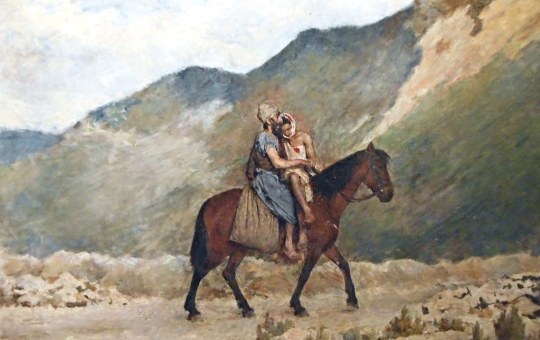
Parable of the Good Samaritan is one of the best known stories from
the Bible.  Some of you are likely sick of it, some of you are bored
by it, and some of you don’t know a thing about it.  Any of those
responses are acceptable around here, but I am going to review the
basic facts for those who haven’t heard them, I’ll let the rest of
you know when you may want to tune back in…

The
Samaritans were hated by the Jews.  They had a shared history, to a
point.  Both were part of the formation of Ancient Israel, both were
led by Kings Saul, David, and Solomon, but after Solomon the Northern
and Southern Kingdoms had a civil war and separated.  The North kept
the name Israel and had two parts: Samaria and Galilee, the South
became the nation Judah – from which we get the language “Jew”.
As you’d expect, the two nations that had fought a civil war to
separate from each other had some resentments towards each other.
Then, the Northern Kingdom fell in battle to Assyria in 922, its
leaders were taken into exile, and those who remained intermarried
with foreigners.  Thus, the 10 northern tribes of Israel were “lost.”
Except, they weren’t really.  They didn’t become a self-governing
nation again, but the love of YHWH and the Jewish tradition remained,
it was just different.

Of
course, the southern nation also fell, and also went into exile, but
it was nearly 350 years later, and they WERE able to rebuild their
nation.  Because of these differences (and similarities) the Jews
HATED the Samaritans, enough that those who were going from Judah to
their Jewish colonies in Galilee would tend to walk AROUND Samaria
even though it made the trip much longer.

Thus,
having the hero of this story be the Samaritan is a really big deal,
it shakes up all kinds of assumptions about who is good in the world.
In fact, the Jewish law scholar can’t even admit that it is the
Samaritan who does right, he instead answers “the one who showed
mercy.”  Indeed, the priest and the Levite (also a religious
leader) should have been the models of good behavior, and aren’t.
This story not only talks about what it means to be a neighbor, and
how showing mercy is what defines a good neighbor, it also upsets
assumptions about WHO can be good, and who IS good, and how we see
possibility in those we might identify as our enemies.

YOU
CAN COME BACK NOW


Now
that we’ve reviewed the characters in the parable, I want to zero in
on one line that jumped out at me this week.  It is verse 33, “But
a Samaritan while traveling came near him; and when he saw him, he
was moved with pity.”  (NRSV)  Or, in the Message, “A Samaritan
traveling the road came on him. When he saw the man’s condition,
his heart went out to him.”  Or in the New American Translation,
“But a Samaritan traveler who came upon him was moved with
compassion at the sight.”

The
thing is, that every time I’ve read this story, I’ve read into it
something along the lines of, “The priest passed by on the other
side, even though he was supposed to be a person of God, the Levite
passed by on the other side, even though he was supposed to be a
person of God, but the Samaritan did what a person of God should have
done.”  I’ve missed the ATTRIBUTION of motivation.

For all these years, I thought
the Samaritan did what was right because it was right, and because
God wants us to take care of each other, so we’re supposed to.
However, the story doesn’t actually say that!!  The story says that
the Samaritan was “moved” and then acted on his response.  The
hero didn’t do the right thing simply because it was the right thing,
the hero was moved to do it.  His heart went out.  He felt
compassion.  He saw the man who had been robbed and something in his
humanity connected to something in the man’s humanity and he
responded to that.

Hearing it this way, it is
almost as if we aren’t responsible for fixing every single brokenness
in the world, and we don’t have to stop what we’re doing for every
hurting person we encounter, and … well, we don’t always have to be
THE Good Samaritan in every situation.  Now when I say that, you
hopefully think I’m crazy, because OF COURSE we don’t, because we
can’t.  Humans are finite and we simply can’t do everything for
everyone.  Further, we can do a lot more good if we focus and do what
we do well than if we try to respond to every little thing that we
see.

And yet, like most people I
know, I’m so overwhelmed by the brokenness of the world, and I feel
responsible to do my part, and often unclear about where the
boundaries lie on where my part is.  Which is to say, I often feel
guilty that I’m not doing more.

Two Sundays ago I was at camp,
and I invited the staff to do a little introductory ice breaker which
included the question “what kind of toothpaste do you use and why?”
I have previously found this to be an amusing question, which has
ended up giving shocking amounts of insight into people’s choices.
This time, however, the first two people to introduce themselves had
found ways to minimize their plastic use and carbon footprint in
their toothpaste choices (cool!), and were happy to share that their
WHY was out of love for creation.  That was awesome.  However, it
meant that for some other people who pick their toothpaste for other
reasons, and for those who hadn’t (yet) decided to make
eco-consciousness in toothpaste purchasing their priority, there was
a lot of guilt in answering the question.  

That
sort of guilt isn’t productive (if any guilt is productive, which I’m
not sure it is).  But it did serve as a good reminder to me of how
many things there are to pay attention to: how are we treating the
people we see in day to day life?  How are responding to those who
make requests of us?  How are we deciding what to buy, and who to buy
it from, and how much to pay for it, and what factors should impact
our purchases?  How do we decide what to give, and where to give, and
how much to give?  How do we decide when to work, when to play, when
to connect, when to rest?  How do we decide where to advocate, and
for what, and how?  How do we know if it has been effective?  How
much attention do we give to our physical bodies and their needs,
what about our emotional needs, what about our spiritual needs, what
about mental needs, and what about worrying about if we are being too
selfish thinking about all this?  How do we invest, if we can?  How
do we use our time, our energy, our resources, our responses, our
responsibilities, … our prayers, our presence, our gifts, our
service, and our witness 😉 … to do the most good, and the least
harm without burning out?

The only clue I have is the one
in this story.  The Samaritan didn’t act simply because it was the
right thing to do, because there are a lot of right things to do and
we just can’t do them all.  He acted on the need in front of him that
MOVED him.  He let his compassion guide him.

As far as I can tell, that’s
REALLY important.  For the Camp Staff who care about eco-choices in
toothpastes, thanks be to God!!  For the ones who don’t, whose hearts
go in other directions, thanks be to God!!  If we try to push
ourselves to care about everything, we will burn out and be able to
care about nothing.  If we try to become someone we aren’t, someone
who cares about things we don’t really care about, we’ll exhaust
ourselves and ignore our actual gifts.

Each of us in this room have a
wide range of things we’re good at, and enjoy, that support and
benefit others.  Each of us have ways that compassion naturally moves
in us, and if we follow the compassion, if we allow the movement of
our hearts to guide us, we will be doing GOOD work that benefits
ourselves AND others, and the kindom, and we might even be able to do
it in sustainable ways.

But
wait, you may be asking.  What if NOTHING moves me?  What if I have
no compassion? What if my heart is broken and it simply doesn’t go
out to anyone?  Am I damned to be the priest and Levite in this
story, the one who showed no mercy and are the examples of bad
neighborliness?

No, dear ones, you aren’t.  If
NOTHING is moving you at all, if your compassion doesn’t reach out
beyond yourself then there are two possible realities.  One is that
you haven’t found the place where your gifts lie yet, and it would be
useful to expand your exposure to the world until you find where it
does move.  More likely though, knowing all of you, if your heart
isn’t moving and compassion isn’t flowing it is because you’ve given
too much of yourself away, and you don’t have anything left to give.

If that’s true, and I’d lean
towards thinking that is true in this beautiful collection of Jesus
followers who try to be Good Samaritans in the world, then your job
is to sit with YOURSELF and offer your heart, and your compassion to
YOURSELF until you are filled back up.  You might even need to seek
out others who can offer you their hearts, and their compassion,
their listening ears or supportive shoulders.  

The world can be a very
difficult place, and if you are a person with empathy, it can be
incredibly draining.  If your heart isn’t moving, then it needs some
tender loving care, from God, from yourself, and from God’s other
beloveds.  If compassion doesn’t move you, then give yourself
compassion.

I know this is a
funny way to preach on the Good Samaritan, the normal method is to
tell you to be a good person and take care of your neighbor, but
instead I’m telling you to follow your hearts, and to trust that God
works in you through your compassion and energy – and not to push
further than your heart leads you.  Let mercy guild you, as the
parable says.  But if your heart doesn’t move, then stay put.  You’ll
be needed later, and being ready and rested will be good too.

Dear ones, follow
your compassion, and if you can’t find it, give it to yourself.  God
wants full, whole, loving beings, and that means we need to make
space to be them – even if it means walking on the other side of
the road!!!  Amen

–

Rev. Sara E. Baron
First United Methodist Church of Schenectady
603 State St. Schenectady, NY 12305
Pronouns: she/her/hers
http://fumcschenectady.org/

https://www.facebook.com/FUMCSchenectady

July 14, 2019

Sermons

“Find Hope” based on 2 Kings 5:1-14

  • July 7, 2019February 15, 2020
  • by Sara Baron

Leprosy is understood by the Bible to be highly contagious, dangerous, and even deadly.

The ancient Israelites had laws about how to identify leprosy, how to know if it had been healed, and how to prevent it from spreading. Leviticus chapter 13 deals with nothing else. After an extensive 44 verses about how to examine sores to determine if they are leprosy, the chapter concludes, “Now the leper on whom the sore is, his clothes shall be torn and his head bare; and he shall cover his mustache, and cry, ‘Unclean! Unclean!’ He shall be unclean. All the days he has the sore he shall be unclean. He is unclean, and he shall dwell alone; his dwelling shall be outside the camp.” (Lev 13:45-46, NRSV)

Now that doesn’t sound awesome at ALL, but the New Interpreter’s Bible informs me that it is far worse than it sounds. They say, “All three of these actions – tearing the clothes, messing up the hair, and covering the lower part of the face – are signs of mourning for the dead. So serious is the state of uncleanness that it is similar to the state of death.”1 Leprosy in Ancient Israel, referred to a wide variety of skin diseases, some of which likely were highly contagious and potentially deadly, but most of which were not. Yet, it because it was poorly understood, and dangerous to the community, a person with leprosy was exiled from the community, which is itself a form of death.

The Bible is primarily a communal document, a reflection of the way that society was supposed to act. As such, it was worried about the spread of dangerous disease within society, and took the well-being of the whole more seriously than the well-being of the individual. That is, the stigma of being removed from society, and having to go around yelling “unclean” so no one would touch you, was clearly TERRIBLE for the individual, but kept the community safe. Leprosy was the ultimate stigma: something entirely beyond the individual’s control that isolated them from their entire community. (Hmm, what else is like that?)

The irony of course is that germ theory hadn’t come into being yet, and there wasn’t much differentiation of skin diseases. In fact, the Bible spends a lot of time differentiating between a SCAR and a SCAB, indicating that people thought that was important – that people not become lepers because of SCARS. Medical science still had some development to do, but people had noticed the contagion idea, and they did what they could to care for the whole.

If there is any good news in this, it is that there was a way to be UN-DECLARED a leper, it was not a permanent stigma. Or at least, it didn’t have to be if one’s skin cleared up. Heaven help those with eczema though. And, of course, we want to be aware in any conversation about leprosy that this not an ancient problem that is now simply a good metaphor. Today, about 180,000 people a year contract leprosy, although it is now treatable. Also, it isn’t really THAT contagious. You have to have repeated contact with “nose or mouth droplets” from someone who is infected. It isn’t, say, the measles. (Perhaps the measles were also considered part of leprosy in Biblical times??? That would actually explain A LOT.)

I’ve gone deep into explaining leprosy in Ancient Israel, because the story indicates that leprosy was understood differently in the neighboring country of Aram (modern Syria). While the Israelites expelled lepers from society, in Aram the general of the King’s army had leprosy, and was regularly talking to the king. I’m not sure what to make of this. Perhaps this is a bit of a Biblical dig at Aram, indicating they didn’t know how to care for society. Perhaps, though, it reflects some historical memory. What if Aram didn’t expel its lepers? What if something that created a stigma in Israel, didn’t in Aram? The two countries were neighbors, and were eternally in skirmishes with each other, so were likely pretty equally matched, which would indicate that perhaps excluding lepers didn’t really help.

What if there didn’t have to be a stigma, and people could still survive as a society without kicking others out?

What if, instead of observations about contagions, Ancient Israel was really allowing the natural human tendency of “ick, get away from me!” to have its way? What if people just didn’t want to see the ways that skin diseases can disfigure? What if fear simply got the best of them?

The human response “ick, get away from me” is real. It has applied to many individuals and groups over the eons, perhaps it is a defining factor of society about who is called “icky” and who has the power to decide who is “icky” and who isn’t. This is the power to define stigma.

People who are transgender are most likely to be violently assaulted and murdered in our society, and the greatest danger is for tranwomen of color. There isn’t any logical reason for this. It has basically come down to a response from individuals of “But gender is supposed to work the way I thought it did when I was a kid, and if it doesn’t, ick.” The power of stigma is the power of murder.

In the past few years there have been culture wars over bathrooms, and who gets to use them. (eyeroll) Somewhere along the line, I read a piece2 that clarified that bathroom wars were an old trick being revived. In our shared past of segregation, bathrooms were segregated. White women sought to maintain segregation by indicating they were afraid of getting diseases from sharing toilets with women of color. That is, they said they were afraid of contracting sexually transmitted infections from toilet seats. That was another way, among a myriad of ways, that white society indicated that bodies of people who weren’t white were “icky.” This is how marginalization works. 🙁 This is also how we get concentration camps on our Southern border filled with people with dark skin, because stigma dehumanizes and allows inhumane treatment of God’s beloved people.

As a child I was taught not to sit on the toilet seat in public bathrooms by my Grandmother, but was told I could by my mother, and it took a loooong time to figure out why they disagreed about that. Today the fear of bathrooms has been transformed to create fear of sexual assault in bathrooms, when the truth is that what we’ve done is make going to the bathroom a terrifying experience for transgender people – who are themselves especially vulnerable.

Yet, there are Arams. Many societies in the past, and many in the present, recognize more than 2 genders, and a lot of countries have better protections for trans people than we do. The United States has created racism in its own image, and we have managed to export it along the way, but societies and countries in the past and the present are able to show us other ways to understand race, identity, and ethnicity.

Years ago now, Sylvester stood in this pulpit and preached about what it was like when he was first diagnosed with HIV. He talked about visiting his sister and knowing that his cup would be thrown away and his sheets burned when he left. A United Methodist retreat for people living with HIV and AIDS that I once got to volunteer at offered massages for the retreat participants – because of reality that people with HIV and AIDS don’t get enough human touch. I’m not sure I know of places in the world where this has been solved, although basic education and the passing of years has decreased the stigma some, and intentionality to include and TOUCH has mattered.

I also think there is a stigma in our society around poverty. “Don’t get too close, or it will get you” seems to be an unspoken fear. I suspect the danger really is, “don’t get too close, or you’ll be motivated to change things, and that will change your life forever.” Yet, we live in a society that is comfortable with obscene wealth for a very few at the expense of the lives of nearly half. Yet, by associating a stigma with people living in poverty, it becomes “their problem” instead of the reality that poverty is the natural outcome of our societal laws and priorities.

Stigma is POWERFUL. It is dangerous. It is contagious, and it is deadly.

It is a far bigger problem than the people who get forced to hold it. One of the worse parts of stigmas is when they get internalized by the people who have been stigmatized.

In 2 Kings, God has the power to free Naaman from the stigma of leprosy. Elisha is God’s prophet in this story, and he is able to offer a means of healing in God’s name. Of course, Naaman doesn’t have all the stigma of leprosy in Ancient Israel, but he does have leprosy, and then he comes into Ancient Israel with it at which point he was a foreigner, who had bested them in war, who had the stigma of leprosy too. (They must have been terrified.)

The story says God healed him, and he was clean, and free of stigma, and very, very grateful. Just because was healed doesn’t meant that others were, and that also draws some big questions about who gets access to let go of stigma and why. However, I’m firmly in the camp that God is anti-stigma. Or, perhaps I should say, God doesn’t DO stigma. God is against stigma, and the ways that it gets used to dehumanize, violate, dismiss, and separate people. God is about shared humanity, peace, acknowledgment, and connection. Stigmas work against God.

We know and love a God who welcomes and delights in a lovely diversity of human beings and human bodies. God is the one who who says, “Blest are people who are transgender; they shall know my complexities. Blessed are people who are marginalized because of their race; they are able to build the kindom. Blessed are the people who live with HIV and AIDS; they are holding my hand already. Blessed are the poor, for theirs is the kindom. Blessed are the lepers, for they shall be healed.” Stigma just doesn’t hold up under the weight and power of God’s love.

And it isn’t supposed to hold up for us either. May God heal us, that the stigma society places on God’s beloveds might lose their power for us. May we, like Namaan and Elisha, trust in God’s power to eliminate the power of the things that keep us from a full and abundant life. May we build a society more like Aram – able to welcome people into our midst as full partners in our shared work, regardless of the stigmas others would want to put on anyone. May we follow our God who is against stigma and for connection. Amen

1Walter C. Kaiser Jr. “The Book of Leviticus: Introduction, Comment and Reflections” in The New Interpreter’s Bible Vol 1., ed. Leander E. Keck, convener (Nashville: Abingdon Press, 1994), 1097.

2Maybe this one? https://psmag.com/magazine/how-social-bias-is-segregating-americas-bathrooms

–

Rev. Sara E. Baron First United Methodist Church of Schenectady 603 State St. Schenectady, NY 12305 Pronouns: she/her/hers

http://fumcschenectady.org/

https://www.facebook.com/FUMCSchenectady

July 7, 2019

Sermons

“Sheer Silence” based on 1 Kings 19:1-15a

  • June 23, 2019February 15, 2020
  • by Sara Baron

Elijah
had it rough.  In his time, the people were uncertain about their
loyalties.  Their shared story of being led out of bondage in Egypt
and to freedom in their own land by a God who cared about them and
how they treated each other… wasn’t primary anymore.  Their current
king was worshiping another gods.  Elijah was a prophet for YHWH,
called to speak out for justice, and for YHWH-God’s vision of people
treating each other well and creating a society where everyone could
survive AND thrive.

The
other gods weren’t into creating fair and equitable societies.  They
were into power, and control, hierarchy, and wealth – and most of
all they were into themselves.  They were easier to worship because
there felt like a direct correlation between sacrifices to those gods
and personal success.  (Aka, the prosperity gospel isn’t new.)

Worshiping
the God of our tradition isn’t always easy, and Elijah was proof of
that.  He was a prophet when neither the power structure nor the
people tended to want to hear him.  He was asked to bring bad news,
time and time again, and it was NOT appreciated.  For most of his
life he is presented as a very lonely creature.  He is said to have a
servant, but he seems to be on his own for the most part.  In the
preceding story he claimed a great victory for God over the other
gods  –  in a way I find utterly horrific – and gained the
attention of some of the people in doing so. He also upset the king
and queen, and was running away, certain of his impending death for
what he’d done, on the basis that the queen said she was going to
have him killed.

He
ran, by himself, into the desert.  It seems to me that he decided it
was better to control his own death than be tortured and shamed as he
died.  Running into the desert was claiming the right to at least die
alone.  The Bible, remember, thinks of the desert wilderness as a
place where there is not enough to survive without God’s help.

I
mention this, because I think there are a lot of deserts out there
–we have deserts of loneliness, we have deserts of grief, and
deserts of exhaustion, deserts of confusion, and deserts of
hopelessness, deserts of meaning, and deserts of beauty.  Research
says 45% of people in the US don’t have enough money for rent and
food1,
so there are a lot of people dealing with exactly the kind of deserts
that the Bible is talking about, no metaphor needed.  However, the
rest of the deserts also exist, both for people with enough money for
food and rent, and for those without.  For those of us who believe
that ALL people are beloved children of God, and who thus want to
work for a world where justice rolls down like waters, and mercy like
an every flowing stream, our country can feel like one big desert
of injustice and mercilessness.

Elijah
goes off into the desert by himself, too exhausted and scared and run
down to do anything but find a broom tree to lie under.  A broom tree
is a little desert shrub.  A devotional about broom trees says “Its
deep roots draw in the moisture of land that is otherwise barren.
…In the desert, water is invisible. It lies hidden beneath the
surface and is often too deep to reach on our own. But water
is there and the roots of a broom tree prove its existence. In the
same way, hope can be discovered even in the deepest moments of human
suffering.”2
Hagar also lay down under a broom tree to await oncoming death.
Hagar, too, was taken care of by God.  It seems that in the Bible
utter despair and hopelessness happen in the desert – and because
the desert is so HOT and the sun is so unyielding, the little shade
that the broom tree offers ends up being the place that people lie
down to give up their fight and let the despair win.

And,
in the Bible, that means that the broom tree, like the desert, is
where God steps in.  For Hagar, that meant helping her see the well
that was going to sustain her life.  For Elijah, it is a bit more
complicated.  He lies down under the broom tree to give up, and the
first thing that happens is … he falls asleep.  He stops fighting.
He lets the exhaustion win.

And
then, a messenger of God (I’d lean towards assuming a human one, but
that’s just me), delivers food and water – good food and water from
what I can tell – and wakes him up to eat it.  And then get gets to
go back to sleep.

I
like this part.  I may like this part best.

I
like that Elijah doesn’t have to do anything more.  He sleeps, he
eats and drinks, and he goes immediately back to sleep.  Sometimes,
friends, that’s all we have left when we’ve given our all to the work
of kindom building, and we have NOTHING left.  Sometimes finding food
and drink is too much, and someone has to help us, and even when they
do, all we can do afterwards is go back to sleep.  This is also
lovely encouragement for the people who tend to be messengers of God
who show up with food and drink.  The prophet may get a lot of glory,
but the prophet wouldn’t make it without those others who prop them
up.

Even
Elijah, even the one known for standing alone in his generation, even
he didn’t do it himself.  The food and water to sustain his life came
from outside his capacities.  They were gifts to support him.  The
work of building the kindom takes many people doing their part, never
just one standing alone.  In this church, we do some of those
“messenger under a broom tree” type ministries.  We support the
people of God by making the journey a touch easier, by seeing what is
needed and offering it.  Our breakfast is food and drink in some
people’s desert.  Sustain is too.  

This
passage is good to remember and see the valuable work of those who
are “messengers of God” with hidden, quiet support.    I think is
also honest about the times when life has drained EVERYTHING we have
from us, and that sometimes in life we sit under a broom tree without
any intention to ever get up again.  At those times, we don’t even
have a choice.  We can’t do any more.

And,
friends, I think that’s OK.  I think we’re allowed to be exhausted,
drained, horrified, and in despair.  Elijah is a pretty deal in the
Bible, and he gets just sleep under a broom tree!  I don’t want to
rush out from under this broom tree.  In the stories of the Bible,
sitting under them in despair is honest, and real.  It is a
reflection of what has happened, and what is happening, and that
there is no where else to turn.

AND
YET, God is the one who makes a way out of no-way.  God lets Elijah
sleep under the broom tree, BUT God also makes sure that Elijah gets
the sustenance he needs for the next part of the journey.  I guess
that means we get to sit under broom trees, we get to recover, we get
to be aimless, we get to rest and rebuild strength, but … it is
always a stop along the journey and never the journey’s end.
However, before anyone feels rushed out of their broom tree offering
shade in the desert, let’s note that he got to sleep, eat, drink, and
sleep again and eat again and drink again.  He got rebuilt before he
had to leave.  If you aren’t rebuilt yet, I’m not sure you have to
leave yet.

But,
leave the liminal space of the broom tree of hopelessness, we will.
God lets us be there, but not stay there.  Elijah gets awoken a
second time by a messenger, who has left food and drink again, and
then he gets kicked out from under the broom tree.  

It
seems to work for him.  On that rest, recovery, and sustenance, he is
able to complete his journey.  His journey is to Mount Sinai, where
Moses got the commandments from God.  Like Moses before him, Elijah
has the chance to know God more deeply there.  The story makes space
for Elijah to name his grievance and be heard, “I have been very
zealous for the LORD, the God of hosts; for the Israelites have
forsaken your covenant, thrown down your altars, and killed your
prophets with the sword. I alone am left, and they are seeking my
life, to take it away.” (verse 10).  And then and there, from a
cave on mountain far from home, Elijah experiences God.

The
story takes the time to clarify who God is and is not.  God is not in
the destruction, or the fear, or even the awe.  God is not in the
loud and extraordinary.  Instead, God is in the regular, the every
day, the silence.  There was probably silence under the broom tree,
but it seems Elijah needed the journey before he could hear its
significance.  So, Elijah emerges from the cave to stand in the midst
of sheer silence.  Teachers of Centering Prayer call silence “God’s
first language.”  In the midst of the presence of the Divine,
Elijah is again given the space to name his grievance and his grief.
God, who is in the silence, LISTENS to the one who has been
exhausted.

Now,
God’s response at first glance does not appear to be the very
empathetic.   Elijah repeats his claim that “I have been very
zealous for the LORD, the God of hosts; for the Israelites have
forsaken your covenant, thrown down your altars, and killed your
prophets with the sword. I alone am left, and they are seeking my
life, to take it away,”  and God replies, “Go to Damascus.”
Which, by the way, is like 500 miles away – through the desert.

See?
Isn’t it good there was some time under that broom tree before we
got to the cave?  I think it is because of the time to be, without
trying to do, that Elijah was able to hear God again.  And be ready
for the next steps of his journey.  By the way, Elijah was sent to
Damascus to anoint two new Kings (one for Aram and one for Israel)
AND to anoint his successor.  And, for a while, Elijah and Elisha got
to work together for justice, and Elijah didn’t have any more work he
did on his own.  After the broom tree, things got easier, and
there was more support.

Thank
God for broom trees, and prophets, and messengers (with food and
water), and rest, and restoration, and sustenance, and silence, and
companionship, and hope, and a God who cares for all people even when
we’re too exhausted to care for ourselves.  Amen

1https://money.cnn.com/2018/05/17/news/economy/us-middle-class-basics-study/index.html

2https://fivetalents.org/blog/2017/8/21/beneath-the-broom-tree-discovering-hope-in-the-deepest-moments-of-suffering

–

Rev. Sara E. Baron
First United Methodist Church of Schenectady
603 State St. Schenectady, NY 12305
Pronouns: she/her/hers
http://fumcschenectady.org/

https://www.facebook.com/FUMCSchenectady

June 23, 2019

Sermons

“Wisdom, She Calls”based on Psalm 8 and Proverbs 8:1-4,…

  • June 23, 2019February 15, 2020
  • by Sara Baron

I’ve recently gotten
feedback that many people around here like it when I preach from the
heart, from authenticity, from … myself, and not JUST from context.
This is a bit of a challenge because the authentic me is sort of a
mystic, and I’ve never been entirely clear how comfortable that is
for all of you.  However, I’m really grateful for feedback, so I’m
going to give it a try, and trust that you’ll continue giving
feedback if this is not what you were looking for at all.  

Today is Trinity Sunday.
Thus, our lectionary readings have given us space to consider the
Spirit, who in Proverbs is the Spirit of God’s Wisdom, the firstborn
of creation.  In its purest, most orthodox
forms, Trinity says that God IS Three Persons that are also One, and
the love between the 3 Persons is the foundational energy and
motivation of the universe, from which creation arose, and from which
God’s love for all humanity begins.  I’ve never been able to commit
to an orthodox understanding of Trinity, although I did give it a
good faith effort for a decade or so.  I adore this idea of love as
the foundation of the universe, but I’ve had to come to that
conclusion in other ways.  I don’t hold a traditional view of
Trinity, although I think those views can be strikingly beautiful.  

Instead, I’ve been most
formed by the thinking of Marjorie Suchocki, professor emerita of
theology at Claremont School of Theology, and the author of the book
“God, Christ, Church: A Practical Guide to Process Theology.”  In
it, she talks about the idea of Trinity as a symbol for the
complexity and unity of God.  She says,  “God
as trinity becomes a symbol to indicate the sense in which the unity
of God embraces a complexity of a magnitude grater than which none
other can exist.”1
In more simple words, she says that God is one and God is infinite.
She doesn’t actually think the specific 3 of Trinity is the point,
but rather acknowledges that there is inherent value in thinking of
God as being  transcendent, immanent, and relational.  That is God is
beyond all that is, God is IN all that is, and God is in relationship
to all that is – and those are three things, so we think of God in
three ways.  

Suchocki’s
idea that Trinity means many and yet one has resonated for me.  God
is, of course, one.  We’re monotheists!!  And there is force of love
undergirding and infiltrating all parts of Creation, unifying us all.
At the same time, of course there are many facets to the Divine.
God is beyond our words, our metaphors, our understanding.  God is
complicated.  Any aspect of God we attempt to speak about or connect
to is both a part of God AND not the entirety of God.  God is love,
unconditional all encompassing love!!!  And, God is also one who
wants justice – so that good lives and good relationships can be
present for all people and not just for some.  And that doesn’t
ALWAYS feel only like love.  God is eternal, and yet God is also
present.  God is for us, and for each of us, and for all of us, all
at once.  In these ways, it makes sense to think of God as many, even
though God is also one.

In
some very similar ways, I think it makes sense to think of ourselves
as many and as one!    I mean each of us, each person, is both many
and one.  (Although, come to think of it, we are also one body of
Christ – one and many.)  We’re now at the mystical point of this
sermon 😉  If mystical isn’t going to fly for you, you may want to
think of all of this as development of compassion, although I’ll
admit to you that those are not well differentiated for me.

Years
ago, my spirituality professor told me about a prayer form called
with an acroynm FLAG.  In it you notice a strong emotion and
anthropomorphize that strong emotion as a young child.
Then you ask it:
Fear – what are you afraid of?
Longing –
what do you long for?
Ache – what is your ache/wound?
Gift –
what gift are you trying to offer that I’m not receiving?

This
prayer has been a great gift to me over the years, but in recent
years I’ve noticed that it relates to a whole bunch of other areas of
thought who are also looking at “self” in different ways.
Because this now comes from a lot of disciplines, to explain it I’m
going to glob them all together like we do when we work with all 4
gospel narratives at once.  We’re going to call it “parts theory.”
Because of how useful it has been in my own prayer life, as well as
in conversations with people,  it is one of the theories that I now
use to make sense of human beings- myself and others.  

Parts
theory says that we are a conglomeration of parts.  When this emerges
out of “non-violent communication” work, the parts are associated
with human needs.  In “Focusing”, the parts are associated with
physical sensations in various parts of our body.  In sensorimotor
psychology, parts relate to coping mechanisms necessary for survival,
particularly in childhood.  Going back to the prayer form I first met
this idea in, the young children we imagine are often expressions of
our self and our past. I think it may even be true that in the Center
for Courage and Renewal Teaching, where we talk about the maps of our
souls and the various terrain within, that we are actually
approaching parts from another angle.  Most places I’m looking for
understanding of how humans work seem to be moving to parts theory.

Now,
once we acknowledge that in our internal landscape there are various
parts doing their own things, then we think about how they relate to
each other and to our self as a whole.  Parts theory suggests that
dealing with ourselves is a lot like presiding over an unruly Church
Council meeting (who, us?) or perhaps an Annual Conference committed
to nonconformity (who, us?).  Parts tend to have their own points of
view, they remember the things that fit their narratives, they push
the things that fit their narratives, they ignore things that don’t
fit their narratives, and when they want things they ask.  And when
they ask, and we ignore them, they get louder (and sometimes meaner)
and this cycle can continue until we have a LOT OF INTERNAL
screaming.  Also, parts build connections with other parts, and parts
are antagonistic to other parts.  

If
you think of parts as trying to meet needs, this can become clearer.
So a part that is seeking out peace
is likely to be well partnered with the parts that seek rest
and beauty
and maybe even acceptance.
However, the part seeking out peace
is
likely in some conflict with the parts seeking out spontaneity,
stimulation, or
even growth.  And
when we’re talking about parts that have been harmed in the past,
this can be pretty strong.  For example, when a person lived through
abuse as a child, and the abuser was the caregiver, then the natural
human instinct to draw close to caregiver for safety and the natural
human instinct to run away from harm are in constant conflict…. and
those parts are trained to be on constant alert.

There
is also a Part in Charge.  I have tended towards calling this the
adult self.  While
the adult self is the moderator/chair of the council, the truth is
that sometimes the adult self loses control of the body.  In parts
language, that means that sometimes other parts hijack the adult
self, and the other parts are the ones running the show – by which
I mean the body, the facial expressions, the words, the tone, etc.
So if you think of a recent time when you said or did something that
you later regretted, and wondered “Why didn’t I have better
control?” the answer is likely that a part hijacked the adult
self

and “you” weren’t in control at that point.

Prayer
can be a time when we make space for our parts, listen to our parts,
create the capacity for empathy for our parts, and stop fighting them
in general.  The FLAG method works for this, as do many others.  It
can also be a time when we teach the parts meditative practice so we
can all have some much needed peace within.  Building the capacity to
listen to ourselves also builds our capacity to listen to each other.
That’s one of the goals – if we are going to be part of building a
more peaceful and just world, we’re going to have to learn how to
find peace within, and that will likely require learning how to
listen to (rather than silence) parts.  

Many
forms of contemplative prayer teach us how to be in the present, in
our bodies, and how to be connected to our breath.  These are
wonderful practices on their own.  They’re also the skills needed to
bring the adult self back from being hijacked.  In the neuroscience
part of these theories, the parts are mostly in the amygdala part of
the brain and the adult self is in the prefrontal cortex.  So
whatever we can do to THINK, and be PRESENT, helps move us back to
the prefrontal cortex.  

Parts
theory both feels TRUE, and feels exciting to me.  I appreciate how
inherently spiritual it is, to listen.  Now, many parts that we are
familiar with speak in … less than constructive ways.   Because of
that, we’re often a bit scared of them.  However, there is some good
news.  The horrid things that parts say are ALWAYS meant to be
helpful.  If you actually listen to the things they say, then you can
sometimes figure out how to flip it around to the positive thing the
part wants for you.  They’re shockingly transparent.  “You aren’t
enough” can mean, “You were really hurt one time when someone
said you weren’t enough, and I don’t want to you be hurt again, so
I’m going to keep your ego small so you don’t experience a drop in
self-confidence again.”  You know, stuff like that.

We’ve
talked about some of this before.  Some of our parts communicate
through criticism, and they manage to tell us we’re wrong A LOT.  My
parts have a lot they want to get done.  No matter what I’m doing,
they have about 50 other things I should be doing, and they tell me
I’d get them done if I were a “good person” / “good pastor.”
None of the parts is able to notice that I can’t do 51 things at
once, so my adult self is always having to work at setting
priorities, at listening, and at soothing, so all the parts aren’t
screaming at once that their thing isn’t getting done.  That said,
knowing about parts, thinking in terms of parts, and listening to
parts has quieted things within me significantly, and I experience a
lot less internal angst, and thus more peace.  (On good days.)

Did
you hear the end of the Proverbs passage?  In it, Wisdom talks about
delight – the delight in being with God, and the delight Wisdom and
God had in humanity.  Delight is part of what we’re going for, and
there are many paths to it.  Finding peace within is a form of making
space for delight.  When we can see what’s happening, and remain
present and loving, there is a LOT of delight available to us.  It
really is a bit like traditional Trinitarian doctrine: love spills
out.  Thanks be for that.  Amen

1Marjorie
Suchocki, 229.

–

Rev. Sara E. Baron
First United Methodist Church of Schenectady
603 State St. Schenectady, NY 12305
Pronouns: she/her/hers
http://fumcschenectady.org/

https://www.facebook.com/FUMCSchenectady

June 16, 2019

Sermons

“Ascension??” based on Luke 24:44-53 and Acts 1:1-11

  • June 3, 2019February 15, 2020
  • by Sara Baron

Often,
we breeze past Ascension Day, because it never falls on a Sunday, we
don’t have a special service for it, and it is just as easy to use
the texts for the Seventh Sunday of Easter.   To be perfectly honest,
I was expecting to do this again this year, except for the truly
fantastic Children’s Time Story about the Ascension, and the
opportunity to tie worship together tightly.

Furthermore,
that final line in the Ascension story, “Men of Galilee, why
do you stand looking up toward heaven? This Jesus, who has been taken
up from you into heaven, will come in the same way as you saw him go
into heaven.” (Acts 1:11)

pretty much preaches itself!  There are few lines more perfect.
“Come on people!  Stop staring at what has been, and see what is!”
 Or, we could go with “Stop waiting for what God is going to do
next, God has already done enough!”  It fits something I often want
to say.

However,
I got thinking about the Ascension, and suddenly things got really
fuzzy for me.  What does it mean, for us today?  Does it mean
anything?  (I mean, normally, we skip over it.)  What has it meant to
others?  How does that impact what it means for us today?

To
add to my confusion over the meaning of Ascension came the normal
weekly task of hymn selection. There are websites with hymn
suggestions to fit scriptures, a useful thing,  and I discovered that
the hymns for ascension were themed on Jesus’ power and kingship.
Frankly, I had no idea why.  

Luckily,
our house is basically a theology library.   The 6 volume dictionary
of the Bible put out by InterVarsity Press includes a volume
“Dictionary of the Later new Testament and its Developments” and
an entry on ascension.  Before I quote their opening lines, it may be
useful to know that this comes from a significantly more traditional
Christian worldview than one I occupy.  In fact, I barely know about
this one, despite the best efforts of my seminary theology
professors.  (I was bored to tears by “traditional” German
theology, I didn’t even know why people were still writing it, as it
was just a rehashing.)  Clearly I barely know this stuff, I had to
look it up.  Anyway, they say,

“The
ascension is the second stage of Jesus Christ’s three-stage
exaltation, in which after his bodily resurrection (the first stage)
he visibly departed earth and entered the presence of God in heaven
to be crowned at his right hand with glory, honor, and authority.
The third stage, his enthronement, or session at God’s right hand,
commences his perpetual reign and intercession for his people.

… Acts
gives the most detail about the ascension.  It brings out its
decisive role for christology, the coming of salvation blessings, the
church’s mission, and eschatology.  The book of Hebrews teaches that
the ascension was essential to the completion of Christ’s
high-priestly work and to his continuing intercessory work.  1 Peter
and Revelation pursue the theme of ascension as victory over hostile
spiritual powers.  In the apostolic fathers the ascension undergirds
the Christian calendar and, since it culminates in Christ’s universal
reign, provides a rationale for virtue.”1

And
now I know why the hymn suggestions were about power and kingship,
which is helpful.  However, that description also served as a
reminder of just how many layers of scholarship and tradition have
built on each other, often in ways that are no longer useful (if ever
they were.)

As
a counter to that, Luke Timothy Johnson, professor of New Testament
at Candler School of Theology, explains what he gets of the ascension
narrative.  He says,

“Luke’s
two ascension accounts (Luke 24:51 and Acts 1:9-11) serve to remove
Jesus’ body from the sight of humans as a preparation for another
mode of his presence.  This is a deeper level of absence than the
empty tomb, for it means that even as the Living One, Jesus will no
longer be present in the sort of bodily shape that his disciples
knew.  That earlier mode of bodily presence was still limited.  If
Jesus ascends to the right hand of God and receives from [God] the
promise of the Holy Spirit, then then ‘life’ that is at work in him
can be poured out over all humans, so that his presence can be
mediated in all the ways in which those led by his Spirit body [go]
forth.”2

Seen
in this way, the ascension is almost a prelude to Pentecost.  Until
the experienced presence of Jesus has departed, the new experience of
being bathed in the power of the Holy Spirit cannot come.  This,
then, is one of the transition points of the Christian narrative, and
in that way I think it does make sense as an extension of the
Resurrection narratives.  In this case, I think Marcus Borg does the
best job explaining how:

“the
experiences that lie at the heart of Easter… carried with them the
conviction that God had vindicated Jesus.  Easter is not simply about
people experiencing a person who has died.  The Easter stories aren’t
‘ghost stories’ (see Luke 24:37-43).  Rather, they are stories of
vindication, of God’s ‘yes’ to Jesus.  God has exalted Jesus, raised
him to God’s right hand, made him Lord.  And lest we forget how Jesus
died, the Easter stories in both John and Luke remind us that the
risen Jesus still carried the wounds inflicted by the empire that
killed him.

There
is a continuity between the post-Easter conviction that God has
vindicated Jesus and the message of the pre-Easter Jesus.  ‘Jesus is
Lord’ is the post-Easter equivalent of Jesus’ proclamation of the
kingdom of God.  God is king, and the kings of this world are not,
Jesus is lord, and the lords of this world are not.  And just as
Jesus’s passion for the kingdom led him to oppose the imperial
domination system, so his followers’ passion for the lordship of
Christ led them to defy the lordship of Caesar.”3

Another
scholar mentioned that the ascension story is CLEARLY not meant to be
taken literally, since it happens in Luke on Easter and in Acts 40
days later, and the same author wrote both volumes.  That means that,
much like the creation narratives, we’re supposed to be looking the
deeper meaning instead of getting obsessed with the literal one.
(Phew.)  However, the thing that no scholar I read made mention of,
which didn’t particularly make sense to me, was how this compares to
the story of Elijah’s ascension.  I mean, there are plenty of books I
didn’t look at, but I did glance through 15 of them, and you’d think
they’d mention the ONE OTHER ascension narrative in the Bible,
wouldn’t you?  Let’s hear the crux of that narrative:

Then
Elijah took his mantle and rolled it up, and struck the water; the
water was parted to the one side and to the other, until the two of
them crossed on dry ground.

When
they had crossed, Elijah said to Elisha, ‘Tell me what I may do for
you, before I am taken from you.’ Elisha said, ‘Please let me
inherit a double share of your spirit.’ He responded, ‘You have
asked a hard thing; yet, if you see me as I am being taken from you,
it will be granted you; if not, it will not.’ As they continued
walking and talking, a chariot of fire and horses of fire separated
the two of them, and Elijah ascended in a whirlwind into heaven.
Elisha kept watching and crying out, ‘Father, father! The chariots
of Israel and its horsemen!’ But when he could no longer see him,
he grasped his own clothes and tore them in two pieces.

He
picked up the mantle of Elijah that had fallen from him, and went
back and stood on the bank of the Jordan. He took the mantle of
Elijah that had fallen from him, and struck the water, saying, ‘Where
is the Lord, the God of Elijah?’ When he had struck the water, the
water was parted to the one side and to the other, and Elisha went
over.  When the company of prophets who were at Jericho saw him at a
distance, they declared, ‘The spirit of Elijah rests on Elisha.’
They came to meet him and bowed to the ground before him. (NRSV, 2
Kings 2:8-15)

Now,
Elisha was the disciple of Elijah, and this is a story of the Spirit
and Power of Elijah being given to Elisha as Elijah ascends into
heaven.  It is a bit more spectacular of a story, what with the
chariot and horse of fire and whirlwind, but the gist is really
similar.  Not only is someone who has been speaking God’s truths
“elevated” at the end of their life, and therefore affirmed as
God’s special messenger, the disciple(s) of the God-speaker, are
empowered by the same action.  In fact, as far as I know it, Moses
(whose body is said to be buried by God so no humans could find it),
Elijah, and Jesus are the only characters in the Bible whose lives
are so important that in their deaths they are cared for directly by
God.  

So
I think it is relevant!  I think that these stories, which come from
a time when the three tiered universe was presumed true (which is the
idea that heaven is above us and if it is exists hell is below us,
ideas that don’t work once we get to the concept of a spherical
earth), actually imply that by being taken into heaven, Elijah and
Jesus were  “entering the realm of the divine.”4
 That’s related to the radical claim that early Christians made
about Jesus.  You may know that LOTS of people were said to be
resurrected in ancient times.  Only two things about that claim for
Jesus were weird:  first that he was resurrected after being killed
by the Roman Empire, which was an embarrassing sort of thing to claim
for your religious leader in most cases, and secondly that he was the
“firstborn of the resurrection.”  Christian theology pretty
quickly developed the idea that because God raised Jesus from the
dead, that those who followed as “little Christs” along “the
way” would ALSO be raised (somehow, someday).  Jesus didn’t just
express God and  return to God, Jesus opened the way for others to
also express God and eventually return to God.

The
ascension also, inherently, has elements of overcoming hierarchy.  In
a three-tiered universe AND a top down patriarchal system, the amount
of power and glory a person had was expressed as how “high up”
they were.  (This still makes sense to us today, which should maybe
concern us.)  To have Jesus elevated beyond the boundaries of earth
itself then, is an INCREDIBLE metaphor for Jesus blowing up the whole
hierarchy, which is even better after the so called embarrassment of
his crucifixion.   And then, of course, it still all ends with the
messengers of God telling the disciples of Jesus to bring their minds
and energy back to earth and get back to work in building the kindom.
I still don’t know exactly what ascension means, but I’m thinking it
was worth this exploration and maybe some more down the road.  May
we’ll figure it out – eventually.  Amen

1“Dictionary
of the later New Testament and its developments” editors Ralph P.
Martin and Peter H Davids (Downers Grove, Illinois: Intervarsity
Press, 1997, page 95-96.

2Luke
Timothy Johnson “Living Jesus: Learning the Heart of the Gospel”
(HarperSanFransciso, 1999) 21-22.

3Marcus
Borg, “Jesus: Uncovering the Life, Teachings, and Relevance of
a Religious Revolutionary” (USA:
HarperOne, 2006) page 289.

4Footnote
in The Jewish Annotated New Testament: New Revised
Standard Version Bible Translation
,
edited by Amy-Jill Levine and Marc Zvi Brettler (Oxford: Oxford
University Press, 2011), 199.

Rev. Sara E. Baron
First United Methodist Church of Schenectady
603 State St. Schenectady, NY 12305
Pronouns: she/her/hers
http://fumcschenectady.org/

https://www.facebook.com/FUMCSchenectady

Sermons

Untitled

  • May 20, 2019February 15, 2020
  • by Sara Baron

In
the Gospel of John, we hear,  “I
give you a new commandment, that you love one another.”  Of course,
it is not a new commandment.  At all.  Rather, this is as old of
commandments as commandments come.  Love commandments are
fundamental.  There are two parts, the love your neighbor part
(Leviticus 19:18)  “You shall not take vengeance or
bear a grudge against any of your people, but you shall love your
neighbor as yourself: I am the LORD.” and the love God part.  (Deut
6:4) “Hear, O Israel: The LORD is our God, the LORD alone.  You
shall Love the LORD your God with all your heart, with all your soul,
and with all your might.”  Jesus’ commandment to love each other is
grounded in the already there tradition as an abiding commandment.
Further, that’s a tenet of every major religion in some form or
another.  

It
isn’t new, but it is still challenging.  You know that passage from 1
Corinthians 13 that people love to have in their wedding ceremonies?
The one that says
“Love
is patient; love is kind; love is not envious or boastful or arrogant
or
rude. It does not insist on its own way; it is not irritable or
resentful; 6it
does not rejoice in wrongdoing, but rejoices in the truth. It bears
all things, believes all things, hopes all things, endures all
things. Love never ends.”  The one that is actually Paul writing to
the church in Corinth who are fighting amongst themselves, and he is
telling them what Christian love toward one another looks like?
Well, if Paul had to write that letter to do that, then we can assume
the people weren’t following the commandment too well.

And,
of course, we have the history of Christianity showing us more
examples of how badly we follow this commandment.  If our love for
one another is meant to be way we show that we are Christ’s, OYE.
There was the split between the Eastern and Western Church.  The
Protestant Reformation was a wreck – I can’t even go into the
horrors it other than to say that at least 100,000 people were
killed.  And then, in our tradition, our Methodist Church split all
over the place over the issue of slavery, and power, and money, and
we’re facing a new split now because the church doesn’t know how to
love.  We have NOT loved each other well.  We have not shown
ourselves to be disciples of Christ, at least not on the big scale,
not if it means showing the world how well we love.

Instead,
on the large scale, I think we look like most other human
institutions, obsessed with power, money, and control.  It isn’t
pretty.

While
there are great things that do happen on the larger scale (UMCOR,
Africa University, supporting seminaries, Imagine No Malaria), I
don’t think the larger scale is the one that CAN be reflective of
love.  The blessed ties that bind us together are just not big enough
for the size of organizations that exist.

Have
you heard of Dunbar’s number?  The New Yorker explains it well:  

The
Dunbar number is actually a series of them. The best known, a hundred
and fifty, is the number of people we call casual friends—the
people, say, you’d invite to a large party. (In reality, it’s a
range: a hundred at the low end and two hundred for the more social
of us.) From there, through qualitative interviews coupled with
analysis of experimental and survey data, Dunbar
discovered

that the number grows and decreases according to a precise
formula
,
roughly a “rule of three.” The next step down, fifty, is the
number of people we call close friends—perhaps the people you’d
invite to a group dinner. You see them often, but not so much that
you consider them to be true intimates. Then there’s the circle of
fifteen: the friends that you can turn to for sympathy when you need
it, the ones you can confide in about most things. The most intimate
Dunbar number, five, is your close support group. These are your best
friends (and often family members). On the flipside, groups can
extend to five hundred, the acquaintance level, and to fifteen
hundred, the absolute limit—the people for whom you can put a name
to a face. While the group sizes are relatively stable, their
composition can be fluid. Your five today may not be your five next
week; people drift among layers and sometimes fall out of them
altogether.1

Dunbar’s
numbers are about the limits of how many people you can feel
connected to at certain levels.  They’re also about how many people
can feel connected to each other as a group, and how much structure
is required to connect people at different levels.  The gist is, the
larger the group, the less people feel connected, the more work is
required to create a sense of community.

This
may explain a bit about church size and function, as well as a lot of
human behavior.  It also explains why we’ve struggled so much as an
Annual Conference to feel bonded to each other – we get together
only once a year and we’re STILL bigger than the largest group that
can have actual cohesion.  The disconnect between levels of the
church makes sense in this model, although so does the fact that our
church is built in layers, so that relationships can be built.

The
key seems to be, that human beings, human institutions, and human
societies run on relationships, and none of them can be successful if
they outgrow relationships.  Institutions that are larger than
relationship capacity EITHER have to have ways to subdivide to allow
relationships to stabilize OR they will lose their focus and
identity, because they lose their basis in relationship.

I
don’t think Jesus was talking about institutions, I think he was
talking about PEOPLE, and the way they treat each other.  The part of
the command that IS new is that is it no longer love “your
neighbor” but now “love one another.”  It takes the community
from physical proximity to one that is defined by shared work.
(Which may be more similar than it sounds to begin with.)

Only
relatively small groups can have enough cohesion to be defined by how
well they love each other, it just can’t happen on a massive scale.
But let’s be really honest – it doesn’t always happen on a smaller
scale either.  Humans can be REALLY hard to work with.  #shock
Groups can really struggle.

I’ve
really been thinking a lot about group dynamics, OK, I ALWAYS think a
lot about group dynamics, it seems like they’re super duper important
to every part of following Jesus.  One of the harder things about
functioning in a group is that the group is usually looking out for
the group’s best interest, and that doesn’t always line up with each
individuals best interest.   This isn’t that fun if you are one of
the individuals whose needs aren’t aligned.  You’d almost think
groups aren’t worth it, if it weren’t for the great benefits they do
offer:  companionship, connection, shared reality, wisdom, growth,
hope, a place to make a contribution, support, acceptance, belonging,
being known, laughter, inspiration, purpose, stimulation,
interdependence – stuff like that.  (I think groups are TOTALLY
worth it, can you tell?)  

Perhaps
because of the constant need in a group to balance between the needs
of the whole and the needs of individuals, it is common in groups for
individuals to attempt to gain control over one another.  Sometimes
one, or some, or all of the people, just WANT THINGS DONE THEIR WAY.
I expect that sounds obvious, and I expect that you have experienced
it.  Vying for control is one of the basic dynamics of most groups,
and it can unravel them, and the degree to which people are vying for
control can relate tightly to how functional the group is.

Now,
thinking about a person trying to control groups, and trying to
control other people in groups is ALSO interesting, and it leads me
to some self-reflection.  After all, sometimes I’m that person and
sometimes I’m not, and I’ve been wondering about what makes the
difference.  Two pieces of it have occurred to me:  I don’t tend to
seek control when I don’t really care what choices are made (so when
something doesn’t much matter to me), and I don’t tend to seek
control when I trust the group process to come up with a good answer.
That suggests that I’m more likely to seek control when I think
something really matters (duh), and when I’m scared.  This has been a
bit of a relief for me as an insight, because I’m guessing I’m not
the only one who gets controlling when I get scared, and that means
that when I feel like people are trying to control me, it gives me an
option of being compassionate towards them because 1. they care a lot
and 2. they’re scared instead of … well all the other narratives
I’ve otherwise created in my head about other people trying to
control me.  If people are feeling scared, that elicits compassion
from me, whereas if I just respond to my experience of someone trying
to control me, I’m far more likely respond with annoyance,
frustration, and … let’s be honest, defiance.  Now, I dislike that
this has to be said, but it does:  Having compassion for someone’s
fear does not require us to give them their way.  This is inherently
true.  Also, as people of God, we are seeking to be motivated by
love, not fear, so we don’t let fear rule.

Now,
let’s jump over to Peter in Acts.   This is a hard story to preach
on, because I want to be very respectful of the Jewish tradition of
keeping kosher, which I find beautiful and meaningful.  Keeping
kosher is a form of being faithful by paying attention to eating in
just ways, and it forms an identity of faithfulness, patterned into
one’s life.  All that means  that the formative story of why
Christians abandoned our Jewish roots, that were formed in keeping
kosher, is a tender sort of thing.  Giving up keeping kosher was
giving up a primary Jewish identity, and Jesus’ early followers were
good Jews.  Keeping kosher was good practice.

That
said, the history of Christianity is also found in this story.  What
was once a sect of Judaism became a major world religion, in part
because of these decisions – the ones to include Gentiles as equal
partners in the Way of following Jesus, and not to require Gentiles
to become Jewish in order to become Christian.  A GOOD THING had to
be let go in order to make it possible to do ANOTHER GOOD THING.  To
welcome in new people required letting go of what had been very
important.  To make space for what God was up to next in that
community required letting go of something that was already sacred.
Peter is horrified in this story about what is being asked of him.
But we wouldn’t be here if he hasn’t adapted.

That’s
a lesson that we all have to learn time and time again, particularly
if we want to live well in community.  The “love one another” bit
requires adapting to each other, and it requires constant attention
to the living tradition, to see what needs to bend, or adapt, or be
let go.  This loving each other thing – its really hard work.

But,
it is worth it.  We know a God of love BECAUSE we know love through
each other.  Thanks be to God, and may we continue to love one
another.  Amen

1Maria
Konnikova ”The Limits of Friendship“  October 7, 2014
https://www.newyorker.com/science/maria-konnikova/social-media-affect-math-dunbar-number-friendships

–

Rev. Sara E. Baron

First United Methodist Church of Schenectady

603 State St. Schenectady, NY 12305

Pronouns: she/her/hers

http://fumcschenectady.org/


https://www.facebook.com/FUMCSchenectady

May 19, 2019

Sermons

“Giving Life” based on Acts 9:36-43 and John 10:22-30

  • May 13, 2019February 15, 2020
  • by Sara Baron

Let’s
talk about messianic expectations for a minute, as in, what were the
expectations of the messiah for the ancient Jewish people?  Also,
where did the whole idea come from?  (Believe it or not, I think this
is going to come around to something relevant.)

The
expectation that God was going to set things right by working
with/through a messiah was an idea that emerged during the Babylonian
exile, probably after the royal line was intentionally extinguished
by the Babylonians.  Until that point, there was an expectation that
the monarchial line of David was always going to sit on the throne in
Jerusalem, and when the monarchial line was extinguished, things got
confusing.  (To be fair, I think that David and his descendants were
a more significant part of propagating that story than God was, but
for the people it was discombobulating anyway.)

Things
were all up in the air.  The Promised Land was intimately correlated
with God’s covenant with the people, and they’d lost it.  The story
of God giving the people their freedom was their primary narrative,
and they’d lost that too.  Losing the monarchy was just another loss
in the midst of blow after blow to the people’s lives and faith.

It
isn’t clear where the story started, but it did.  The story came to
be that God was going to restore the fortunes of ancient Israel
through the messiah.  The expectation itself, though, wasn’t
consistent.  Sometimes there was going to be a new king, a just king,
a good king, and he was going to lead the country into a new freedom
and dominance.  Sometimes there was going to be a new military
leader, a general, who lead the people to win all the battles, and
restore their land (and often other people’s too).  Sometimes it was
a new high priest, one able to lead the people to connect again with
their God, and restore worship in a new temple. Sometimes the messiah
was going to be a new prophet, who spoke with the power and truth of
the prophets of old, a new Moses and a new Elijah rolled into one,
whose capacity to speak the truth would bring down the power
structures and allow God’s new power structure to emerge.

And
often, the messiah was a combination of several of those things.  But
in each case, the messiah restored the nation of ancient Israel
through either political, economic, or military might, and the rest
came into being too.  God was going to work through the messiah, and
God was going to restore the fortunes of Israel through the messiah,
and it would all be OK again.

Since
it make the most sense to connect the goodness of the future God was
going to create with the goodness of the past where God was known to
have worked, most people assumed that the messiah would be a
descendant of David, of which there were many even though the king
and his children had died.  This expectation is why Matthew and Luke
go through such pains to tell us that Jesus, like David, was born in
Nazareth and review his lineage.

When
we remember what the expectations for the messiah were, we can see a
few things more clearly:  first why potential messiah candidates were
cropping up under the oppression of the Roman Empire – when people
were looking for God to save them again, and secondly why some of the
Jews of the day did NOT think that Jesus fit the bill.  After all,
the fortunes of Ancient Israel were NOT reversed by Jesus, not
politically, nor economically, nor in military might.  Quite the
opposite even, by the time the Gospels were written the second temple
had been destroyed, Jerusalem had been ravaged, and the masses had
been killed AGAIN in 70CE.

All
of that is back story to pick up the meaning in the lesson today from
the Gospel of John, where Jesus is asked if he is the Messiah.  In
the Gospel, the Jewish authorities really annoyed that he won’t tell
them, the literal translation of “how long are you going to make us
wait” is “how long are you going to take away our life?”1
However, this is the Gospel of John we’re dealing with, and that
means we should be looking for metaphor rather than historical fact.
John is using this story to teach his readers that Jesus IS the
messiah, and that it is better to be one of his sheep than not to be.

I
think the Gospel of John leaves the door open for other shepherds who
take care of their sheep too, a many flocks each with their own
shepherd approach, and I like that.  I also love the image of Jesus
as a shepherd who has taken care of his sheep long enough that we
know his voice and trust him to lead us well, to good food, safe
pastures, and still waters.  And that Jesus takes care of his sheep,
even protecting us from those who would seek to do us harm.

But,
I wonder if we are like the members of the Jewish establishment in
this story, asking who the messiah is.  I wonder if we are still in
the messianic mindset.  That is, I wonder if we are waiting for God
to act, and for God to act through someone else, to make things
better.  Or perhaps I should say, I wonder WHEN we are in that
mindset, since I know we aren’t always there.

It
is sort of funny, since we are the inheritors of the tradition that
claims the messiah has already come, that we seem to continue to seek
a messiah!  As far as I can figure out the stories of Jesus and of
resurrection, the narrative is that God was working with and through
Jesus in his life and then after Jesus died, that capacity he had to
transform the world was gifted to his followers, so that now we can
work together to continue his work.  We can now show the world what
love looks like.  We can now empower God’s beloveds.  We can now be
sources of healing. We can now teach of a God of
never-ending-all-inclusive grace!  What was once the work of one is
now the shared work of many.

We
aren’t supposed to be waiting for God, because we believe that God is
working with US, and sometimes waiting on US.  We aren’t supposed to
be waiting for someone else to fix things anymore, because we’ve
learned that WE are supposed to be working with God in fixing things
for everyone.  

Yet,
sometimes we still expect other people to do it, or maybe God to do.
And sometimes that’s OK – not everything is ours to do and trusting
others to also do their part is not only OK, it is excellent.  But
waiting on a messiah, waiting on God to work though ONE person to fix
things, THAT isn’t our job.  

The
transformation from being a follower of Christ to doing Christ’s work
is evident in the disciples in the book of Acts.  In our story today,
Peter raises a woman from the dead, just like Jesus raised a girl in
Mark.  In the Mark version, Jesus is said to speak in Aramaic, saying
little girl, arise, which is recorded as “Talitha, cum.”  In
Acts, the grown woman is named Tabitha, and Peter says, “Tabitha,
get up!”  The parallelisms are clear enough, which means the
differences are what make things interesting.  

In
Mark, Jesus is directive, and he has witnesses, and he simply takes
her hand, says the words, and it happens.  In Acts, Peter is quieter,
he does not have witnesses, but he is said to pray and seek direction
before he speaks.  In Mark the girl’s value is mostly established
from the love her powerful father has for her.  In Acts, the woman is
a disciple, a person who has devoted her life to care of the poor, a
beloved member of the community, whose worth seems to come from the
ways she has lived her faith.  I really love the little detail that
the widows all showed Peter the clothing she’d made for them.  Widows
were among the poorest members of society, and she’d cared for them
so well that what she’d made was worth bragging about.  Her life
mattered to theirs.

It
seems clear to me that Peter is being presented as LIKE Jesus, but
not AS a new Jesus.  Peter now has the connection to God that allows
him to see what others cannot, but he has to nurture that connection,
which we see when he prays before he acts.  Peter is PART of the
inheritance of Jesus’ power and work, but he isn’t the whole thing
(Tabitha is part of it too).  Peter is, then, like all of us.  Able
to follow in the footsteps of Jesus, and WITH the rest of the
community able to continue his work, but none of us are supposed to
replace Jesus.  We’re not asked to do it on our own.  Our tradition
says we’ve already had a messiah, and thus we don’t have to.

Jesus
says, “little girl arise” and Peter says “Tabitha, get up”,
and I find myself wondering about how often we hear God asking us to
do the same.  “Get up.”  “Get moving.”  “Get to work!”
I’m not sure how much of what we hear is actually God and how much is
our own inner critic, combined with the unrelenting expectations of
the world.  When I look at the Bible holistically, there is a balance
between the “get ups” and the “sit down and rest a whiles.”
God who freed the people from slavery in Egypt used that slavery to
explain the need for Sabbath, for a full day of rest EVERY WEEK, in
order to fully establish the humanity of all.  God is as worried
about rest as God is worried about “get up and do!”  We, however,
are often much more worried about “get up and do” so we tend to
listen better to that one.

Or
at least I do.  Sorry for all the times I project myself onto all of
you.

God
is seeking for us BALANCE:  the capacity to make a contribution to
the world, and the space to savor the goodness of life, the time for
intimate relationships, and the joy of getting things done.  God
gives us the gift of LIFE, and then guides us to living it in the
fullest.  We may hear a lot of “get ups” but only because we
aren’t as tuned into the “rest a whiles.”

So,
I ask of all of us:  can we remember we aren’t called to be the
messiah, even if we’re lucky enough to get to be part of continuing
his work?  And can we listen as well the urging of God to rest as we
do to act?  Can we receive the gifts of life, and savor them, even as
we seek to make sure everyone gets the gifts? Can we receive the
gifts of rest and the gifts of calls to action, and listen to them
both?  I suppose we can at least try.  Amen

1Gail
O’Day, New Interpreter’s Bible Volume IX: John, Leander
E. Keck editorial board convener (Nashville: Abingdon Press,1995)
676.

–

Rev. Sara E. Baron

First United Methodist Church of Schenectady

603 State St. Schenectady, NY 12305 Pronouns: she/her/hers

http://fumcschenectady.org/

https://www.facebook.com/FUMCSchenectady

Mary 12, 2019

Sermons

“Odd Commandments” based on Acts 9:1-20 and John 21:1-19

  • May 6, 2019February 15, 2020
  • by Sara Baron

Today
we’re dealing with stories of 3 men who undergo changes.  The change
in Ananias is probably the least significant, and may be the most
fun.  Ananias is briefly described as “a disciple in Damascus,”
where disciple means student and implies student of Jesus or the
early church.  Damascus was then, as it is today, a city in Syria
which is north east of Galilee, about as far northeast of Galilee as
Jerusalem is south of it.

Ananias
is my kind of disciple.  He is in the midst of a visionary experience
with Jesus himself, and is told to go find Saul to fulfill a
concurrent vision that Saul is having.  His response is EXCELLENT.
He says, “I’ve heard of that guy.  He has done a lot of evil, and
he has the authority to do a lot more.”  Which I take to mean, “Um,
Jesus, you sure you have the right guy?  Cause what you are telling
me makes no sense.  This is the guy killing us off, and thus not one
who is likely to be invested in helping you out.  Also, I’d rather
not.”  I appreciate anyone who talks back, asks for clarity, and
double checks instructions that sound wrong.  

In
this case, as the story goes, Jesus was quite sure that Saul actually
was the right guy, and Ananias was open to doing as he was asked, and
it worked out.  Thus, I don’t think that there was a huge change in
Ananias.  He was already a student of Jesus, he was wise enough to
ask for clarity, and courageous enough to do what was asked.  When he
was told to do something new, and convinced it was really on purpose,
he was game.  However, he didn’t follow blindly.  Phew.

Saul
and Peter experience bigger changes.  I was reminded recently that
most people have a lot of things to do and learn in the world that
don’t have to do with the Bible and Christianity, and thus it is
particularly helpful to say directly:  Saul is also Paul.  Saul is a
Hebrew name, Paul is a Roman name, the same guy was called both,
depending on where he was.  So Peter and Paul, two relatively huge
figures in early Christianity, undergo major changes in today’s
stories.  I’m not sure which one is bigger – if you need extra
entertainment in this sermon, feel free to try to decide for
yourself.

That
story in Acts about Saul (Paul) and Ananias starts off saying,
“Meanwhile Saul, still breathing threats and murder against the
disciples of the Lord, went to the high priest and asked him for
letters to the synagogues at Damascus, so that if he found any who
belonged to the Way, men or women, he might bring them bound to
Jerusalem.” (Acts 9:-1-2)  in the previous chapter of Acts, Saul
was introduced as standing in approval when Stephen was stoned, and
dragging disciples in Jerusalem to prison.  (Ananias had not been
exaggerating.)

Saul
had gone to all the trouble of getting special permission to
persecute early Christians outside of Jerusalem.  He was deeply and
profoundly committed to eliminating the scourge of Jesus-following
from faithful Judaism.  Saul was from a committed Pharisee family,
Pharisees at the time of Jesus were a sect of Judaism who were
particularly careful in their observance of laws and traditions of
Judaism.  They were often the experts in Jewish law, and many were
scribes and sages.  At the time of Jesus, and of Saul, Pharisees were
not the most common sect of Judaism, rather they were the ….
populous nerds, if that makes any sense, and around here it SHOULD
;).  After the destruction of the Temple, the Pharisees were the
strongest sect left, and modern Rabbinic Judaism is largely based on
the Pharisee perspective.

I’m
explaining all that because I’ve often wondered why Saul was SO angry
about the early Jesus-movement.  He seems to have taken it
personally, in that he made it his personal mission to root it out
and kill it.  The Pharisees, from my perspective, didn’t have a
particular reason to be threatened by the early Jesus-movement.  The
ruling sect, the Saducees, did, because they were responsible for
keeping things quiet and under control and the Jesus followers didn’t
help with that.  But the Pharisees existed quite peaceably with other
sects of Judaism, and I really think early Jesus-following could have
been understood as just another sect before Paul started his
missionary work.

It
could be that Saul/Paul was really upset about the ways that Jesus
threatened the value of the Law, particularly about strict Sabbath
observance, but I don’t quite believe that.  There were far more
important violations of Jewish law happening, and Paul wasn’t stupid.
From all accounts he was incredibly faithful and very intelligent.
Perhaps one of Jesus disciples had really annoyed Paul.  Perhaps one
of the stories or teachings he heard drove him particularly nuts.
Perhaps he noticed the power of the fearlessness of the early
followers, and noticed that the nascent movement was a bigger threat
than others noticed.  Perhaps he was just doing his job, and his job
happened to be to root out THIS threat, and he thought it needed to
be done in Damascus too.  Try as I might, I can’t quite get my head
into his thought pattern to figure out why he was rushing to arrest
people and approving even of murder.

But,
he was.  

And
then this … something happened.  He became blind.  He heard a voice
he attributed to Jesus.  He prayed and fasted for three days, then
Ananias came and healed him, he could see, and he became a part of
the very movement he’d been trying to kill.

That
Paul guy.  He didn’t do things in half-measures.  He was 100% against
you and then 100% for you, and he did both with complete devotion and
passion.  It is a bit scary.  I guess it also makes sense.  A
capacity for passion can be harnessed in a lot of different ways.
Also, when someone who has stood VEHMENTLY in one position manages to
change their mind, they are sometimes just as VEHEMENT on the other
side afterwards.  

I
wish I could see the bridge though.  I suspect it would be very
interesting.  Something about how Paul valued his faith and
understood God had led him to think that the Jesus-followers were a
threat to what mattered, and Paul was willing to do anything to
protect God and God’s people.  After the change, Paul was still
willing to do anything to protect God and God’s people, it is just
that his conception of God’s people had expanded.  I suspect the same
motivation was there all along, but his interpretation changed.  

It
seems to me that this may be a helpful tool to remember when we are
face to face with people with whom we are on ENTIRELY OPPOSITE SIDES
of things.  There are a few such examples in our society (and
denomination) today, and I know you are aware of some.  The irony is
that there is often a shared value in our positions, but a difference
in interpretation.  If you’ll allow me to admit it, I suspect that
the VAST majority of people in the United States care about our
country, care about the people in our country, want people to have a
chance to thrive, and want our country to be a leader and positive
example in the world.  There are some incredible differences in how
we think those things can be accomplished, but if you look at it that
way, we’re seeking the same thing.  One of the ways we can meet
people with whom we disagree, if they are willing and we want to keep
being in connection, is to keep digging deeper and deeper until we
find shared values underneath what appear to be radically different
positions.  A game can be made of how deep two people have to dig to
find shared values.

Paul
is an example of an extremist, but one who shows with his life that
the same passion can be expressed in polar opposite ways, and that
gives us a chance to remember that those with whom we most
passionately disagree may be people with whom we … well, share
fundamental values. )

OK,
onto our final changer – Peter.  I’ve always thought Peter was set
in up the Gospels to be a bit of an idiot so we’d feel better about
ourselves when we are being idiots, but John Dominic Crossan thinks
that the Gospels are rough on Peter because they reflect some
ambivalence about his role as church leader.  In any case, Peter
usually looks like an idiot.

This
is no exception.  After Easter, Peter is sitting around, aimless and
decides to go fishing.  Now, fishing for Peter is not like fishing
for any of us.  (I’m unaware of any commercial fisher-people in this
church.  If I am misinformed, please let me know.)  Peter, at least
according to the Synoptic Gospels, had been a fisherman before Jesus
called him.  (John doesn’t share this information, in fact this story
sounds shockingly like the call of Peter in the Synoptics.)  A
fisherman was a commercial position.  Peter had likely fished the sea
of Galilee, as his means of making a living.  Scholars seem to argue
a bit about fishing – they agree that a large profit was being made
at this time from fish, as demand for it was high in the Empire at
that time.  Scholars don’t seem to have clarity about whether or not
the fisherman were able to actually keep any meaningful portion of
the wealth they produced.  Based on how the world works, I’m leaning
towards, “nope.”

In
any case, if Peter had been a fisherman, and then left fishing to go
follow Jesus, then going  back to fishing after Jesus’s death was
going backward.  This was AFTER Easter, so after the disciples were
supposed to have GOTTEN IT, that they could keep on sharing Jesus’s
message, that they could empower others as he had empowered them,
that the work wasn’t done but it was now theirs to do.

But
in this passage, they DEFINITELY don’t get it, and so they go fishing.
They revert.  They pretend away the past year, INCLUDING Easter, and
just go back to what they knew.

I’ve
gone fishing.  I’ve found wonderful new ways of life,  new
possibilities, transformations, and then let them slip away.  I’ve
gone to anti-racism trainings, and committed to attending to my own
privilege, and then come home to be immediately distracted by all
that is normal in my life.  I’ve gone away on retreat, found my
center, remembered how much I NEED to spend time in connection with
the Divine to be my whole-self, and then allowed myself to be
immediately pulled into things that aren’t whole-self inducing.  Or,
on a SUPER practical level… on a regular enough basis that it is
embarrassing, I notice that I get a little bit overwhelmed, and am
not sure which way to turn in the midst of too many options, and I
turn to my phone to do something ENTIRELY meaningless rather than
exist in the uncomfortableness of not knowing.

I
go fishing.

I
go back to what I know, what I have been, what comforts me, EVEN when
I know better.

I
think, maybe, we all go fishing.  But Jesus called the disciples away
from the fishing, in this story he does it AGAIN.  He didn’t let them
revert, he kept on prodding them into the fuller life they needed and
the ways they could gift the world around them.  He commands Peter to
feed and tend his sheep and lambs… which is NOT fishing.  The story
says that when Peter first saw Jesus he leapt into the water to swim
to where Jesus was.  That is, he KNEW that where he was supposed to
be wasn’t fishing, it was in the new life Jesus had called him to.

I
think that’s true for us too.  Rather than breath threats and murder,
we’re called to work with those who God loves (ahem, all.)  Rather
than be afraid, we’re called to speak love to those who scare us.
Rather than revert to what is comfortable, we’re called to new life
and new possibilities.  They can feel like odd commandments, but
we’re called away from fishing and into taking care of vulnerable
sheep – including ourselves and each other.  Thanks be to God that
God doesn’t make peace with the status quo, or leave us in our
comfortable places.  Amen

Rev. Sara E. Baron
First United Methodist Church of Schenectady
603 State St. Schenectady, NY 12305
Pronouns: she/her/hers
http://fumcschenectady.org/

https://www.facebook.com/FUMCSchenectady

May 5. 2019

Posts pagination

1 … 19 20 21 22 23 … 29
  • First United Methodist Church
  • 603 State Street
  • Schenectady, NY 12305
  • phone: 518-374-4403
  • alt: 518-374-4404
  • email: fumcschenectady@yahoo.com
  • facebook: https://www.facebook.com/FUMCSchenectady
  • bluesky: @fumcschenectady.bluesky.social
Theme by Colorlib Powered by WordPress