Skip to content
First United Methodist Church Schenectady
  • Lenten Photo Show
  • About Us
    • Meet the Pastor
    • Committees
    • Contact Us
    • Calendar
    • Our Building
    • The Pipe Organ
    • FAQs
    • Wedding Guidelines
  • Worship
    • Sermons
    • Online Worship
  • Ministries
    • Music Ministries
    • Children’s Ministries
    • Volunteer In Mission
    • Carl Lecture Series
  • Give Back
    • Electronic Giving
  • Events
    • Family Faith Formation
Sermons

Teaching Each Other Grace

  • November 2, 2025March 17, 2026
  • by Sara Baron

“Teaching Each Other Grace” based on Psalm 149 and Ephesians 1:11-23 – An All Saints Sunday Sermon

As people of faith following the seasons of the church year, we are blessed with times of waiting, with Holy Days, and with times for growth and development. For most people, Christmas and Easter are the holiest of Christian holidays, which I think is consistent with the way the seasons of the church year are set up. That said, All Saints Day/Sunday is a Holy Day in the church year, and while it gets less attention than the big holidays, it often feels like the holiest of all to me.

According to the United Methodist Book of Worship, “All Saints is a day of remembrance for the saints, with the New Testament meaning of all Christian people of every time and place. We celebrate the communion of saints as we remember the dead, both of the Church universal and of our local congregations.” I’ll amend so far as to say that I think of saints as those who have lived their love of God and/or God’s creation and thus taught me how to be better at loving – and people who have taught me about God and love have come from more faith traditions than only Christianity.

Today we particularly remember the names of those who have died in the past year, and in doing so we are able to see the impact of their collective witness. In this moment in time, it can feel a little bit shaky to be people of faith deeply committed to love, justice, compassion, inclusion, and humility. We see policies and procedures of death and destruction all around us, and sometimes we struggle to hold on to hope.

But, when we look at the lives of the saints, when we think about how they lived their lives and how they impacted us, I believe we are able to be steadied. Those who came before us lived their faith for good and it mattered. They lived grace. We can do it too. These saints today were extraordinary people who changed the world for the better – but that’s true every year.

We stand on the shoulders of giants, we stand in the midst of the great cloud of witnesses, they taught us, they teach us, and we too can live grace.* (God’s unconditional love.)

Or, as the Psalm says, “God takes pleasure in God’s people.” And so do we. As Paul says, “I have heard of your faith in the Lord Jesus and your love toward all the saints, and for this reason I do not cease to give thanks for you as I remember you in my prayers.” Amen to that.

So, in remembering our saints and giving thanks to God for them, we are reminded that we too are part of a community whose work is to teach each other grace.

And, on that basis, I’ll end today with a poem about death and life.

The Summer Day by Mary Oliver

Who made the world?
Who made the swan, and the black bear?
Who made the grasshopper?
This grasshopper, I mean—
the one who has flung herself out of the grass,
the one who is eating sugar out of my hand,
who is moving her jaws back and forth instead of up and down—
who is gazing around with her enormous and complicated eyes.
Now she lifts her pale forearms and thoroughly washes her face.
Now she snaps her wings open, and floats away.
I don’t know exactly what a prayer is.
I do know how to pay attention,
how to fall down into the grass,
how to kneel down in the grass,
how to be idle and blessed,
how to stroll through the fields,
which is what I have been doing all day.
Tell me, what else should I have done?
Doesn’t everything die at last, and too soon?
Tell me, what is it you plan to do
with your one wild and precious life?

And, if you are willing to take suggestion, may the plan for your wild and precious life being sharing grace like those who have gone on before us?

Amen

Rev. Sara E. Baron 
First United Methodist Church of Schenectady 
603 State St. Schenectady, NY 12305 
Pronouns: she/her/hers 
http://fumcschenectady.org/ 
https://www.facebook.com/FUMCSchenectady

November 2, 2025

Uncategorized

“Why do we (the church) exist?” based on Deuteronomy…

  • January 31, 2021
  • by Sara Baron

a
Sermon

by
Rev. Sara E. Baron

First
United Methodist Church of Schenectady

January
31, 2021

For much of the past year, I’ve
been in crisis mode.  Crisis mode requires full attention to be on
the present, as the demands of the present are too large to allow
time to reflect on the past or plan for the future.  Of course,the
physical realities of distance also make planning for the future
difficult.

While
the pandemic is still raging, and there are a sufficient number of
other crises that need attention, my capacity to stay in crisis mode
is declining.  It is, after all, a really demanding state and cannot
be held onto indefinitely.  

I
don’t mean I’m taking unnecessary risks with COVID safety – I still
believe that the Wesleyan rule “First, do no harm” is our
guidance in this era, and everything I do to keep myself safe also
creates more safety for our communities.

What
I do mean is that I’m ready to accept some of the gifts of this era:
of a pause on reality as we knew it, and a major transition point
from what was to what will be.  In particular, I think it is a good
time for the church to consider its most basic nature.  

Why
do we exist?

Should
we continue to do so?

I
hope you’ll grant me a little bit of patience now that you know where
I’m headed, because the scriptures today are incredibly useful to
answering those questions, but to hear them well requires putting
them in context.

The
gospel lesson centers on the question of authority, specifically why
Jesus acted like he had any!  Wise scholars point out “Authority is
the ability, actual or assumed, to control the behavior of others.”1
Jesus, by birth, wasn’t supposed to have authority, yet he presents
himself as having it, and using it.  

Until
this point in the Gospel, Jesus has been out in the wilderness, and
on the lakeshore.  His entrance into the synagogue on the Sabbath was
an entrance into the space where the Scribes had authority, and his
words and actions SHAKE THINGS UP.  This is the start of Jesus
messing with the status quo, and challenging what is assumed to be
true.2

I believe that is much of the
role of Christianity today, but I’ll get back to that.

This question of authority is
also central to the Hebrew Bible reading today.  It comes in the
midst of a passage about the appropriate ways the roles of king,
judge, and priest should be fulfilled.  Our passage is about the way
the role of prophet should be fulfilled.  It is interesting because
the author of Deuteronomy is pretty clearly uncomfortable with the
role of prophet, and yet doesn’t think he can get away with
pretending prophets away.  It is likely that Deuteronomy reflects the
perspective of the priestly voice, and the priests and the prophets
had an uneasy relationship.

The priests, like the kings,
inherited their power and role, which functioned to distance them
from everyone else.  They got their authority at birth.  Prophets, on
the other hand, emerged out of no where and were seen to have the
authority of speaking for God (at least by their followers.)  They
often served to call others in authority to account, particularly for
the care of the vulnerable, and to warn that an unjust society would
not be sustainable.

The passage wants to limit
prophets. They have to be insiders, which is HILARIOUS, because I
just dare anyone to attempt to impose such a limit on the Divine.
They’re threatened a bit too, in hopes of reigning them in.

I think the role of the prophet
is interesting for THIS church, because historically the role of this
church in the Church-At-Large and in Society has been the role of
prophet.  This is a church where justice-seekers gather, trying to
build the kindom of God, and willing to name things AS THEY ARE in
order to do so.  Or, to be a little less diplomatic about it, we’re
really good at being a thorn in the side when one is needed.  We
don’t go away, we don’t stop agitating, we aren’t willing to throw
anyone under the bus, and we are OK with people being annoyed with
us.  We believe that calling for justice is the work of God, and
we’re going to do it.

In
contrast, the role of priest is largely one of ritual, and is a role
that is dependent on the good-graces of others.  A priest is limited
in function because a priest has no means of survival other than the
good will of the people or more often of those in power.

To
be simplistic about it, the priestly role is about creating the
religious myths that uphold the status quo.  The prophetic role is
about calling out the injustices of the status quo and motivating
change to a better system.

I
see those two roles intertwined in the Bible, struggling against each
other, and I see them in religious history as well.  So it is no
shock that some of each is in every religious community, but more so
than most, this church is defined by its role as prophet.  

It
may make sense then, that I also see Jesus as functioning in the
prophetic role.  I am, after all, the pastor of a prophetic church.
In this Gospel lesson, Jesus is using his authority.  So, he is using
“the ability, actual or assumed, to control the behavior of
others.”3
This seems to lead to the question:  what was Jesus changing the
behaviors from and what was Jesus changing the behaviors to?  Scholar
Ched Myers says, “Mark’s Gospel was originally written to help
imperial subjects learn the hard truth about their words and
themselves.  …. His is a story by, about, and for those committed
to God’s work of justice, compassion, and liberation for the world.”4

That
is, Jesus was about opening the eyes of the people to see how they
were being oppressed, and to work together to break the chains of
oppression, so that they could build a society and a world without
oppression.  

We
are quite clearly not Jesus’s audience, nor Mark’s.  While our
community has a wide range of socio-economic statuses, we are a part
of The United States which is far more similar to Rome in the time of
Jesus than it is to Nazareth.  So what does the authority of Jesus
call us to today?

I
believe Jesus calls us out of systems of oppression, and their myths.
Those myths include:  some people matter more than others, some
people deserve more than others, there isn’t enough to go around –
so every person or group should fight for their own good, life is
about getting “ahead,” the status quo is mostly good, “be nice”
and don’t upset people, some people are just going to have to be left
behind and nothing can be done about it.  There are a lot of myths
under this that support it, ones that maintain sexism, racism,
heteronormativity, the exclusion of people with disabilities, and
other forms of HIERARCHY of humans.  

These
myths can be hard to let go of.  They’re pervasive, they’re
insidious, and they’re even found in most faith communities, because
faith communities are comprised of people who also exist in society.

Jesus
calls us to justice, compassion, and liberation for the world.  Jesus
calls us to kindom building, to being the beloved community, to
sanctification.  (Sanctification is the process of letting go of
everything that isn’t love so that love can motivate all of our words
and actions.)  God’s love extends to each and every living person,
and each and every living being.  The change God seeks is from the
status quo to a world of equity, equality, compassion, and love.
THIS is the role of Christianity in the world.

The
work of the church is to value what God values, to model a community
that lives by those values, to support each other in the
transformation towards sanctification, and to believe that the work
of the kindom is the work of our lives.  This is why we do things
together – so we can learn from each other, so we can love on each
other, so we can learn compassion from the inside and then share it
in the world.  As we let go of the myths of systems of oppression,
we’re freed to see more and more clearly what justice looks like and
to live it more deeply.  

THIS
is why we are people who take on the prophetic role.  We have been
blessed to be able to see what oppression looks like AND to see what
life can be with God’s equality and equity at the center.  

Why
do we exist?  To live the values of the kindom, to show them to each
other and the world, to be hope for what can come.  Should we
continue to do so?  Yes, I rather think we should.

May
God help us along our way!  Amen

1
Bruce J. Malina and Richard L. Rohrbaugh Social Science
Commentary on the Synoptic Gospels
(Minneapolis: Fortress Press, 2003) “Textual Notes: Mark
1:231-34” p. 150.

2 Ched
Myers, Binding the Strong Man
(Orbis Books: Maryknoll, NY, 1988, 2008), 141-143.

3
Malina and Rohrbaugh p. 150.

4 Myers,
11.

Sermons

“Is There Anything To Stop Me?” based on Acts…

  • September 3, 2017February 15, 2020
  • by Sara Baron

If you pay attention to very early church history (and I mean, who doesn’t???) you may know that Paul was the great advocate of sharing the good news of Jesus with “the Gentiles”, aka people who weren’t Jewish. Much of the book of Acts reflects the tension between the apostles, whose focus remained in Jerusalem and with the Jews, and Paul who took the message “to the whole world.”

This has been the story I’ve been taught, the one I’ve then taught in return. Acts 8 argues with it, and I never noticed. In Acts 8, Phillip crosses most of the boundaries that anyone thought existed. He spends the chapter with a Samaritan magician and then an Ethiopian eunuch. This feels consistent with Jesus who kept on talking to Samaritans, Roman Senators, and anyone who wanted to talk to him, but the early church was already struggling with the questions of who was “in” and who was “out.” The people Phillip was with were supposed to be “out,” excluded from the community.

When it all started, Phillip was supposed to be in the 2nd team of leadership, he was one of the ones chosen to deal with the trivial matters that the apostles couldn’t be bothered with. Yet somehow, the message of grace keeps coming from him to unexpected people. And all of this happens BEFORE the conversion of Paul. Perhaps God, through the Spirit, was already shaking things up, well before Paul’s participation.

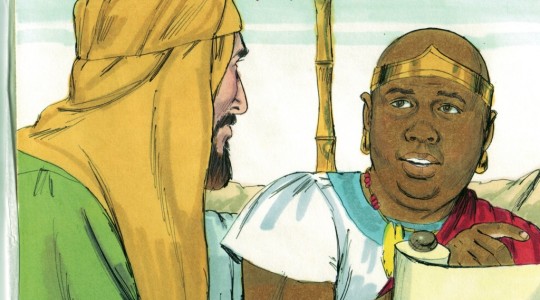
Today’s text centers on the interaction between Phillip and the unnamed Ethiopian eunuch. (Noticeably unnamed much like many of the women in the Bible and unlike most of them men.) We have rather a lot of details about the Ethiopian, for not having a name. However, we don’t have clarity on this person’s gender identity. The Bible uses male pronouns, but let’s be honest – the Bible uses male pronouns as a default position. The most defining characteristic of this person was their status as a eunuch. Peterson Toscano, who self describes as a Quaker and obsessive gardener, lives in Sunbury, PA with his husband, the writer, Glen Retief as well as a gay Biblical Scholar, wrote an excellent blog on this passage. In it, he seriously considers the experience of eunuchs in the Bible:

Then there are the eunuchs of the Bible–so many eunuchs. We must remember that in ancient times, eunuchs stood out. They typically had their testicles removed before puberty, sometimes with their consent, but usually not. As a result, they did not develop secondary sex characteristics that come during puberty. They retained high voices. They did not develop the body hair or the facial hair like men of their time. They looked and sounded different from the men and women around them.

Eunuchs could not produce offspring. While some did partner, most did not. They were often single and childless unless they adopted. In a world where everyone seemed to be part of a family unit of some sort, they stood out as loners.1

Some scholars have said, “In order to earn and to maintain identification as a man, a free adult male citizen or native had to be perceived as one who dominated unmen—women, foreigners, slaves, and children.”2Traditional gender identity didn’t entirely fit for this one.

I’m going to use “they/them/their” pronouns, and ask forgiveness to the one whose story is told if their preference would have been otherwise.

We do know a lot about this unnamed person, whose gender isn’t binary though! They were from Ethiopia, which would have seems really far away for those from Galilee and Judea, almost like the ends of the earth. Most likely, they also looked different than the Galileans and Judeans did, with darker skin and a different sort of dress. They were the queen’s treasurer, which means they were probably very wealthy. The first set of Jesus’s followers were predominantly poor, and someone with that much wealth was quite different in that way too. They were almost certainly not Jewish, although they are a worshipper of YHWH. They were literate, which most people and most disciples were not. And they were employed by a foreign government, which would have aroused some suspicion about priorities within the early church. Those are some big differences.

We’re told that they have just come from worship in Jerusalem. That would not have been an emotionally easy experience, perhaps particularly for this person. Being outside of the gender binary at that time, and in that place, meant a loss of power. For worshipers at the ancient Temple, only Jewish men with unharmed genitalia were permitted to enter the internal (and thereby more sacred) “Israelite Courtyard.” Women, Gentiles, and those with nontypical male genitalia were confined to the outer court. This individual was used to having significant power and influence, and might have particularly not enjoyed being treated as “second class.”

Yet, for the sake of the queen, the eunuch’s status was imperative. In their society, it gave them access to their role. At the same time, as Peterson Toscano says:

Likely as a child this one was taken from home and parents. This one was physically held down, likely without giving consent, and was operated on. Through a painful procedure with the real risk of infection and more pain, testicles were removed.

This one grew up but never went through puberty. As boys matured and changed, this one did not change in the same ways. This one was assigned a position in a royal court. This one could not start a family. This one was both respected and mocked, sometimes at the same time because of an elevated status in the palace and what was seen as a social deformity. This one may well have felt isolated, rejected, and even experienced physical challenges and disabilities because of the lack of testosterone in the system.

So, this person, with so very many identities that differed from the majority of Jesus followers, was reading a passage from Isaiah that might have had some resonance with his own life. They have questions about the passage’s meaning, which is particularly valid to have when one is reading scripture! In the midst of this, Phillip appears and asks if they know the meaning. My friend Michael Airgood wrote a paper on this passage. In it, Michael chooses to use the pronounces xe/xyr/xem for the eunuch. He says, “When Philip asks xym if xe understands what xe is reading, xyr response indicates strongly that xe has felt the exclusionary forces of religious bigotry. You can almost hear the rejection in xyr voice, ‘How can I understand unless someone guides me.’”3 Being excluded had included being excluded from religious education. Once Phillip shares what he knows, the Ethiopian-eunuch-officer-worshiper is convinced that the Jesus movement is something they wanted to be a part of. So, they ask, “Look, here is water! What is to prevent me from being baptized?”

We know the answers to this! Much of this person’s identity could have been used as a barrier to inclusion in the Body of Christ. They were already excluded from full participation in the Jewish Temple as well as from from family life. This person knew exclusion, and the early Christian community was more more self-similar than it is now. This person was different in a lot of ways, and it might have been thought, too many ways. Phillip could have told them that they needed to do more studying and that they should come back in a few years, or that they needed to work with mentor, or that only people with standard order genitalia were welcome, or that they had to pass some sort of purity test, or simply lied and said that the water they were nearby “wasn’t good enough.” I’ve heard of modern-day church folk coming up with many of those excuses, and more.

This is an intensely vulnerable question. The one who asked it knew that there were plenty of things that could have been seen as reasons to prevent them from being baptized. The one who asked it was JUST excluded. The one who asked it had been excluded in innumerable ways throughout their life. Yet, the one who asked it, asked directly, despite expecting a long list of reasons for exclusion, again.

That is, I don’t think the one who asked, “What is to prevent me from being baptized?” expected to be welcomed into the Body of Christ, much less without an argument. I also think that the apostles in Jerusalem had a conniption over this when they heard, but that may just be related to my experience of the institutional church 😉 Many commentators have wondered with me if Phillip and the Ethiopian-eunuch-officer-worshiper continued to read the scroll of Isaiah as they discussed things together. I hope they did. If they kept reading, three more chapters, they would have gotten to this passage:

“ Do not let the foreigner joined to the Lord say,
  ‘The Lord will surely separate me from his people’;
and do not let the eunuch say,
  ‘I am just a dry tree.’
 For thus says the Lord:
To the eunuchs who keep my sabbaths,
  who choose the things that please me
  and hold fast my covenant,
 I will give, in my house and within my walls,
  a monument and a name
  better than sons and daughters;
I will give them an everlasting name
  that shall not be cut off.” (Isaiah 56:3-5, NRSV)

There was also, Judaism that was already ancient in the eunuch’s time, an awareness that God doesn’t hold to human boundaries. In many ways this story feels like the this Isaiah passage brought to life. Did you notice that the eunuchs don’t stop being eunuchs, they’re accepted as they are and within the faith tradition given all the things that would otherwise be denied to them? The commentator in the New Interpreter’s Bible on this Acts passage intends to speak of Phillip, but also seems to speak of Isaiah when he says, “The essential task of the prophet, then, is to clarify membership requirements of those belonging to God, sometimes in ways that redraw Israel’s boundaries to include the exclude ones.”4

One of the oldest Christian communities in the world is the Ethiopian church. Their tradition says that faith was brought to them by this eunuch, and has been maintained ever since. It gives me chills to think that it is only because of the bravery of that one to ask that vulnerable question, that a church could exist.

So much of the world, and counter to the message of God and Jesus, so much of the church teaches people that they are not enough! According to those broken theories, there are standards to be met, barriers to overcome, behaviors that must be amended, and even people who can’t ever measure up. The message of God and Jesus is that we are already enough. This person, this eunuch, even without a name, trusted God enough to ask if they were welcome. Phillip, moved by the Spirit of Grace, knew enough to welcome in those who wanted to be part of the Body of Christ.

This is a story that has happened many times: human beings worry that they’re not enough and wonder if the people claiming to speak for God (the church) will welcome them. This is also a story that hasn’t happened enough: that the people who claim to speak for God (the church) welcome in God’s beloveds (any and all people). This is also a story that hasn’t happened often enough: that the people of God remember that God is enough, that we are enough, and that no one is fundamentally lacking. May we be people of this story, people who trust in God’s enough, in people’s enough, and in God’s unending and unbreakable grace. Amen

1Peterson Toscano, “Intersecting Identities – Queer Identity and the Ethiopian Eunuch” found athttps://petersontoscano.com/ethiopianeunuch/ on August 29, 2017.

2 Ken Stone and Teresa J. Hornsby, Bible Trouble: Queer Reading at the Boundaries of Biblical Scholarship. In “Atlanta; Society of Biblical Literature” (ebook, 2011), 177.

3 Michael Airgood, “WHAT IS TO PREVENT ME FROM BEING BAPTIZED?” THE GOSPEL’S QUEER JOURNEY TO THE ENDS OF THE EARTH. Turned in for seminary credit 8/18/2017.

4Robert W. Wall “Acts of the Apostles” in The New Interpreter’s Bible, Vol. X, edited by Leander Krik et al, (Abingdon Press: Nashville, 2002), 142

–

Rev. Sara E. Baron

First United Methodist Church of Schenectady

603 State St. Schenectady, NY 12305

Pronouns: she/her/hers

http://fumcschenectady.org/

https://www.facebook.com/FUMCSchenectady

Sermons

Untitled

  • April 30, 2017February 15, 2020
  • by Sara Baron

On
April 4th several of us went to the University of Albany
to hear Supreme Court Associate Justice Sonia Sotomayor.  Very early
in the evening she explained that she likes to be up and moving, and
she started wandering around the room while speaking.  The wandering
wasn’t random.  She systematically worked her way around the entire
room, stopping at every row of every aisle, and walking across any
front row entirely.  While talking coherently. she allowed every
person who reasonably could do so to touch her.  She just offered her
hand, and people in the outside 3-4 seats were able to physically
connect with her.

She
was clear from the outset that this is her preferred way of engaging,
but I was also aware that it was a remarkable way to fulfill the
needs of those who come to hear her speak.  She is the third woman
appointed to the Supreme Court, and the first Hispanic/Latinx.  She
is an inspiration to an enormous percentage of the population, and
her choice to let people touch her seemed like a way to take that
inspiration role seriously.  

In
all the wisdom Justice Sotomayor has, knowing the importance of touch
seems like part of it, as does taking seriously the role of being a
bearer of hope.  She offered her hand as a beacon, letting her touch
defy some of the brokenness of the world.

–
– – –

The
first gospel lesson today also centers on the power touch.  Two
women, in very different life stages are transformed by it.  The two
stories, told together, are intended to reflect on each other and
enhance the meaning of each other.  The young girl was 12, the
anticipated age of maturity.  The woman had suffered for 12 years,
emphasized as long enough for a baby to reach maturity.  The young
girl was believed dead.  The woman’s was in a living death of
isolation, poverty, and extinguished hope.

The
young girl wasn’t able to speak for herself, so her loving father
begged for Jesus’s help.  The woman
wasn’t to touch anyone, and anything she sat on or laid down on (as
well as her touch) would make others unclean.  This should have
impeded her capacity to speak for herself too.  The story seems to
suggest that she doesn’t have family to care for her, because they
refer to her dissipated wealth as her own.  No one could do it for
her.  She definitely wasn’t supposed to spend time in tight crowds.

(Two
thoughts about this.  As damaging as such a life would be for a
person, I think it makes some sense in context.  The ancient Jews
believed that blood was the life force in a body, that’s what made it
sacred.  They would be understandably concerned about continual
bloodflow.  Secondly, in an era before germ theory or antibiotics
about all people knew for sure about medicine was that you could get
sick from sick people.  In order to care for the community, you kept
people from passing along illness.  It is awful for the individuals,
but better than letting the whole community die.  I don’t want this
story to be heard as implicating ancient Jewish society as unloving.
It seems to me they were doing the best they could.)

This woman, whose 12 years of
life had been without human touch or connection, as well as without
without successful treatment, and was now without resources because
she’d tried to fix it; broke the rules.  She moved in a tight crowd,
touching others as she went.  She sought, intentionally, to touch
Jesus, EVEN THOUGH her touch would make him ritually unclean.  Some
scholars suggest that such an action made her eligible to be stoned.
No one could speak for her, the laws made it impossible for her to
speak for herself, so she broke the laws, taking a huge risk, seeking
life again.  She reached out to touch Jesus, not knowing what
would happen next, if she’d be healed or stoned, accepted or
violently rejected.

– – –

On Tuesday the Judicial Council
of The United Methodist Church met in Newark, New Jersey to hear oral
arguments about the election of Bishop Karen Oliveto.  Bishop Oliveto
was elected this past July by the Western Jurisdiction of the United
Methodist Church in an unanimous vote that was uncontested.  She’s a
gifted spiritual leader, a joy-filled human being, a natural church
leader, and a living example of grace.  The issue is very simple:
Karen is married to Robin, and both Karen and Robin are women.  The
Western Jurisdiction knew this when they elected her, Karen’s
decision to run happened after the Pulse Nightclub massacre.  She was
reminded of all of the violence done to the LGBTQIA1
community, and thought it was important to use her ministry to
visibly change some of the narrative (in the church and the world.)

The
United Methodist Church is officially a homophobic denomination.  It
intentionally and structurally oppresses the queer community.  By
putting herself forward for election, she offered the possibility of
giving hope to the queer community in the midst of its grief and the
multitudes of harms.  This particular United Methodist Church, along
with 836 other United Methodist churches and communities, has taken
an official stance declaring that we believe that The United
Methodist Church is WRONG and that God’s love and the churches doors
should be open to people without consideration of their sexuality or
gender identity.  This church, and 836 others, advocate for the full
inclusion of LGBTQIA people in the church and the world.  The Western
Jurisdiction agrees, and they elected Bishop Oliveto because of the
gifts and graces she has for the episcopacy.

Despite the systematic
oppression of the church, as Kevin has explained in 20 page brief
(one of many filed) what they did was legal and appropriate.  (The
fact that the Judicial Council ended up sort of disagreeing doesn’t
in any way make me doubt Kevin’s analysis.)

The Judicial Council meets twice
a year, and they always have several items on their docket.  Two
other pieces this April related to the commissioning and ordination
of out queer clergy.   Unfortunately, while there are MANY in our
denomination who agree with us about God’s love extending to all
people, there are also many willing to engage in witch hunts to
prevent the church’s blessing from falling on queer people. The
conservatives wanted to invalidate the ordinations of out queer
clergy!!!

On
Tuesday, as I woke up, people had already gathered in Newark.  Bishop
Oliveto, her wife and her mother, queer clergy from across the
denomination, queer laity, and allies of all sorts were present,
visible, singing, and connecting to each other.  I watched it on live
feed.  Tickets were given to two rooms: one the room in which the
Judicial Council sat and the arguments would be made, and one for
overflow connected via a live stream.  Laity and allies exchanged
tickets with queer clergy so that they could be together, sitting in
solidarity with Bishop Oliveto.

As I watched the live stream, I
saw the Queer Clergy Caucus2
enter the Judicial Council room, and kneel to pray.  It took my
breath away.  It looked like the hemorrhaging woman reaching her hand
toward Jesus.  That group of beloved and beautiful people of God have
stayed in a denomination that has called them names and declared
their lives “incompatible with Christian teaching.”  They have
courageously refused to leave, refused to be silent or invisible, and
continued to ask for the church’s blessing on their whole lives and
ministries.  They have reached out to touch Jesus, knowing that the
laws stand in the way, that the crowd will judge them, that the
disciples would try to stop them, and needing to touch Jesus anyway.

They knelt to pray, to reach out
and touch Jesus and hoped the church wouldn’t stop them this time.
They’ve done it before.  They’ll do it again.  But every time it is
an act of courage.  So far, every time they reach out, the church has
TRIED to stop them.  

– – – –

In the Gospel, Jesus’s response
is grace-filled.  He calls out the woman (who must have been
TERRIFIED), and by doing so publicly he is able acknowledge her
healing and restore her relationship with the community at large.
She was able to touch others again, she was able to connect, she was
able to be a part of the whole.  She was afraid that by touching him
she’d bring him shame, but she took the risk anyway, and instead all
that separated her from the community was lifted from her.

That’s
what the queer clergy caucus was hoping the church could replicate.

The young girl brought back to
life when Jesus grabbed her hand becomes a metaphor for the life that
Jesus has to offer, and gave as well the hemorrhaging woman.  The
touch of Jesus brings life – and hope – as well as healing.

– – –

In our second Gospel lesson,
people are also walking with Jesus, and their lives are also changed
by it.  The story ends with people more alive than when they began.
The theologian John Dominic Crossan3
often says, “Emmaus never happened.  Emmaus always happens.”
That is, he doesn’t think that it is a story reflecting actual
historical events, but instead reflecting deep Christian realities.
This year it occurs to me to wonder how literally the story is
intending to indicate that a third person actually showed up.

Perhaps, instead, the Holy
Spirit was with the two walking together, and together they started
piecing together the teachings of Jesus and the meanings offered.
Perhaps the collective (even of two) felt so much more than one and
one that it was as if there was another one leading their
conversation.  I’ve had conversations like that.  (I’ve had
conversations like that this week at the “Change Leaders Summit”
hosted by the General Commission on Religion and Race as we dreamed a
less racist church).  I could metaphorically say that the some
moments of talking to another have been so sacred and eye-opening
that it was as if Jesus was the third person in the dialogue.  

If that is one of the
metaphorical meanings of the gospel lesson, the it is potent.  The
disciples are running away!  They’re going in the wrong direction,
and even then Jesus is with them and guiding them.  In the end they
turn back and return to the place they’d been frightened away from.
They move from fear back to life.  In connecting with Jesus they
connect with their hope, their meaning, and the purposes of their
lives.  They were reconnected to Jesus, and perhaps via the power of
the Holy Spirit to guide sacred conversations.

– – –

Returning
to face the fears is part of the inherent Easter story.  So is the
transformation of the Body of Christ from the historical Jesus to his
followers throughout time.  We are now expected to respond to the
world with his courage and grace, to respond to all the ways he
responded to the hemorrhaging women, the powerless girl, and –
however it happened – the frightened disciples

Those Queer Clergy praying in
the Judical Council hearing room were living out the Easter story.
They faced the fears of rejection, and went anyway.  Others may want
to cut them out of the Body of Christ, but they believe that Jesus
responds to them with grace. They know enough to reach out for Jesus
and know that Jesus will see them and bless them, even if the church
will not.

It turns out that today Bishop
Karen Oliveto IS still a Bishop.  Thanks be to God.  Furthermore,
none of the commissionings or ordinations of our out queer clergy
siblings were overturned.  Thanks be to God.  Unfortunately, there is
also a lot of bad news that came from the decisions.  The church has
attempted to crack down to gain control offer the resistances
movements that seek to include ALL of God’s people fully in the
church.  (They seem to forget that their methods NEVER work over the
long run.)  There are many in our church who are hurting and there
are many in our world who are hearing from our denomination that they
are not worthy of love.  

– – – –

The denomination is wrong.  It
can’t control or limit God’s love.  Nor can it control or limit the
queer community and its allies.  The people of God will keep reaching
for God, whether the church tries to stop them or not.  When people
reach out, Jesus responds with grace.  When people reach out we can
follow the lead of the Spirit who will guide us to bring hope and
grace to each other.  God is faithful, whether the church is or not.
For that, I am mightily thankful to God.  Amen

1 Lesbian, Gay, Bisexual, Transgender, Queer, Intersex, Asexual

2 https://www.facebook.com/UMQClergy/

3 Coming
to First UMC Schenectady on September 23-24.  SQUEAL.

Rev. Sara E. Baron

First United Methodist Church of Schenectady

603 State St. Schenectady, NY 12305

Pronouns: she/her/hers

http://fumcschenectady.org/
https://www.facebook.com/FUMCSchenectady

April 30, 2017

Sermons

“NOT Worthless”based on  1 Samuel 1:4-20 and 1 Samuel 2:1-10

  • November 15, 2015February 15, 2020
  • by Sara Baron

I spent a lot of time thinking about what to say about the terrorist attacks in Paris, before I realized that there were also terrorist attacks made by the same group in Baghdad and Beirut which the news cycle had not taken quite so seriously. Then I realized that there were also deadly natural disasters in Japan and Mexico on Friday. Then I worried that there were likely other tragedies that I didn’t know about. Then I thought of the 200,000 deaths in Syria that have motivated 4 million refugees to leave their homes. Then I remembered that there are lots of refugees NOT from Syria. On Facebook I kept seeing these words, written by a poet named Warsan Shire from Nairobi, Kenya:

“later that night

i held an atlas in my lap

ran my fingers across the whole world

and whispered

where does it hurt?

it answered

everywhere

everywhere

everywhere.”1

I asked Drew Vickery, who was here this weekend for the CCCYM (Conference Council on Youth Ministries) event what he thought I should say about the attacks on Paris, and after a few hours he got back to be and said, “Nothing. I think you should focus on hope.” #fromthemouthsofteens. I don’t have words to take away the pain of the world, I don’t have words that will stop or transform extremist militants, and I surely don’t have words that will bring any of the lives tragically lost.

The hours I spent reading up on the terrorist group last night brought one imperative sentence to light, “For certain true believers—the kind who long for epic good-versus-evil battles—visions of apocalyptic bloodbaths fulfill a deep psychological need.”2 This clarified my role for today: to offer a form of faith that is not about defining “good” or “evil” but rather about seeking wholeness for ourselves that can encourage others into wholeness. So, here we go…

Hannah is surprisingly resilient. It isn’t that painful things don’t seem to hurt her – they do – a lot! They don’t overcome her. We see it twice in her story. The first thing that we know about her is that she’s barren. Now, people in the ancient world did not think that barrenness COULD be a male problem, but even if they had, Hannah’s husband’s OTHER wife was distinctly not barren. A woman’s value came in her childbearing capacity, and to be barren was to be worthless. To be barren was to be ashamed. Hannah was barren.

And yet…her husband loved her. This is not particularly normal, nor expected for marital relationships at the time. In fact, it looks like it was true in only one of Elkanah’s marriages. He loved Hannah, and he gave her preferential treatment because of it. His words indicate that he doesn’t even care that she’s barren, which I think supports the case that he really loves her and not just her “value” in his life.

This was not sufficient for Hannah. She wanted to have a child. We are completely incapable of determining if this is about her maternal instincts or if it is about a desire not to be in shame, but let’s assume it is some of both. Her husband’s love did not take away her shame, although it may have helped her have resilience to it.

Every year when she had the chance, she went to the house of God and prayed there. We’re told that she asked God to open her womb, and even tried to strike a deal with God about it. This is imperative to her story, she eventually gave birth to the prophet who would anoint the first kings, and it better be clear how faithful his mother was in order to establish his faith.

This is the first place that I see Hannah’s unusual resilience. By most accounting, if a woman’s womb was barren, it was barren because of divine punishment. Yet, as one scholar put it,

“Hannah at once embodies both the patriarchal constructions of her worth and a deep assumption that God is concerned about her. … When Hannah seeks out God’s presence in this state of anguish, her prayer signals that she is aware of a divine concern for those who are questionable worth. She does not come to God with formal petition. She does not come with traditional sacrifice. She comes in loneliness, isolation, and despair. She lays bare all the emotion and pain.”3

She believes that God cares about her, despite her barrenness, despite her shame. She is resilient to her own shame. It doesn’t stop her from seeking the Holy One AND making requests of God and EVEN bargaining with God (which is a dangerous idea). She doesn’t let it stop her, and that indicates that she thinks God might listen to her.

That’s some GOOD theology for a mostly powerless, shamed woman 3000 years ago.

There is a repetition of her resiliency as well. Eli, the priest, is often presented as not knowing a whole lot about God. He isn’t a bad guy, he just hasn’t had much contact with the Divine. So, when Hannah was praying with all her heart, Eli confused this with a drunken stupor, and decided to come up and shame her about that.

She might have slinked away.

But not Hannah. She, a lowly, barren woman corrected him. She is such a delight! She wasn’t mean about it, she correct his assumption. She has NOT been drinking. She explains that she was PRAYING (we don’t know if she gets this out with or without sarcasm in her voice), and she makes a request of him, “Do not regard your servant as a worthless woman, for I have been speaking out of my great anxiety and vexation all this time.” She not only asks favors of God, she asks one of the high priest.

And we should know something is going on by now, because Eli receives her correction and grants her request. Then God does too, and she gives birth to a child and names him Sam-u-el, “God has heard.”

I wish more people were like Hannah, refusing to be put in their place, denying the capacity of anyone else to define their value to the divine. I wish more people took the mantle of shame that other people tried to put on them and simply refused to wear it because they KNOW that they are worthwhile to God.

The Magnificat of Mary which celebrates God’s mighty acts is song that fell from Mary’s lips when she was pregnant with Jesus. It is based strongly on Hannah’s song that she sang to celebrate God’s mighty acts when Hannah was pregnant with Samuel. Hannah’s song, just like Mary’s, focuses on God’s power to care for the poor, the broken, and the vulnerable. It also emphasizes God’s capacity and willingness to bring down the high, the mighty, and the rich. They are songs of celebration of God’s work for the disenfranchised. They are RADICAL claims about God that anyone with a vested interest in the status quo should worry about.

Hannah is the Biblical predecessor to Mary. She’s a big deal, in large part because she knows that God cares about the people that the people don’t care about – including her.

Hannah is a model of shame resilience on the basis of God’s grace, a model we desperately need in modern day Christianity. This week I read Karen McClintock’s book Shame-Less Lives, Grace-Full Congregations, and she had a lot of wisdom to share about shame and grace. Early on in the book she points out that, “We are encouraged by the dominant culture to self-improve rather than self-affirm and to strive for more rather than to be content with what is and satisfied with ourselves. The pervasive and soul-defeating presence of cultural shame leads to perfectionism, addition, and self-hatred.”4 Later, she clarifies that, “Shame is not a course-correcting emotion. While guilt says, “I made a mistake,” shame says, “I am a mistake.‘”5

At two point she offers the words that make SO MUCH sense of the world, “Shame is often the first tool grabbed off the workbench by those entrusted to maintain the status quo,”6 and, “Because shame feels so terrible, we avoid it through the use of blame.”7 But it wasn’t until she said, “You can never be satisfied with yourself if you are constantly striving to be as wise, good, kind, or as generous as God,”8 that I knew she was preaching to me. She continued that point with a quote from Barbara Brown Taylor who said, “I thought that being faithful was about becoming someone other than who I was, and it was not until this project failed that I began to wonder if my human wholeness might be more useful to God than my exhausting goodness.”9

Finally, since this is a quick run through of an excellent book, I want to offer one of her stories:

“I had the opportunity to mentor a clergyperson I’ll call Sam during his first few years as a parish pastor. … To help him integrate his adult self and his ashamed little boy, I had him spend a few weeks between our conversations thinking of himself as ordinary.  I encouraged him to ask himself, ‘What would an ordinary person feel right now?  What would an ordinary person want, do, say? The exercise provided him with a reflective distance between his idealized self and his ordinary self. Once he accepted his ordinariness, he could balance service with replenishment and encouragement with separation."10

I think Hannah knew how to do that. She was just an ordinary woman, so was Mary, and they knew God to care for ordinary people.

With the possible exception of Jesus, every character in the Bible is visibly and deeply flawed. This clarifies that God works with and through real people, not perfect ones. They called on their actions sometimes, but God doesn’t ask them to “shape up or ship out” when it comes to their flaws. They’re just accepted as they are.

Dear ones, God created you as you are and loves you are as you are. You need not be perfect, you need not be particularly GOOD, you need not be extraordinary. You are enough.

May that knowledge fill the world.

I suspect it will help. Thanks be to God and may God help us ALL. Amen  

____

1 Accessed at http://www.goodreads.com/quotes/812310-later-that-night-i-held-an-atlas-in-my-lapon 11-14-15.

2 Graeme Wood, “What ISIS Really Wants” in The Atlantic March 2015 Issue. Accessed athttp://www.theatlantic.com/magazine/archive/2015/03/what-isis-really-wants/384980/ on Nov. 14, 2015.

3 Marcia Mount Shoop “Theological Perspective of 1 Samuel 1:4-20” in Feasting on the Word Year B Volume 4 edited by Barbara Brown Taylor and David Bartlett (Westminster John Knox Press: Louisville Kentucky, 2009) page 292.

4 Karen A. McClintock, Shame-Less Lives, Grace-Full Congregations  (Herndon, VA: The Alban Intitute, 2012) p. 4.

5 McClintock, 22.

6 McClintock, 52.

7 McClintock, 67.

8 McClintock, 95.

9 McClintock, 101, quoting Barbara Brown Taylor, Leaving Church: A Memoir of Faith (New York: Harper Collins, 2006), 218-219.

10 McClintock, 107-109.

–

Rev. Sara E. Baron

First United Methodist Church of Schenectady

603 State St. Schenectady, NY 12305

http://fumcschenectady.org/

November 15, 2015

Sermons

“John Wesley v. Race Relations: Grace” based on Galatians 3:27-29…

  • August 17, 2015February 15, 2020
  • by Sara Baron

This
week Target announced its intentions to remove gendered labels from
its toy and children’s bedding sections.  They also intend to remove
gender clues – like the blue or pink background of the shelves.
Foxnews.com started their article on this change in this way, “Target
stores are undergoing a sex change of sorts.”1
Many people seemed to respond to the news as Fox covered it –  as if
Target was attacking gender, and they attacked back.  

They
told Target that they’d take their business elsewhere, because they
were traditional people who loved their children.  That is, they
spoke as if their lives and values were under attack.  I think, for
many people, they were.  Now, I don’t think that the concept of
gender is particularly fragile, and I have no concerns that it is
about to break.  So I don’t think it is in need of vigilantes
defending the importance of placing Barbies on shelves with a pink
background. At the same time, if gender roles are one of the primary
ways that people make sense of the world, then defending the roles,
and defending the ways the roles are formed, would be a way of
preserving the world as one knows it and in this mindset, as it
should be.

It
is easy enough to understand why people, who are aware of changes
happening all around them, might choose to cling to the social  norms
that help them make sense of the world.  The fear that could come
with sensing change and feeling out of control could easily arise
into a desire to maintain the norms you have always known.  However,
it is dangerous.

People
experienced their values and ways of life under attack with this
news, and they attacked in kind.  There are all kinds of ways that
behaviors like this happen in our society.  Most often as a society
we encourage others to behave as we see fit through passive
aggressive comments, but more extreme measures, including violence,
are used as well.  It amazes me, actually, how strongly people
associate their security and well-being with the maintenance of
social norms.

The
value placed on social norms relates to the high murder rate for
trans women of color.  In the United States, the murder rate is 4.5
people out of 100,000 people every year2.
 Or, 1 in 22,222.   The murder rate for trans women of color is 1
person out of 8.3
That makes it about 3000x higher than the US average.  3000.  Times.
Higher.  MURDER.  Rates.  The mere existence of trans women of color
threatens people so profoundly that they get killed.  The combination
of racism, sexism, and gender normativity has proven deadly at
enormously high rates.

People
will go to extremes – including extremes of violence – to
maintain their world view and the social norms.  This is also true of
the myths we live by.  The reasons for slavery were profit, but
church leaders and theologians used their authority and the authority
of the Bible to justify it.4
They were part of the creation of the theory of race.

Yes,
the theory of race was created
to justify the money made for slave owners by the labor of slaves.
The myth called race theory has killed millions of people. I have
read about this before, but I reviewed my knowledge this week by
reading a paper by Audrey Smedley,  Professor of Anthropology Emerita
Virginia Commonwealth University.  She says,
“Race
originated as a folk idea and ideology about human differences; it
was a social invention, not a product of science. Historians have
documented when, and to a great extent, how race as an ideology came
into our culture and our consciousness.”5
“English laws had terminated all forms of slavery centuries before
their arrival in the Americas.”6

The
differentiation between poor workers in the colonies started because
of the fear created by the Bacon rebellion in 1676.  It was a threat
to the social stability of the time.  Smedley explains, “The
decisions that the rulers of the colony made during the last decades
of the 17th century and the first quarter of the 18th century
resulted in the establishment of racial slavery. They began to pass a
series of laws separating out Africans and their descendants,
restricting their rights and mobility, and imposing a condition of
permanent slavery on them. … Some colony leaders began to argue
that Africans had no rights under British laws and therefore could be
subject to forced labor with impunity.”7

She
continues, “Colonial leaders were … laying the basis for the
invention of race and racial identities. They began to homogenize all
Europeans, regardless of ethnicity, status, or social class, into a
new category. The first time the term “White,” rather than
“Christian” or their ethnic names (English, Irish, Scots,
Portuguese, German, Spanish, Swede) appeared in the public record was
seen in a law passed in 1691 that prohibited the marriage of
Europeans with Negroes, Indians, and mulattoes (Smedley 2007, 118). A
clearly separated category of Negroes as slaves allowed newly freed
European servants opportunities to realize their ambitions and to
identify common interests with the wealthy and powerful. Laws were
passed offering material advantages and social privileges to poor
whites. In this way, colony leaders consciously contrived a social
control mechanism to prevent the unification of the working poor
(Allen 1997).”8

From
this early history, we gained the conception of race.  A final note
by Smedley, “In the 1860s, slavery ended, but “race” as social
status and the basis of our human identities remained. Race ideology
proclaimed the existence of separate, distinct, and exclusive groups
that were made unequal by God or nature.”9

The
intentional creation of race, for the purpose of legitimizing the
barbarous act of slavery – already known to be barbarous for
centuries in British law – but necessary to turn a profit has
dehumanized human beings and legitimized their murders for nearly 400
years.  

We
see, almost every day now, the impact of this theory on the lives of
people in our country. The creation of race theory was not only the
creation of a theory about so-called “blacks” but also the
creation of the idea of so-called “whites.”  Since then it has
expended to define and separate people into various “categories”
of humanity with associated stereotypes.  The categories also have
associated murder rates.  People of color, both men and women, young,
middle aged and old are being killed in our country, including by our
police forces at atrocious rates.  The THEORY of RACE is still
perpetuating its evil.  It
is time to throw the theory out and replace it with a better one.

A
better world view comes from a more ancient source.   Paul says,
“There is no longer Jew or Greek, there is no longer slave or free,
there is no longer male and female; for all of you are one in Christ
Jesus.”  As followers of Jesus, we are not to buy into social norms
about race, or gender, or any theory  that some humans have value and
others don’t.  There is no distinction.  We are united.  We are one.
A harm to any individual is a harm to us all.

The
gospel passage about the Syrophoenician woman comes to the same point
as Paul! Ched Myers, author of Binding
the Strong Man,
points out that the woman’s “solicitation is an affront to the
honor status of Jesus: no woman, and especially a gentile, unknown
and unrelated to this Jew, would have dared invade his privacy at
home to seek a favor.  A rebuff by Jesus thus is not only
understandable but expected.”10
And the dog comment was REALLY insulting.  But she doesn’t give up!
She argues back with him.  Which was a further affront to his honor.
Yet, at that point he concedes the argument, acknowledges her point,
and
heals her daughter, thereby extending his ministry outside of Jewish
boundaries.  And it is said that he heals her daughter because of her
ARGUMENT, not her faith!!  To go back to the words of Myers, “Jesus
allows himself to be ‘shamed’ (becoming ‘least’) in order to include
this pagan woman in the new community of the kingdom; so too Judaism
will have to suffer the indignity of redefining its group boundaries
(collective honor) in order to realize that gentiles are now welcomed
as equals.”11

I
love the words.  “Judaism will have to suffer the indignity of
redefining its group boundaries in order to realize that gentiles are
now welcomed as
equals.”
Doesn’t it sound like the work of transforming race theory?  It also
sounds like the work of grace, the unmerited favor and love of God
which we all experience whether we realize it or not.  

Grace
is God’s love for us.  We are not expected to be up to the standard
of offering pure unmerited favor and love to others AND YET it is the
goal of Methodists to put aside the things that keep us from being
able to do so until nothing but God’s love lives in us – that is –
until grace can shine through us.  We’re at trying to attain life
lived as grace.

By
both of our texts today, we are challenged to extend the love of God
beyond any reasonable boundary – to all people.   In Christ we are
called beyond the things that separate us, beyond the things that
define us, into wholeness with God and with each other.  Social norms
don’t stand in the way of grace.  We are to throw away anything that
gets in the way of living toward grace, including social norms.

Grace
is the most defining doctrine of United Methodists, likely based on
the theology of John Wesley which was entirely focused on it.  It is
so our thing that Amazing Grace is our favorite song by a landslide.
Of all United Methodists, 39% claim it as their favorite song.12
And grace, it seems, is the essential way to transform the world.
It leads us to compassion.  It leads us to humanizing other people.
It stretches us beyond our comfort zones and our safe places.  It
takes our norms and chops them to pieces, and in doing so makes space
for joy and love and wonder to abound.

In
this sermon series, in addition to all the other things that have
been happening, I’ve been sharing some of the ways I’ve recently felt
free to name and understand the Divine.  John Shelby Spong in A
New Christianity for a New World
discusses the idea of God as the ultimate source of love.  He says,
“One worships this God by loving wastefully, by spreading love
frivolously, by giving love away without stopping to count the
cost.”13

Sisters
and brothers – that’s it.  That’s God.  That’s the gospel.  That’s
the Epistle.  That’s John Wesley’s point in new words.  That’s the
solution to race theory.  Love wastefully, and let others see it.
Wasteful, boundless, ridiculous, wonderful love – grace – changes
the world.  Thanks be to God.    Amen

1 Cody
Derespina, “Target
going gender neutral in some sections” on published on August 13,
2015 at
http://www.foxnews.com/us/2015/08/13/target-going-gender-neutral-in-some-sections/
Accessed August 15, 2015
2 https://www.fbi.gov/about-us/cjis/ucr/crime-in-the-u.s/2012/crime-in-the-u.s.-2012/tables/1tabledatadecoverviewpdf/table_1_crime_in_the_united_states_by_volume_and_rate_per_100000_inhabitants_1993-2012.xls
3 http://www.transstudent.org/transvisibility
4 Summary
of Howard Zinn’s A People’s History of the United States
chapter 2: “Drawing the Color Line” (Perennial Classics, USA,
1980)
5 Audrey
Smedley  “THE HISTORY OF THE IDEA OF RACE… AND WHY IT MATTERS”
a paper presented at the conference “Race, Human Variation and
Disease: Consensus and Frontiers,” sponsored by the American
Anthropological Association (AAA) on  March 14-17, 2007 in
Warrenton, Virginia.  Found at
http://www.understandingrace.org/resources/pdf/disease/smedley.pdf
on August 15, 2015, page 2.
6 Smedley,
3.
7 Smedley,
4
8 Smedley,
6.
9Smedley,
7.
10Ched
Myers, Binding the Strong Man
(Orbis Books: Maryknoll, NY, 1988, 2008), page 203.
11 Myers,
204.  
12 http://www.kintera.org/atf/cf/%7B3482e846-598f-460a-b9a7-386734470eda%7D/survey1.pdf
13 John
Shelby Spong A New Christianity for a New World: Why Traditional
Faith is Dying and How a New Faith is Being Born
(HarperSanFrancisco, 2001) page 72.

_____

Rev. Sara E. Baron
First United Methodist Church of Schenectady
603 State St. Schenectady, NY 12305
http://fumcschenectady.org/
https://www.facebook.com/FUMCSchenectady 
on August 16, 2015

  • First United Methodist Church
  • 603 State Street
  • Schenectady, NY 12305
  • phone: 518-374-4403
  • alt: 518-374-4404
  • email: fumcschenectady@yahoo.com
  • facebook: https://www.facebook.com/FUMCSchenectady
  • bluesky: @fumcschenectady.bluesky.social
Theme by Colorlib Powered by WordPress