Skip to content
First United Methodist Church Schenectady
  • Lenten Photo Show
  • About Us
    • Meet the Pastor
    • Committees
    • Contact Us
    • Calendar
    • Our Building
    • The Pipe Organ
    • FAQs
    • Wedding Guidelines
  • Worship
    • Sermons
    • Online Worship
  • Ministries
    • Music Ministries
    • Children’s Ministries
    • Volunteer In Mission
    • Carl Lecture Series
  • Give Back
    • Electronic Giving
  • Events
    • Family Faith Formation
Sermons

“Those Who Walked the Walk” based on  Habakkuk 1:1-4;…
  • November 3, 2019February 11, 2020
  • by Sara Baron

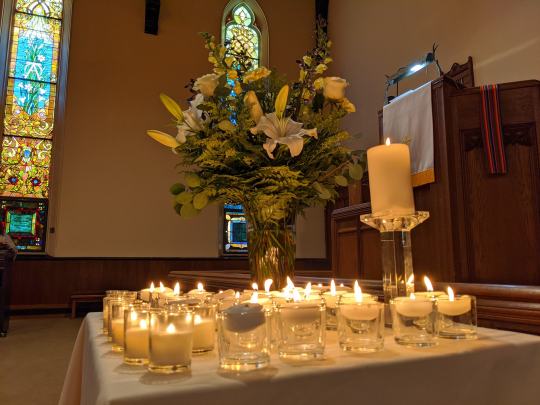
(Thanks to Kevin Kempf for the great picture!)


Have you heard of “thin
places?””  I’ve heard it described as places where the veil
between this world and the next is thinner – or where God’s
presence can be especially felt.  Ideologically, thin places don’t
make any sense to me.  I believe that God is all-present, so God
isn’t any more or less present anywhere.  

And yet… I have experienced
thin places.  I don’t understand them, but I know them.  You may be
needing some examples.  Mountaintops are commonly thin places, which
I suspect has less to do with the altitude and more to do with the
effort to get to them and the views they offer.  Things just feel
different at the top of a mountain, and many people have experienced
them to be thin places.  Sanctuaries are another common choice –
ones in churches or ones at camps.  I have often wondered if places
where many people have prayed are changed in some way by the
pervasiveness of the prayers – and thus made more holy.  (Again,
this doesn’t fit my understanding, but it fits my experience.)
Sometimes, I think, thin places are not places even, they are
moments.  I once had a chance to ask a church about when they’d most
strongly experienced God and a whole lot of them mentioned the births
of their children.  It is also very common (but not universal) for a
death to be a thin place.  

I
also suspect thin places might have a lot more to do with us being
open to the presence of God that is always with us than a change in
the amount of presence, but however it is, I think they ARE.  And,
further, one of those moments that has often been a thin place for me
is All Saints Sunday.  Over the course of my ministry, more years
than not, this has been the holiest worship service I’ve led.

This year, like every year, the
names we are about to read lie heavy on my heart.  Oh friends, the
saints who have gone on ahead of us taught us so much!  We are who we
are because of them!  It is an honor to read their names and remember
their lives, but it is also heavy to live without them.  One of our
traditions, in this church, is to also name the saints whose loss is
still especially heavy on our hearts, even if their departure was
more than a year ago.  The list of those names is also dear – and
beautiful and sad and heavy.

Today conjures in my mind that
simple line “the great cloud of witnesses” from Hebrews 12, which
is an incredibly comforting image.  Life can feel overwhelming at
times, and sometimes I have no idea where to turn, but remembering
that those who taught me, and loved me, and guided me – guide me
still and show us the way – is very powerful.  It is even better to
notice how many of there are!

So, indeed, All Saints Sunday
is, for me, a thin place, and the names we are about to read and the
lives they represent are an honor to remember and name.

Now,
the gospel passage may not seem terribly well connected to all of
that, perhaps because of the terrible Sunday School song that too
many of us learned about Zacchaeus.  (If you don’t know it, I beg
you, stay ignorant.)  The story itself, however, is not as trite as
the song.  There are surprises all over this story, if you pay
attention to them.  One is that a wealthy and powerful man was
particularly interested in Jesus, who aimed his ministry particularly
at people who were living in poverty and disempowered.  The second is
that the wealthy and powerful man was willing to forgo his dignity to
try to see Jesus, which seems to want to remind us just how exciting
Jesus was in real life and how worthy of seeking out he was (is).
Then there is the amazing turn in the story when Jesus decides to
focus his attention on Zaccheaus, this wealthy and powerful man,
which I think absolutely no one expected.  Zaccheaus, however, was
happy and gracious.  Then there is the unsurprising grumbling of the
crowd, who are peeved that Jesus is hanging out with this guy (tax
collectors being about as popular then as border patrol agents are
today).  And then there is the turn around where Zaccheaus, having
had this experience with Jesus, commits to a moral and fair life.
(I’m going to disregard my assumptions that he probably couldn’t
afford to pay back 4 times as much as he’d over taken…. that’s not
the point.)  It seems that being with Jesus was a thin place for
Zaccheaus, where he could access love, hope, and wonder, and be
changed by it.

The beautiful thing about the
Zaccheaus story is that sometimes we are ALL Zaccheaus, and the story
seems to say that’s OK.  Sometimes we have power, and sometimes we
use it wrong, but we’re still TRYING our hardest to know what’s right
and do it, and when we figure what what we’ve done wrong, there is a
chance to change it.

Now,
that’s where this fits in with our Saints today. Because none of the
Saints we celebrate today were actually perfect in their lives.  Not
a single one.  Our memories may get fuzzy around that, but all the
people we are remembering were fallible.  All of them, as well,
sometimes had power and sometimes used it wrong.  That’s human life.
What’s WONDERFUL is when people realize what they’ve done and seek to
change it.  That’s why they are our saints – because of their
willingness to grow, learn, and change.

Friends, this is an interesting
reminder for those of us trying to follow in their footsteps.  And it
is a two-fold reminder:  (1)  we are not expected to be perfect.
Really.  We can’t be, and trying just makes it all worse.  (2) And,
when we discover how we’ve erred, if we are willing and able to
change, it makes all the difference.  This is, often, a cycle we have
to keep on living.  I see it clearly in myself in working towards
anti-racism, a goal I yearn for.  However, every time I learn
something new, I have to realize how much I’ve erred in the past, and
change it.  AND THEN, you know what, the next thing I learn shows
that I’ve still been erring and I still need to change, and I’m not
there yet.  It feels AWFUL, and yet it would feel way worse to keep
messing up once I know what I’m doing.

The
Habbakuk passage feels a little bit too on point for a while, doesn’t
it?  It is bemoaning the injustices of the world, and THEN it totally
changes!!  The prophet’s concerns are met by GOD’s response, and God
says, “Write the vision; make it plain on tablets, so that a runner
may read it.  For there is still a vision for the appointed time; it
speaks of the end, and does not lie. If it seems to tarry, wait for
it; it will surely come, it will not delay.  Look at the proud! Their
spirit is not right in them, but the righteous live by their faith.”
Oh.  My.  So our work is to dream, and vision, and make the vision
for God’s goodness clear and visible to others.  A commentator
writes, “At at time when the wicked are in control, when the vision
describing God’s intention to reestablish justice has not yet become
a reality, Habakkuk is called in the interim to trust God’s
assurances and to remain faithful.”1
Not to lose hope, not to give up, not even to keep on bemoaning
reality, but to trust and share the vision.  

And the vision that has been
shared with all of us is why we are here.  We want to be part of
building God’s vision in the world into everyone’s reality.  And the
saints taught us it was possible and showed us the vision.  And their
lives have made this a thin place, where we are able to see, a little
more clearly, the beauty of the vision of God and the hope that is
the world for the present and the future. Thanks be to God.  Amen

Sermon Talkback Guiding
Questions:

  1. I talked about “thin”
    places in the beginning, does that idea make sense to you and if so,
    where have you found some?
  2. How are “Saints” related to
    learn, growing, changing – and admitting erring?
  3. What else do you see in the
    story of Zaccheaus that I didn’t bring out?
  4. Did the Habbakkuk reading
    switch too fast for you?  (Or not fast enough)
  5. How do you name God’s vision
    that we’re working on?
  6. Of the saints we celebrated
    today, or have celebrated previously, how did they teach you of
    God’s vision for the kindom?
  7. What helps you remember that
    you don’t have to be perfect?
  8. What helps you have the courage
    to change when you’ve erred?

1Theodore
Hiebert, “Habbakkuk” in The New Interpreter’s Bible Volume
VII,
ed. Leander E. Keck (Nashville: Abindon Press, 1996), p.
638)

–

Rev. Sara E. Baron
First United Methodist Church of Schenectady
603 State St. Schenectady, NY 12305
Pronouns: she/her/hers
http://fumcschenectady.org/

https://www.facebook.com/FUMCSchenectady

November 3, 2019

Sermons

“The Merciful” based on 1 John 3:1-3 and Matthew…

  • November 5, 2017February 15, 2020
  • by Sara Baron

There
is a timelessness to All Saints Sunday, similar to the spacelessness
to World Communion Sunday.  On World Communion Sunday, as the Table
of Christ feeds people around the whole world, we are able to connect
to our siblings in faith without distance separating us.  On All
Saints day we connect to those who went on before us, blessed us, and
entered the great cloud of witnesses.  I often think of the great
cloud of witnesses as being not just around us, but under us – they
are the ones on whose shoulders we stand.  

Some
of the saints we knew well, some of their names will be read today,
some of them predated us by too many years for us to know them by
name, and yet they form the great cloud of witnesses.  This reminds
us, as well, that we are here only for a brief period of time in the
work of the church.  Someday, we too, will be part of the cloud.  The
generations march ever onward.  The cloud will someday include us,
and those who aren’t even here yet!  The generations march ever
onward.  Today is a day of timelessness.

It
is also a day of timelessness in that grief slows down time, and time
can feel relentless.  On All Saints Day we don’t JUST remember those
who went on before us, and take a moment to acknowledge them, we also
notice the heartbreak of grief and attend to each other in our
heartbreak.  While it is wonderful to have a great cloud of witnesses
around us, most of us would rather have those we love right here with
us!  We are thankful to God for their lives, but usually we really
wish we were able to share more time with them!

There
is a deep holiness to the All Saints celebration, deep enough that
there is mystery in it as well.  In seeking to be faithful to the
lives of the Saints, the lectionary has given us rather mysterious
text as well.  It seems simple, until you try to make sense of it!
Here are the useful bits I’ve learned about these so called
Beatitudes:

  1. The
    verbs really matter.
  2. A
    bunch of the individual “blessings” are quotes from the Hebrew
    Bible.
  3. A
    lot of explanations exist to solve seeming contradictions

I’m
gonna explain each.  First of all, the verbs.  Those who speak Greek
say that a whole lot of effort is made into having the verbs be in
the form they’re in.  Namely, that the statements say blessed ARE,
but then indicate a future reality (mostly).  Furthermore, they
aren’t commandments, they are stated as facts.  Finally, according to
Feasting on the Word, “In
Psalm 1 the Hebrew word translated in our English text by our word
‘blessing’ is the word ’ashar,
which means in its literal sense ‘to find the right road’. … This
is the meaning of ‘ashar in the nine uses of ‘blessed’” in the
Beatitudes.”1
That means that these mean something like “You are on the right
road when you are poor in spirit.”2
Or, perhaps, “You who are merciful are on the right road, you will
receive mercy.”  So each line says “this group of people is on
the right road – and this is where it will lead them in the
future.”  These aren’t particularly normal verb constructions,
which is why they’re worth mentioning.

Now,
the Jesus Seminar thinks there is evidence to suggest that Jesus
likely said 4 of these blessings – because they show up in Luke and
Thomas.  Those are: the poor in Spirit, those who grieve, those who
hunger and thirst (for righteousness), and those who are persecuted.
They think Matthew filled in the rest as a way to uphold the early
Christian Community.3
In both cases, the blessings have striking Hebrew Bible roots.  

First
off, this text seems to be a reworking of Psalm 1, that being a Psalm
that talks about blessed people rather extensively (in the “to find
the right road” meaning).  Regarding comfort to mourners, which the
Jesus Seminar thinks goes back to Jesus, that sounds a whole lot like
Isaiah 61:1-3, “The
spirit of the Lord God is upon me, because the Lord has anointed me;
he has sent me to bring good news to the oppressed, to bind up the
broken-hearted, to proclaim liberty to the captives, and release to
the prisoners; to proclaim the year of the Lord’s favour, and the
day of vengeance of our God; to
comfort all who mourn
;
to provide for those who mourn in Zion—to give them a garland
instead of ashes, the oil of gladness instead of mourning, the mantle
of praise instead of a faint spirit.”  Regarding meek inheriting,
which the Jesus Seminar thinks Matthew created,  we hear it in Psalm
37:11, “But
the meek shall inherit the land, and delight in abundant prosperity.”

As
a whole, the lists of qualities of people sound like lists in the
Hebrew Bible that relate to who can enter the temple!  There are
moral standards being held here, and they reflect the tradition they
grow from.  For example,

Psalm
15:1-5

1 O Lord,
who may abide in your tent?
   Who may dwell on
your holy hill? 
2 Those
who walk blamelessly, and do what is right,
   and
speak the truth from their heart; 
3 who
do not slander with their tongue,
   and do no evil
to their friends,
   nor take up a reproach against
their neighbours; 
4 in
whose eyes the wicked are despised,
   but who
honour those who fear the Lord;
who stand by their oath even
to their hurt; 
5 who do
not lend money at interest,
   and do not take a
bribe against the innocent. 
Those
who do these things shall never be moved.

Psalm
24:3-6 does the same.  So, Jesus is REWORKING, or REMOLDING his own
tradition, and then Matthew is doing the same.   Given those
realities, the really interesting pieces may be in what finally gets
included and excluded?  Why were the poor in spirit, those who mourn,
the meek, those who hunger and thirst for righteousness, the
merciful, the pure in heart, the peacemakers, and those who are
persecuted for righteousness the groups of people who fit?  Is it
because things were hard for peasants and things were hard for early
Christians?  Or is there something deeper?  (I don’t know, I’m just
wondering.)

Finally,
people have done a lot of work to try to understand this passage, as
it is one of the best known parts of the Bible while being rather
obscure.  The New Interpreter’s Bible has points out, “Peacemakers
does not connote a passive attitude, but positive actions for
reconciliation.”4
(180, NIB)  Marcus Borg explains some of the others:

“’Poor
in spirit’ almost certainly does not refer to well-to-do people who
are nevertheless spiritually poor, but to people whose material
poverty has broken their spirit.  Moreover, ‘righteousness’ in the
Bible and Matthew does not mean personal rectitude, as it most often
does in modern English, but justice.  ‘Those who hunger and thirst
for righteousness’  likely means ‘those who hunger and thirst
for justice.’  The meaning of
Mathew’s wording is thus similar and perhaps identical to what we
find in Luke, for it is the poor and hungry who yearn for justice.
In short, like the Lord’s Prayer, the Beatitudes confirm that the
kingdom of God is both religious and political: it is God’s
kingdom, and it is a kingdom on earth
that involves a transformation of life for the poor and hungry.”5

Perhaps
that’s why these groups were included!  Taken
together, the work of scholars establishes that these are meaningful
phrases that fit into the rest of Jesus’ teaching, and that they
aren’t meant to just be a mystery!

So,
these really are powerful teachings.  As one scholar puts it, “In
none of the beatitudes is advice being offered for getting along in
this world, where mercy is more likely to be regarded as a sign of
weakness than to be rewarded in kind.”6
“Christianity is not a scheme to reduce stress, lose wight, advance
one’s career, or preserve one from illness.  Christian faith,
instead, is a way of living based on the firm and sure hope that
meekness is the way of God, that righteousness and peace will finally
prevail, and that God’s future will be a time of mercy and not
cruelty.”7
The Beatitudes continue in the tradition of differentiating the ways
of God – justice, righteousness, peace, well-being for all – with
the ways of the world.  The values the Beatitudes celebrate are not
at all the ones the world seeks, but they are the ones that build the
kin-dom.

On
All Saints we remember those who went on before us, and we remember
the ways that their lives followed God’s ways.  On All Saints we
remember that they have shown us the right road, and that in doing so
they made it easier for us to travel it.  We also remember that the
roads that we choose matter: they matter for the kin-dom itself, and
they matter for those who will come after us.  

It
is a good road, this one that Jesus describes, it is a very different
road than others we could also choose to walk.  It is a good thing we
have models who have walked the road ahead of us – and continue to
walk it with us as the great cloud of witnesses.  Amen  

– 

1Earl
F. Palmer “Pastoral Perspective on Matthew 5:1-12” in Feasting
on the World Year A Volume 4
, David L. Bartlett and Barbara
Brown Taylor, editors (Westminster John Knox Press: Louisville, KY,
2011) 238.

2Palmer,
238.

3Robert
W. Funk, Roy W Hoover, and The Jesus Seminar, The Five Gospels:
The Search for the Autthentic Words of Jesus
(HarperOneUSA,
1993), page 138.

4M.
Eugene Boring, New Interpreter’s Bible Volume VII: Matthew
Leander E. Keck editorial board convener (Nashville: Abingdon Press,
1995), page 180.

5Marcus
Borg, Jesus: The Life, Teachings, and Relevance of a Religious
Revolutionary
(HarperOne:
2015), 190-191.

6Boring,
179.

7Boring,
181.

Rev. Sara E. Baron

First United Methodist Church of Schenectady

603 State St. Schenectady, NY 12305

Pronouns: she/her/hers

http://fumcschenectady.org/

https://www.facebook.com/FUMCSchenectady

  • First United Methodist Church
  • 603 State Street
  • Schenectady, NY 12305
  • phone: 518-374-4403
  • alt: 518-374-4404
  • email: fumcschenectady@yahoo.com
  • facebook: https://www.facebook.com/FUMCSchenectady
  • bluesky: @fumcschenectady.bluesky.social
Theme by Colorlib Powered by WordPress