Skip to content
First United Methodist Church Schenectady
  • Lenten Photo Show
  • About Us
    • Meet the Pastor
    • Committees
    • Contact Us
    • Calendar
    • Our Building
    • The Pipe Organ
    • FAQs
    • Wedding Guidelines
  • Worship
    • Sermons
    • Online Worship
  • Ministries
    • Music Ministries
    • Children’s Ministries
    • Volunteer In Mission
    • Carl Lecture Series
  • Give Back
    • Electronic Giving
  • Events
    • Family Faith Formation
Uncategorized

“Consolation” based on Isaiah 61:10-62:3 and Luke 2:22-40

  • December 27, 2020
  • by Sara Baron

A
month ago, the words to the hymn “Come Ye Disconsolate” jumped
off the page at me.  It isn’t a hymn well known to me, until that
point I’d picked it once in 14 years, but it fit the moment too well
to ignore:

Come, ye disconsolate, where’er
ye languish;
Come to the mercy seat, fervently kneel.
Here
bring your wounded hearts; here tell your anguish.
Earth has no
sorrow that heaven cannot heal.1

Disconsolate
means “without consolation or comfort.”2
 I checked to be sure I had that right.  

Perhaps,
then, it is not surprising what I heard and noticed in today’s Gospel
lesson that had never pulled my attention before.  Parker read verse
25, “ Now there was a man in Jerusalem whose name was Simeon; this
man was righteous and devout, looking forward to the consolation of
Israel,…”  and I thought “consolation!? I never noticed that
before”  Followed by, “what does that really mean?”  I figured
it meant …. something to do with the Messiah.  

The
New Interpreter’s Bible says, “The ‘consolation of Israel’ was a
term for the restoration of the people and the fulfillment of God’s
redemptive work.  … The term comes from references in Isaiah:

Comfort, O comfort my people
says your God.  Speak tenderly to Jerusalem
(Isaiah 40:1-2 NRVS
cf. 49:13)

For the Lord will comfort
Zion
(Isaiah 51:3 NRSV)

Break forth together into
singing, you ruins of Jerusalem;

for the LORD has comforted
his people, he has redeemed Jerusalem
(Isaiah 52:9 NRSV, cf
66:10-13)”3

Right.
So this was about the Messiah, who for the Jewish people was the one
would bring the fulfillment of God’s promises of restoration.

How
interesting it is that it is called the “consolation” and focuses
on comfort!  Simeon is a man introduced as waiting for God to act to
bring comfort, and trusting that God would.  Then, when he sees the
baby Jesus, he sees this as the fulfillment of the promise that he
would see God’s Messiah.  The story also says that a holy prophet,
Anna, saw and understood who Jesus was.

Jesus
as comforter, Jesus as consolation.  That is both a familiar and
unfamiliar idea to me.  I grew up with it, but that version was
very… milquetoast.   Jesus was presented as available to me to make
me feel better when I was sad, to listen to me, to be my friend.
And, I think all of that is true.  But as I’ve grown, I’ve become
equally interested in the idea that God wants good things for
EVERYONE, and in order to make that possible, I need to participate
in building a just society.  God doesn’t just LISTEN, God wants to
help, and we are God’s hands and feet in the world.

The
expectations for the Messiah at the time of Jesus were for a king /
prophet / general who would restore the nation of Israel to political
and military prominence.  As you may have noticed, Jesus didn’t do
that, but as Christians we tend to claim that what he did do was
better!

I’ve
been told many times that my job is to comfort the afflicted and
afflict the comforted, which interestingly was originally said about
the role of journalists.    This year, I think we’re all the
afflicted, so my attention has been largely on comfort.

This
week I read a wonderful article entitled, “Jesus wasn’t born in a
stable and that makes all the difference.”4
I bet you can deduce the point from the title 😉  The author makes a
substantive argument that the word “inn” is mistranslated in Luke
2:7(b) “She wrapped him in bands of cloth and laid him in the
manger because there was no room for them in the inn.”  A better
word would be “spare room.”  As in “she was out in the main
family room with the family and the livestock because the spare room
was already overflowing.”  Jewish peasants at the time kept animals
with them in their homes.  And throughout the Middle East it would be
UNTHINKABLE not to stay with family if you have family.

The
author’s primary point is that when we think of Jesus being born out
in a stable, his family rejected by everyone, alone and distanced
from everyone. That is, we tend to think of Jesus being born
APART.   Luke’s actual story puts Jesus in the middle of a small
house filled with a lot of family, so stuffed that the only
reasonable place left to put the baby down was in the
dug-into-the-ground animal feeding troughs.  (A place he wouldn’t
roll away.)

The
“spare room” translation makes it clear that Jesus was part of
the Jewish peasantry.  So does the detail in today’s reading about
giving a sacrifice, and the fact that what was given was the poor
person’s gift, for those who couldn’t afford the more expensive “a
whole lamb” option.

Remembering
that Jesus was born into a devout, poor, Jewish family helps me
understand his role as comforter.  There is an understanding of pain
and a yearning for justice that fits having grown up both poor and
devout.

I
do think that old quote is true, of journalists, of preachers, and
even of Jesus himself.  Comfort the afflicted, and afflict the
comfortable.  And, dear ones, most of us are both.  And, more than at
most points in our lives, we’re the afflicted.  So, may you make
space in your being to accept the comfort and love of God.  “Earth
has no sorrow that heaven cannot heal.”  NOT EVEN 2020.

And
that’s some good Christmas news.

Amen

1United
Methodist Hymnal #510

2Summarized
from Apple Dictionary

3
 R. Alan Culpepper, “Luke,” in The New Interpreter’s
Bible Vol. 9
(Nashville: Abingdon Press, 1994): 70.

4https://www.psephizo.com/biblical-studies/jesus-wasnt-born-in-a-stable-and-that-makes-all-the-difference/

Uncategorized

“God, Hope, and Fear” based on Isaiah 64:1-9 and…

  • November 29, 2020
  • by Sara Baron

“But in those days, after that
suffering, the sun will be darkened, and the moon will not give its
light,  and the stars will be falling from heaven, and the powers in
the heavens will be shaken.”  Is it fair to say, CHECK?  I mean,
these things haven’t literally happened, but it feels like it is
close enough.  The world has we know it has been through at least as
much upheaval as the moon losing it’s reflective qualities.

It also sounds like grief to me, the
darkness and heaviness of grief, when even if the sun shines, it
doesn’t matter, because the heavy cloud of loss serves as a thick fog
that doesn’t let the sunlight in.

And most people are grieving right now,
to greater or lesser extents.

This year (probably for the first
time), I’m glad that Advent Scriptures are apocalyptic.  Usually I’m
annoyed by that.  But this year, they… fit.

“The sun will be darkened, the moon
will not give light, the stars will stop shining.”  

Yes, fine, that happened.  Now what?

Well, the writer of Mark says that when
that happens, Jesus will show up.  It probably helps to remember that
the early Christians expected end times during their lifetimes, and
that the destruction of the Temple and Jerusalem by Rome in 70 CE
seemed like the beginning of the end.  The Gospel of Mark was written
pretty soon after that.

So it seems like the Gospel writer is
suggesting, “these terrible times are just a sign of the good
things God is about to be up to.”

Can I admit something?  

That sounds terribly naive!

(I feel like I just lost pastor points
in some tally somewhere.)

Except….

My life has been about paying attention
to the Divine, both in the stories of the Bible and in the stories of
people’s lives, and as much as I hate to admit it, the Gospel writer
isn’t wrong.  When things are looking particularly bleak, and when
everything is shaken up, God is still there – and God is
EXCEPTIONALLY good at breaking into moments like that with grace and
wonder.  (Perhaps the reason a Hail Mary pass is called that…)

Or perhaps, it is just that when
everything else is chaos, there are less barriers to God doing God’s
thing, because it is people’s control that keeps God away.

Now, I believe that people have failed
to contain this pandemic, and people have made choices not to protect
the vulnerable from the devastating economic impacts in individual
and family lives.  Much of this has been done by government, and
institutions.  It has NOT been God’s will that so many got ill, so
many have died, nor that so many have been harmed by the side effects
of the pandemic (which, as with medicine, can be deadly serious.)

Yet, I believe that God is at work to
bring as much good out of all of this as possible.  Because that’s
just how God is.

And I think our work is to try to help
God along the way, mostly by not letting people put up barriers to
God’s work.  

Of course, it can be hard to tell
exactly what God is up to, and it can be REALLY hard to find the
difference between our agenda’s and God’s agenda, but as a general
rule, God’s agenda has to do with bringing full and abundant life to
all people, or any step in that direction that doesn’t do more harm
than good.

The pessimistic part of me is afraid
that the pandemic is going to be used to make profit for the already
wealthy, to consolidate power among those who have it, and to reverse
any progress made for vulnerable populations.  As supporting evidence
I offer:  the stock market, and women dropping out of the labor
force.  I’m stopping there before I get angry all over again at the
injustices.

And, indeed, human beings are an easily
terrified lot, with existential anxiety, and a tendency towards
tribal thinking that results in short term and feel good actions
rather than long term and global problem solving.  We can be our own
worst enemies, and no matter how much someone has (in wealth or
power), basic human fear often tell them it isn’t enough, and they
keep trying to get more.

So, God’s agenda isn’t going to get
implemented automatically.  There are real impediments to it, even
though God’s agenda is the best one out there.

Now more than ever, it can be easy to
feel small and helpless in the face of the problems of the world.
However, we each have our own power, and we have a connection to the
God-of-All who takes our power and effort and might and combines it
with others to make the best use of what we offer.

So, in these early days of Advent, I
invite you to do what you can to advance God’s agenda, and my
suggestion in this case is:  do what you can to let go of your own
fear.  

(NOTE:  this doesn’t mean stop being
SAFE, they’re different)  

Letting go of fear probably means
acknowledging it, naming it, listening to it, possibly even playing
out a lot of worse case scenarios.  You may want to share about this
with someone you trust, it will help even more.  It may be worth
examining fears, as they often contain fears themselves, stacked like
nesting dolls.  The really great part about this is that by the time
you examine all the way down, the fear at the core is quite small and
can be managable!

At the end of this process, reminding
yourself that even in those worst case scenarios you are loved by God
and by other people, you are worthy, you are cared about, and you are
not alone.  None of us can be alone, because God is with us, and God
carries the love of others to us.  

It may feel small, but letting go of
our fears is a way to let God live more fully in us.  And it makes
the world a little bit less fearful and a little bit more …
vibrant.

And that is a lot like lighting a
candle in the darkness.  It makes a big difference.

So, dear ones, face a fear this week,
and let it’s power diminish.  In doing so, you participate in
building the kindom.  Amen

Rev. Sara E. Baron
First United Methodist Church of Schenectady
603 State St. Schenectady, NY 12305
Pronouns: she/her/hers
http://fumcschenectady.org/
https://www.facebook.com/FUMCSchenectady

Uncategorized

“Love” based on Psalm 90:1-6, 13-17 and Matthew 22:34-46

  • October 25, 2020
  • by Sara Baron

I’ll
admit it.  I haven’t been thinking much about the long game.   I’m
very much in the present and the near future… the time frame
between NOW and the “end” of the pandemic (whatever that means)
and maybe the first few weeks to months afterwards.  Part of this is
the depth of unknowing – what will life look like “after”?
What does “after” mean?  When will “after” come, and how?

But
also, I think I haven’t been thinking about the long game because the
present and the near future are overwhelming and I sort of forgot
that there IS a long game.  That is, until I read the Psalm and it
felt like standing in a big field in the middle of no where watching
the stars come out at night.  (I forgot about that too.  There are
too many lights in the city, and travel is too hard with a pandemic
and a baby.)

The
Psalmist says to God, “For a thousand years in your sight are like
yesterday when it is past, or like a watch in the night.”  And it
is perspective, like seeing how SMALL we are in comparison to the
night sky, except in this case even better because the time warp
we’ve been in since March (or longer) is put in perspective too.

This
too shall pass.

It
is incomprehensibly bad, and incredibly hard, and not to be
trivialized.

But,
this too shall pass.

There
still IS a long game out there, and God is still playing it.

That
helps me breathe a little deeper.

God
is still working on the kin-dom, because God never stops working on
the kin-dom.  Despite all the intersecting crises of this moment, God
keeps working towards a world of abundance, of fair distribution, of
love.  And God WILL WIN, no matter the set back.

In
the midst of this remembering to breathe a little deeper and take
some of my fears for the moment and remember that God is playing a
long game, Jenna  posted this image on Facebook of my very favorite
place on earth.

This
image also helps me feel the way the Psalm does, with “For a
thousand years in your sight are like yesterday when it is past, or
like a watch in the night.”  It puts my fears, as well as my
frustrations and my hopes, into context.  There is so much beauty and
there is so much peace, EVEN NOW.

The
Gospel also serves as a much needed reminder speaking into these
difficult days.  The teaching here isn’t unique to Jesus, or to
Christianity.  Rather it is near universal in the world’s religions.
You may know the story of two great Rabbis, Shammai and Hillel in the
century before Jesus:

One famous account in the
Talmud (Shabbat 31a) tells about a gentile who wanted to convert to
Judaism. This happened not infrequently, and this individual stated
that he would accept Judaism only if a rabbi would teach him the
entire Torah while he, the prospective convert, stood on one foot.
First he went to Shammai, who, insulted by this ridiculous request,
threw him out of the house. The man did not give up and went to
Hillel. This gentle sage accepted the challenge, and said:

“What
is hateful to you, do not do to your neighbor. That is the whole
Torah; the rest is the explanation of this—go and study it!”1

This
is the key to a life of faith then:  Love.

Nothing
more or less.

Nothing
complicated.

Love.

Loving
God and neighbors.  We can break it down, or expound on it, but in
the end it is just love.  There is plenty of commentary on what it
means, which is good because it is more challenging than it sounds.

One
piece of commentary that has been most meaningful to me comes from
the Buddhist tradition.  From Buddhism, have learned that
loving-kindness flows from compassion, and compassion HAS TO start
with yourself.  Then it can flow to a loved one, and then loved ones,
and then known ones, and then unknown ones.

Because
most people I know, myself included, aren’t actually all that good at
self-compassion, THIS is my suggestion for you this week:  once every
day find a way you can be more compassionate to yourself, that is to
treat yourself with loving-kindness.

As
this may seem strange, let me make it a bit more concrete:

  If
your self-narrative says, “Self, you are so lazy, there is so much
to do, get up and DO IT” self compassion may sound like, “Self,
you seem warn down.  Clearly you need a few moments before anything
else is asked of you.  What might make those moments more
refreshing?”

or…

 If
your self-narrative says, “Self, you were really mean to that
person you spoke to, you are a failure at basic human dignity.”
self-compassion may sound like, “Self, that went really poorly
didn’t it?  I know I meant to do better, and I didn’t.  Let’s look at
what went wrong, and see if we can find a turning point for next
time.”

or….

 If
your self-narrative says, “Self, for pete’s sake, stop doom
scrolling!  What is wrong with you, you know better!” self
compassion may sound like, “Self, it is a scary time and I know you
are looking for answers and hope.  However, refreshing the news or
scrolling social media doesn’t have it, does it.  It would be nice to
feel like there is more control in the world, but alas, my power is
only so big.  What do I have control over that I could substitute?
Hydration?  Taking a  nap?  Deep breathes?  A walk?  Let’s find
another way to respond to anxiety that helps more!”

That
sort of thing.  This week, I hope you will do this once a day!  And,
if you are superbly good at this (wow!  Go you!) then you can try
having compassion for ONE other loved one a day too.

It
is funny, but loving our neighbors starts with loving ourselves.  And
compassion for the world starts with letting God’s compassion reign
in our hearts.

So,
dear ones, go and love.

Amen

1 https://www.chabad.org/library/article_cdo/aid/689306/jewish/On-One-Foot.htm

October 25, 2020

Uncategorized

“Journey and Stability”based on  Genesis 12:1-4a and Psalm 121

  • March 8, 2020
  • by Sara Baron

It
is commonly said that a journey of a thousand miles begins with a
single step.  It seems, in this story of Abram, that this is true.
God says “go” and Abram takes the first step.  By the accounts of
the Bible, it will be about 2000 miles, this journey he goes on.
Which is about the same distance as walking to Atlanta, Georgia –
and back.  

Or,
its the same distance as walking the Appalachian Trail (AT) as it
wanders from Maine to Georgia.  Thru hikers on the AT are able to
make the hike in 5-7 months.  Abram and Sarai will take quite a bit
longer than that.

Thru
hikers on the AT, however, usually have lives to go back to.  They
take time off, hike the trail (with food mailed to them along the
way), and then return to their houses, jobs, families, friends, and
former lives.  Its said that 3 in 20 people who start out on the AT –
usually with the best hiking boots, water sanitizers, backpacks, and
tents – will complete the journey.

Abram
and Sarai will eventually complete their journey, albeit with
different names by the time they are done. They and Lot and their
servants and their animals traveled for 2000 miles and even when they
“arrived” where they were going, they would never settle.  The
story claims that Abram was 75 when he left on the journey, and 175
when he died. The land where he and Sarah were buried – purchased
at Sarah’s death – would be the only land they would call their own
again.  There were no more houses that they lived in.  The rest of
their lives would be lived in the tents of a nomad.  Once the journey
moved them from the city of their home, they wouldn’t hear their own
language ever again.  And, maybe it was important, and maybe it
wasn’t – but the religion of his birth – the gods that the people
worshipped in the Land of Ur – were left behind as well.  Abraham
left on this new journey called by a God who, as far as we know, had
not spoken to him until God said, “Get up and go.”  And he left.

Abram,
Sarai, and Lot model listening to God’s call and trusting that God
goes with us on our journeys.    That said, sometimes God calls us to
stay put too.  God’s calls can’t be predicted, we aren’t all Abrams
and Sarais.  And while God will call where and how God will call, we
all also have yearning for both journey and for stability.  (Which
sometimes matches God’s call and sometimes doesn’t.)

We
want stability (like
Psalm 121): to have a routine, to have deep connections to people
we see on a regular basis, to know and understand the systems and
institutions around us, to have some predictability to life, to sing
songs we KNOW, to eat familiar food, to have our view of the world
unperturbed.  I have been in Schenectady longer than anywhere else
since I graduated from high school, and I can assure you that there
is a magic and a wonder to knowing where you are going without
needing a map, to learning a grocery store well enough that you can
make a shopping list in the order of the store’s aisles, to having
your doctor actually know your medical history, to having colleagues
with whom you’ve built deep trust over time.  

We
also want change though: we want new experiences, we want to travel
and see new things and learn different ways of being, we want to meet
people who teach us about seeing the world differently, we want
better than what we’ve already known – systems that WORK for
everyone, we want to sing new songs that resonate with our beings, to
eat new delicious food, to have our worldview expanded.  We want to
grow, and change, and become.  We want things to be BETTER.

The
tension between stability and change, between journeying and staying
put is a major tension in life.  Immigrants and refugees live lives
of the journey, Abram and Sarai among them.  

Years
ago I heard this poem, and its been playing around in my head ever
since:

The
Call of Abraham by Kilian McDonnell1

(“Now
the Lord said to Abram, ‘Go from your country.’” Gen 12:1)

Talk
about imperious.
Without a by-your-leave,
or, may I presume?
No
previous contact,
no letter of introduction,
no greeting,
just
out of the blue
this unknown God
issues edicts.

This
is not a conversation.
Am I a nobody
to receive decrees
from
one whose name
I do not know?
And at our first encounter!

I
have worshipped my own god.
To you I had addressed no
prayers,
offered no sacrifices.
asked no favors,
but
quick,
like sudden fire in the desert,
without the most
elemental ritual,
I hear “Go.”

At
seventy-five,
am I supposed to scuttle my life,
take that
ancient wasteland, Sarai,
place my thin arthritic bones
upon
the road
to some mumbled nowhere?

Let
me get this straight.
I will be brief.
I summarize.
In ten
generations since the Flood
you have spoken to no one.
Now,
like thunder on a clear day,
you give commands:
pull up my
tent,
desert my home,
the graves of my ancestors,
my friends
next door, leave Haran
for a country you do not name,
there to
be a stranger,
a sojourner.

God
of the wilderness,
from two desiccated lumps,
from two parched
prunes
you promise to make a great nation.
In me all peoples of
the earth
will be blessed.

You
come late, Lord, very late,
but my camels leave in the morning.

I
love the tension in the poem, the anger, the annoyance, the worry,
the fear, the humanity of it.  The ending is perfect, because despite
it all or because of it all, he goes.  Abraham is the father of
faith, the beginning of the monotheistic tradition.  Christians,
Jews, and Muslims look to him as father.

I
looked at Genesis chapter 11 this week, and noticed something
important. Abram’s father, Terah is the one who starts the Journey.
We say that Abram went from Ur to Shechem, BUT REALLY his father
seemed to make the decision to go from Ur to Haran, which is the
longer part of the journey.  Abram heard the call and left Haran for
Shechem.  That changes things.

See,
if Abram was called out of no where and nothing to do this, with no
prior relationship with God, and he did… and he is the father of
faith, then we might conclude that we’re called to do that too.  But
really it wasn’t like that.  Whether or not Terah knew it, he started
the journey.  Whether or not Terah knew God, he started the journey.
Abram had already experienced migration, and move, he had already let
go of some of the things you have to let go of to leave.  Further,
despite the poem, we don’t really know how long God and Abram had
been talking, it may have been a lot longer.  

The
scripture says, “Now the LORD said to Abram,
‘Go from your country and your kindred and your father’s house to the
land that I will show you.  I will make of you a great nation, and I
will bless you, and make your name great, so that you will be a
blessing.  I will bless those who bless you, and the one who curses
you I will curse; and in you all the families of the earth shall be
blessed.’”

But
it actually doesn’t say, “Suddenly, out of no where the LORD
said….”

If
Abram hadn’t done it, would we be here today?  I don’t think so.
BUT, if Terah hadn’t gone, we also wouldn’t be, and if Isaac hadn’t
been faithful we also wouldn’t be….

Abram
was ONE PART of a journey
.  His part was spectacular and still
startles us today with its faithfulness.  But the journey started
before him, and it was 500 years or more before the promise he heard
was fulfilled.  

Its
not ALL on us, my friends.  We’re called to do our part, but God is
patient, and has long range plans. We aren’t going to solve world
hunger or bring world peace, or even just transform poverty in
Schenectady by ourselves.  We’re just a part – an imperative part,
but not the only part.  The calls to stay, and the calls to go,
they’re all a part of a larger picture – and when we are faithful,
we enable God’s work in the world to grow ever more complicated and
beautiful.  

So,
I couldn’t help but counter the Call of Abraham poem.  I just don’t
buy that it was sudden, as beautiful as the first poem is.  Nor do I
think Abram’s version is the whole story. So, having considered it
from another angle, here is the Call of Sarah.

The Call of Sarah by Sara Baron
(“Now, the Lord said to Abram, ‘Go from your country.” Gen 12:1)

When you’ve been a failure, an outcast, a useless lump,
an ancient wasteland, like I have -which is to say:
a barren woman –
for your whole life, you learn the things others do not.

You learn how to hold your head up,
when there is no reason to be proud.
You learn how to find peace,
when there is no peace to be found.
And ever so slowly,
so slowly indeed that you don’t notice it coming,
you learn that your value is not
what everyone else believes it to be.
You learn that you are not just a failed child-bearer.
You learn that you are alive and good and loved and worthy as just a person, even without being a mother.

I heard it first.
I heard it many decades ago.
I heard it when we were still in Ur.
It took me a decade to admit it to myself.
And another to admit it to Abram,
sweet husband though he is.

After I told him, he looked at me strangely for a while.
Then, a few years later, he started to hear it too.
He looked at me even more strangely after that.

That was 20 years ago.
The call has become louder every day.
It has started to seems reasonable to us,
which just proves that we’re crazy.

We’re too old.

But then again the rituals of worship feel like lies now.
We’ve come to know this one who talks to us, this One-God.
The rest of them fade away as if to nothing in the light of the One-God.

I’m not sure when we decided,
it took so long, and we went back and forth and back and forth….
and then back and forth some more.
It was about when Terah died, that the back and forth line moved so we talked a bit more about going than about how crazy we were.
Then, later, we slowly eliminated our excuses.

After all, we’re old.
What do we have to lose?

I’m ready to leave the pitying eyes,
and move to the desert where I can be free,
To worship and to love the One-God,
To love and connect to my Abram,
To be a blessing, even without being blessed.

We come very late, One-God, very very late.
But our camels leave in the morning.  

Remember
dear ones, there is more to the story than meets the eye –
including the ones who started the journey and the ones who complete
it.  Our parts are imperative, but they’re just a part of what God is
up to.  Thanks be to God.  Amen

1http://www.saintjohnsabbey.org/mcdonnell/poetry.html#The%20Call%20of%20Abraham

Uncategorized

“Mountaintop Views” based on  Exodus 24:12-18 and Matthew 17:1-9

  • February 23, 2020
  • by Sara Baron

When
I was 13 I read the Chronicles of Narnia.  They were good, not my
favorites, but easily kept my attention to finish all the books.
However, it was not until MANY years later that I learned that the
books were written as intentional Christian metaphors, and I was
floored.  Nothing, at all, in the books had felt like Christianity to
me.  I didn’t go back to reread them, but I did get peer pressured
into seeing some of the movies, at which point I was able to see
both: 1. How the story could have been written and understood as
Christian and – at the same time – 2. How I entirely missed it.

(The
key really being that I was raised in a Christianity that centered on
“Let there be peace on earth and let it begin with me” while
those narratives are inherently violent.)

It is
a little bit embarrassing though, to have missed the entire point.
However, I just didn’t see it.  I couldn’t.  There is a deep truth to
the fact that we can’t see things that we don’t have the context to
make sense of.  The Chronicles of Narnia didn’t look to me the way
Christianity looked.  Now, there are 2.3 Billion Christians in the
world, and I don’t think it is reasonable to assume we all understand
our faith in the same way.  Sometimes it is a little bit startling to
realize just how wide Christianity is and how often it contains its
own opposites.  

At
the same time, that’s sort of the beauty of it all.  People from an
incredibly wide range of worldviews, life experiences, and
backgrounds are all able to find meaning in our tradition because it
is quite adaptable to variation.

The
scriptures this week have led me to thinking a lot about perspective,
as they both have to do with changing perspectives.  Mountaintops
themselves are places where people see things differently.  Some part
of that has to do with the effort expended to get to the top, and
another part has to do with seeing things from a different angle.
From the top of the mountain, it is easier to see the forest than the
individual trees.  It is also easier to understand how various parts
of the landscape related to each other.

Additionally,
both of these stories have transformational experiences occur at the
tops of those mountains.  Moses has been called up the mountain by
God, and leaves behind the people he is leading in order to follow
God’s instructions.  As Moses ascends, a cloud descends.  For the
people left behind, that may have created a sense of mystery or
distance from Moses on the mountain, or perhaps anxiety for his well
being.

But
for Moses, alone on the mountain in the midst of a dense fog, for 6
days without further instruction, that was likely INTENSE, like a 6
day silent retreat with visual sensory deprivation.  When I had a 6
hour drive home from college in the days before cell phones, the time
alone with myself was enough to be disconcerting and clarifying.  6
days alone on a mountain in deep fog would be plenty of time for
reflection – to say the least.  There are many people who can’t
handle 30 seconds of silence – for good reason.  Probably most
people in our society get squirmy well before 30 awake minutes
without distractions.  But 6 days!!!  Yet, the people I know  who
have gone 6 days or more away from distractions all describe it as
holy and perspective changing, although not usually easy.

The
six days are a passing note in the story, but my goodness I think
they matter.  On the seventh day, God calls Moses and the cloud
dissipates to reveal the “glory of God” which was so intense the
people at the bottom of the mountain could see it.  After 6 days of
dense fog, that also must have been a new and different sort of
intense.  AND THEN, Moses enters the cloud WITH God and they spend 40
days and 40 nights together.    

This
is one of the stories of Moses receiving the 10 Commandments, and it
seems to emphasize the holiness and uniqueness of the experience.
Moses got A LOT of time with the Divine – way more than his
preparatory 6 days.  

This
story is cleaned up to fit into a good, faithful telling, but there
is an incredible core to it.  As Addison Wright once pointed out, the
faith traditions in the Ancient Near East at this time were all god
and goddess centric.  That is, people sacrificed at Temples or
engaged in behaviors meant to please the gods, with the goal of
gaining favors from the gods.  Favors like fertility for people and
and flocks, rain for the fields, etc.  Thus faith, worship, and
offerings were largely transactional.  Wright believes that something
entirely new emerged in the Sinai desert, and that something new is
the core of this story.  

That
something new was the concept of a God who cared how people treated
EACH OTHER rather than simply being interested in
self-aggrandizement.  That is, the faith traditions of the area
really saw gods and goddesses as being like powerful people –
selfish, greedy, and needing to be manipulated into helping out.  But
somehow, a small group of desert wanderers came to understand a God
(possibly singular, more likely this started as a primary or tribal
god for them) whose PRIMARY CONCERN was moral behavior.  And that’s
the story of the rest of the Bible, right?  The people try to claim
that they’re all about God and God keeps on responding, “then take
care of the vulnerable among you and build a just society.  THAT is
what I want.”

This
new idea of a God interested in moral human behavior and a just
society is the core message lurking under this cleaned up version
about Moses, a mountain, a fog, a fire, and a lot of waiting.  It is
impossible to tell where the original story lies and where it has
been adapted, but the core is powerful and the current version is
powerful and they’re both worthy of consideration.

The
mountaintop experience being such a powerful part of the Jewish
story, it makes a lot of sense that the Gospel writer Matthew tells
the Transfiguration story as another mountaintop story.  In this
case, rather than a dense fog, it is as if a fog has been lifted and
the disciples are finally able to see clearly.

From
the Gospel writer’s perspective, people were confused into thinking
that Jesus was just another teacher/healer, but on the mountaintop
they saw just how holy and special he really was.  The experience of
being close to God on the mountaintop is repeated, with God’s own
voice speaking.   “This is my child, the beloved, with whom I am
well pleased.” It doesn’t get much better than that!  Yet those are
the words that whisper through the ages, being shared time and time
again, because those are the words that God speaks to each of us.
“This is my child, the beloved, with whom I am well pleased.”
Imagining being on mountaintop seeing God’s delight in Jesus reminds
us of why we continue to work in the world as the Body of Christ.  

The
perspective change on the mountaintop is interesting.  In these
stories, new insights are gleaned, ones that change lives.  I’ve been
thinking about when those perspective shifts can happen for the rest
of us.  Climbing mountains remains a good option 😉 but what are
others?  Some of the most common in the church are mission trips, or
participating in new-to-you ministries of the church.  Anytime we
meet and engage with people who are different from us, we gain
valuable perspective.  And, the more we listen to people, the more we
learn.  Sometimes I think perspective shifts are just direct gifts
from God.  Other times they come after long term spiritual practice
or prayer.  Some require those 6 days of silence in dense fog (or
variations thereof).  Julia Cameron in “The Artists Way” says the
way not to get stuck is to write 3 pages of longhand every day and
have a date with yourself to do something new every week.  Her
particular goal is to keep creative juices flowing, but it turns out
those are related, aren’t they?

One
other intersecting piece comes to mind.  When our anxiety is UP, we
tend to see the world more in black and white.  So, rather than
developing increasing capacities to see many perspectives in the
world, we will tend to pick one and STICK WITH IT AT ALL COSTS.  The
challenge is, that for most of us today, anxiety is high.  Of course,
the  current power structure (of any time and place) benefits from
the increased anxiety that leads people to either/or thinking and
doubling down into opposing camps.  It maintains the status quo.  The
status quo is generally the compromise between two opposing camps,
right?  But what is really great for people are win-win situations,
which require creative thinking, the capacity to see multiple
perspectives, and openness to new ideas.

Now,
it turns out we can’t spend our whole lives on mountaintops, and we
all exist within some parameters of perspective that we can’t just
will our ways out of.  Furthermore, we LITERALLY can’t see things we
aren’t expecting to see, which makes it SUPER hard to break out of
our perspective when it is… in fact…. wrong.

My
favorite idea from John Wesley is this, “Sometimes each of us are
wrong.  Clearly, if we knew when we are wrong, we would correct
ourselves and not be wrong.  So, sometimes when others disagree with
us, it is actually a sign that we are currently wrong.  Since we
don’t know which times those are, we should approach all
disagreements with humility.”  

What
would have happened if Moses came back down the mountain with a new
conception of the Divine and people said, “naw, that doesn’t sound
right?”  Where would we be today?  Where would the world be?

Transfiguration
Sunday is the final Sunday before Lent.  It foreshadows for us the
perspective shift of Easter, and by giving us a foretaste of it,
gives us the motivation to engage in reflection for Lent to prepare
ourselves for Easter.  It turns out that Lent is also meant to give
us a perspective change.  It slows us down, offers us time to think,
and reflect, and consider.  

There
are a lot of ways to expand our worldviews, to glean a better
understanding of what is going on all around us.  None of them are
perfect, and our capacities to see and understand will be limited,
but thanks be to God, we can grow and become.  May we take the view
from the mountaintop and let it change us from the inside out.  Amen

–

Rev. Sara E. Baron
First United Methodist Church of Schenectady
603 State St. Schenectady, NY 12305
Pronouns: she/her/hers
http://fumcschenectady.org/

https://www.facebook.com/FUMCSchenectady

February 23, 2020

Sermons

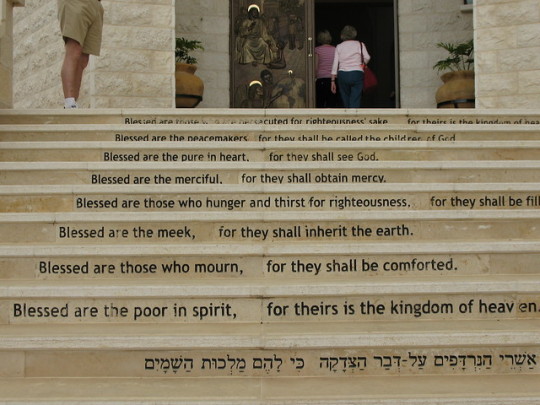
“Requirements” based on Micah 6:1-8 and Matthew 5:1-12

  • February 2, 2020February 11, 2020
  • by Sara Baron

By
my records, this is the 4th time I’ve preached on the
Beatitudes here, and the 7th time overall.  To be honest,
this makes things a little bit challenging.  To be a responsible
preacher, I think I have to go over the basics each time, but to be
an INTERESTING preacher I need to offer you something new.  The
Beatitudes, however, have been around for a while and they aren’t …
well…new.

In
fact, they’re so not new to those of us with lifetime exposures to
Christianity, that I’m not sure we can hear them anymore.  Bruce
Malina and Richard Rohrbough wrote the “Social-Science Commentary
on the Synoptic Gospels” which is one of the most useful books I’ve
ever met.  They put the Gospels into a social context, and use it to
explain how things would have made sense in the stories and to those
first hearing the stories.

Their
commentary on the Beatitudes is particularly helpful, as they
DISAGREE with the general consensus that “blessed” can be
translated as “fortunate” or “lucky” or “happy.”  Those
are all good translations of the Latin version of the text,
but they miss the social context of Jesus’s day.  Instead, they point
out:

The language used here, i.e. ‘blessed’ is
honorific language. … Contrary to the dominant social values, these
‘blessed are…’ statements ascribe honor to those unable to defend
their positions or those who refuse to take advantage of or trespass
on the position of another.  They are not those normally honored by
the culture.  Obviously, then, the honor granted comes from God, not
from the usual social sources.1

The
honor bit of this isn’t simply honor like we understand it today.
One of the primary points of the book is that honor and shame were
understood as a zero-sum reality in the Mediterranean region at that
time.  One was born into a certain amount of honor or shame and the
only way one gained honor was by gaining it FROM someone else and
that person then experienced an increase in shame.  Honor was the
FUNDMENTAL value in society, and it was a “limited good.”  In
fact, the “poor” and the “rich” in the New Testament are not
actually economic terms to begin with.  Rather, to be “poor” was
to be a person living with less honor than one was born to, and to be
“rich” was to have gained honor from others.  Malina and
Rorhrbough put it this way, “The ancient Mediterranean attitude was
that every rich person is either unjust or the hair of an unjust
person,” one who had stolen from others what they had.2
They conclude that,”The terms ‘rich’ and ‘poor’ therefore, are
better translated ‘greedy,’ and socially unfortunate.’”3
(This isn’t to say poverty wasn’t an issue, it was just such a
UNIVERSAL issue that it wasn’t actually the focus.)

This
understanding of honor, and the connection of honor to “blessed
are…”, is the key to understanding the Beatitudes in their
original context.  The challenge is that sometimes the text has been
used to mean the opposite of it’s intention.  When “Blessed are…”
is translated “lucky” it can SEEM like the beatitudes are saying:
“Lucky are the ones who struggle, don’t worry about them, they’re
better off than you think.”  Thus the social order of the day,
whatever day it may be, is upheld and people’s suffering is
justified.

That
sounds sort of like what a STANDARD set of honor and shame statements
would have been – the ones describing society as it was in Jesus’s
day:

Honorable
are those born into good families.

Honorable
are those who are spoken well of in the town square.

Honorable
are those who own large estates.

Honorable
are the elected officials who make the rules.

Honorable
are those who have many servants.

Honorable
are those who have the status to control others.

Honorable
are those who have the ear of power.

Honorable
are those who can enforce their will with violence.

Honorable
are those who speak, and others have to listen.

That
is, honor belongs to and is used by those are are already powerful,
important, and wealthy.  So, shame belongs to the powerless, the
unimportant, the poor, and those who lose status.  This clarifies
just how different the statements in Matthew’s gospel really are.
Because those that society shames, God does not.

Given
the information we have, the Beatitudes might be heard as:

Honorable to God are those who have lost the
honor of society, while they do not own the kingdoms of earth, they
are part of the kindom of heaven.

Honorable to God are those who are mourn, while
they have lost that which matters, loss is not the final word.

Honorable to God are those who refuse to harm
others, while they may lose out on power and wealth, they will end up
with everything that truly matters.

Honorable to God are those who hunger and thirst
for fairness, righteousness, and justice – it is coming.

Honorable to God are the merciful – those who
do not demand what they have a right to and shame others – they
will also receive mercy when they need it.

Honorable to God are those who are pure in
heart, the kind, for when they look in the world, they are able to
see the hand of God at work.

Honorable to God are the peace-able people, the
ones who reject violence and seek win-win situations, they are like
God.

Honorable to God are the ones who are shamed by
society for making the right choices, they also are a part of the
kindom of heaven.

Jesus
is describing an ENTIRELY ALTERNATE values system, one that ignores
the things that society cared about and instead focuses about caring
for each other, building each other up, not being willing to do harm,
and inverting the assumptions about how honor and shame work.

The
work of Jesus in this Matthew passage tracks well with the questions
posed in Micah.  In this passage God reminds the people what God has
done for them, and they respond with a wish to show appropriate…
well, honor and difference to God.  This leads to the question, “With
what shall I come before the LORD?” and the initial thoughts are
the sorts of gifts one might bring a king to indicate that one
understands oneself to be a vassal – that the approval of the king
is important to your own continued life.    But the answer is that
God does NOT work like that.  God isn’t looking for bribes, like the
kings of the world.  God is looking for something else entirely.

You
may well know this answer: to do justice, and to love kindness, and
to walk humbly with your God.  Sounds a bit like the Beatitudes,
doesn’t it?

I
asked a question last week about how we as Christians are supposed to
be in relationship with the world.  I think, perhaps, this is a large
part of the answer.  We are to exist within an alternative value
system, one that sees the world with different eyes.  We are to see
the values of justice, and of kindness, of humility, of peacefulness,
of humility, of mercy  – and let those values guide our lives.  How
we relate to the world at large is not in rejection or complicity –
it is with seeing it with different eyes.  

In
the video for the Living the Questions study last week Rev. Winnie
Varghese suggests that as Christians we should be dreaming dreams so
big that the world thinks we are CRAZY, and the dreams are
impossible. The reason, she says, is because God dreams of a truly
just society, and we’re supposed to be dreamers with God.  I think
that both Micah and the Beatitudes point us in the direction of God’s
dreams – of value systems that value compassion, collaboration, and
kindness.  May we dream right alongside of God, and act accordingly.
Amen

1Bruce
J. Malina and Richard L. Rorhrbough Social-Science Commentary on the
Synoptic Gospels (Minneapolis: Fortress Press, 2003) “Textual
Notes: Matthew 5:1-12” p. 41.

2Malina,
400.

3Malina,
401.

Rev. Sara E. Baron
First United Methodist Church of Schenectady
603 State St. Schenectady, NY 12305
Pronouns: she/her/hers
http://fumcschenectady.org/

02-02-2020

Sermons

“The Call of Baptism” based on Isaiah 42:1-9 and…

  • January 12, 2020February 11, 2020
  • by Sara Baron

Last
weekend, Congregation Gates of Heaven hosted a service of unity for
the Capital Region after acts of anti-Semitism in New York made it
clear that a response was needed.  The event was jointly sponsored by
the Jewish Federation of Northeastern New York, the Capital Region
Board of Rabbis, and Schenectady Clergy Against Hate.  By best
estimates over 800 people showed up!

(Interfaith Chapel at the University of Rochester)

The
event was particularly moving, even as the need for it was
distressing.  Schenectady Clergy Against Hate are well practiced in
pulling together community witnesses after attacks on faith
communities.  In our country today, that’s a good skill to have.
That said, I deeply wish we didn’t have the first idea how to respond
to violent attacks in faith communities.  I wish we’d never had a
violent attack to respond to.

Yet,
we have.  

And
while the acts of violence have often been perpetuated by individuals
acting as lone wolves, there is a disturbing connection between them.
Within a society, violence and the threat of violence act as means
of control, particularly of disempowered groups.  

I
would love to believe that in this forward thinking year 2020 we have
reached new heights of open-mindedness and equity, but evidence
proves me wrong.  Violence against people of minority faith
traditions, against people of color, and against women and non-men
continues, and indeed in some areas are expanding.  I believe this
violence functions as a way to maintain control over each of those
groups.  That isn’t to say that is a coordinated effort, but rather
the way that power works in our society impacts who gets attacked and
what impact is felt.  As each “lone wolf” acts, they function to
perpetuate the system of control.

And,
I believe this is against the will of God.

I
hope is is painfully obvious to say this:

God’s love is for Christians,
Jews, Muslims, Buddhists, Hindus, Sihks, Pagans, Druids, Agnostics,
Atheists, and members of other faith traditions.  God’s love is not
determined by a person’s faith tradition nor faithfulness, and to
claim otherwise makes God very small and mean indeed.

Similarly, God’s love knows no
national boundaries, language barriers, or income requirements, nor
is it impacted conviction histories.  That just isn’t how God works.

And, consistently, God’s love is
for females, males, people who are intersex, and people who are
non-binary all the same.  

None
of this is news.  We KNOW this.  And yet, perhaps we have not been as
vocal as we need to be about sharing this.  It is painfully obvious
that the world around us does NOT know this.  There are a multitude
of forces around us that define who has value and who doesn’t, and
therefore imply that some people matter more than others – and GOD
DOES NOT AGREE.  

The
Intersectional Justice Book Club discussion yesterday was on Michelle
Alexander’s The New Jim Crow,
in which Alexander names the ways that the War on Drugs has created a
racial underclass by imprisoning mostly men of color and then
enabling discrimination of those with convictions.  She points out
that drug use and drug sales occur across racial groups equally, with
a little bit more happening among white people, and yet 90% of
convictions are of people of color (with the vast majority of those
people being of African American descent.)

She
names, quite directly, that if we cared equally about people of
color, we would not permit such a system in our society.

And
yet we do.  

At
the service last weekend, the speakers gave us work to do.  Their
messages included that we have to:  

Advocate
for religious freedom for each other.

Speak
respectfully and affirmatively of other faith traditions AT ALL TIMES

(For me, this works mostly as:
call out the problems in my own tradition before looking for others,
and I haven’t finished on my own tradition yet. 😉  )

Call
out anyone who doesn’t speak respectfully of a faith tradition

Repent
of the times we have contributed to messages of hate

Remember
the contributions of people of other faith traditions

Seek
legislation that makes attacks on faith groups hate crimes

Have
hope

Become
more loving

Rabbi
Rafi Spitzer, of Congregation Agudat Achim in Niskayuna, specifically
reminded us to attend to the things of the Spirit, as a means of
becoming more loving and more peaceful.  That’s the particular
role of those of us who are part of faith traditions: to become more
loving and more peaceful as part of contributing to the world become
more loving and peaceful.  (May it be so.)

This
got me thinking about how well we are doing at developing the things
of the Spirit.  There are lots of ways that things are going well –
we have many ways for people to meaningfully contribute to building
the kindom, we have space for people to be loved as they are, there
is beauty that feeds us, there is space for questions and for being.

I
think there are also ways we could be making more space for the
things of the Spirit.  The most historic Wesleyan question of all is
“How is it with your soul?”  Let me tell you, this is NOT an easy
question to answer, and it is not a question you can ask others if
you are unprepared to hear the real answers.  That said, it is a
great question.  “How is it with your soul?” invites us to think
deeply about the answer, and share it with someone else.  It brings
our faith journeying into contact with each other.  A course I taught
once invited participants to answer the question with weather
metaphors, which turned out to be amazing (“it is cloudy, with a
distinct change of tornadoes”, “it is bright and beautiful, but
bitterly cold,” “the fog is very, very thick”) but I think that
there is even more value in having to answer the question directly.
So, one tiny little thing we could do: we could ask each other “how
is it with your soul?”  

Perhaps
you might even be willing to ask someone this during the time of
passing the peace?  And, dear ones, if you don’t want to answer,
perhaps a weather metaphor might share the gist without being too
vulnerable?

On
a similar note, I don’t think we check with each other enough about
our spiritual practices.  During Lent two years ago we did a study of
a Richard Rohr book, and thus had a regular shared practice of
centering prayer.  It was amazing.  For many of the participants it
was the most regular prayer practice they had, and it was a wonderful
addition to their lives.  (I believe centering prayer is easier in a
group.)  My suspicion is that many of us in this community do not
have regular prayer practices.  Some of this may be due to not ever
having found a prayer practice that works, some of this may be due to
not being the sorts of people who want REGULAR practices, some of
this may be due to allowing other things to take precedence.  I will
admit to you that while I had INCREDIBLE prayer times during my
renewal leave, I allowed them to become lax again this fall and have
been struggling to pick them up again.  I adore prayer, but it is
very (VERY) easy to allow myself to get distracted with … well,
anything and everything else.

Yet,
I know that my own development as a person, and a person of faith,
and into being more loving and more peaceful is directly correlated
to the time I spend in prayer.  My prayer practices tend to be the
quiet and reflective sort, and thus the kind that let me see myself
clearly and make decisions at the right pace for me.  Without them,
I’m pretty anchorless.

So
that’s the second thing I can think of – we could be more
intentional about checking in with each other about prayer and/or
meditative practices – including sharing what works for us,
admitting what isn’t working for us, and being willing to talk about
what impedes us from practicing.  My personal experience says that
when I’m avoiding prayer, I’m mostly afraid of that some judgement
I’m making on myself is shared by God.  Thus far, it never has been.

Of
course, prayer practices are a WIDE range of things that can include
walking, or dancing, or bike riding, as well as sitting quietly,
writing, or coloring, and for many they even include conversation.
We as a church talk about and develop our prayer and meditative
skills more – I think it would benefit us and the world.  

For
the first time this year, when I read Isaiah 42, I didn’t get worried
about the servant like I always have before.  Instead, I heard it as
being all about the nature of God.  The passage tells us about God
who has joy in people, who wants justice for all the nations, who
doesn’t move us towards justice with violence, who is patient and
consistent and trustworthy.  This God, the very one who made all of
creation, is with us and working towards good with us.  What has been
and has been hurt and broken is NOT all that can be, there is new
goodness that can and will come with God.  Healing and hope are
possible.  

These,
you see, are things of the Spirit.  They are things of seeing clearly
what is, and yet seeing what can be.  And those things of the Spirit
are what our baptisms are all about.  Baptism welcomes us into the
community of the Spirit, so that we can work together towards love
and peace for all.  And baptism teaches each one of us that we are
beloved by God,  which means we don’t need to prove ourselves worthy
of love, and means that we have love in abundance to share.  

Dear
ones, there is a lot broken in the world, but God isn’t done with us
yet.  And as we share with each other and seek out the Divine, we
make it possible to bring more goodness into the world.  May we do
it!  Amen

Rev. Sara E. Baron
First United Methodist Church of Schenectady
603 State St. Schenectady, NY 12305
Pronouns: she/her/hers
http://fumcschenectady.org/

https://www.facebook.com/FUMCSchenectady

January 12, 2020

Sermons

“Hope for Restoration” based on Isaiah 35:1-10 and Luke…

  • December 15, 2019February 11, 2020
  • by Sara Baron

I did my seminary work in
Southern California (Los Angeles county) which is a desert climate.
The choice to be far away in a different subculture of the USA was
intentional, as I figured I could use some perspective on the
Northeast.  The desert climate part wasn’t intentional.  I just liked
the school, so I decided to go there, and it happened to be in the
desert.  I had no expectation, whatsoever, that this would be
relevant.

So, clearly, it was.  The first
piece of learning came from the campus itself, which was planted with
biblical plants so we as the students could have a better sense of
what the Bible was talking about.  Because I’d grown up in the water
abundant Northeast, I hadn’t really considered the ways that my
visioning of the Bible was insufficiently desert like.  

Then came the fact that I don’t
LIKE the desert.  I hated that the sides of the road were filled with
pebbles with nothing growing in them, because without watering,
things just didn’t grow.  I hated being dehydrated, and the amount of
water I had to drink to be hydrated.  I didn’t like the heat.  I came
to resent Palm Trees for being there when trees I knew and loved
couldn’t be.  (Can you tell LA wasn’t a natural fit for me?)  

Somewhere along the line as we
learned about Christian history it became clear how much of early
Christianity was formed by the words and actions of solitary desert
thinkers, and later monastic desert communities.  The so-called
“Desert Fathers” were new to me, but heavens they were important.
My classmates who were native to the area waxed poetically about the
beauty of the desert, and its starkness, and the rich spiritual
depths of being alone in such a stark environment that was so
unfriendly to life.  I understood part of what they meant, I love the
great outdoors, and I have felt closest to God in nature.  Except, I
don’t actually LIKE stark and dangerous landscapes.  They are
DEFINITELY beautiful.  For me they are startling in good ways too,
but not really in God-connection ways.  My soul isn’t a desert soul,
although I recognize that desert is as good of a climate as any
other.  (This is all about my preferences, not about what is good.)

But then, in the winter of my
second year, a friend read that the recent rains we’d had were
sufficient to make the desert bloom.  The desert blooms erratically,
it isn’t an every year sort of thing.  More than that, this was the
100- year bloom, and plants believed to be extinct were in full bloom
under the unusual conditions.  We drove out to Joshua Tree National
Park to see it, and it was breathtaking.  From afar, the landscape
actually still seemed stark – it wasn’t as if the plants were more
abundant than they’d been before.  But as you looked, flowers were
EVERYWHERE.  The flowers were more diverse and more delicate than I’d
ever seen before.  We saw a burning bush in bloom – you can
definitely tell why it is called that.  Out of what seemed to be bare
rock came tiny flowers.  Rock faces exploded with color.  

There was nothing in my life
that had prepared me for the desert bloom.  Even now, it stuns me,
the transformation of it all.  That hidden in the starkness was
beauty beyond my imagination.  The flowers were bright, and
different, but sooooo fragile.  It was often hard to believe they
existed.  It blew my mind to see yards of dusty pebbles in every
direction, the floor the desert, and then to notice a tiny little
flower breaking through all on its own.  

To say it directly, I have seen
nothing that proclaims resurrection more than the desert in bloom,
and I think it is radically unfair that this desert hating
North-easterner got to to savor the 100-year desert bloom, and see
life emerge from what looked like lifelessness.  But I’m thankful
anyway.  

Isaiah starts this profound
passage with imagery of the desert in bloom.  I shared all that,
because I don’t think that we who know spring flowers, and summer
flowers, and even fall flowers can hear how BIG the vision of the
desert in bloom is for desert people, nor how much of a miracle it
is.  The clear joy of this passage fits incredibly well with the
desert in bloom.  It is abundant, it is colorful, it is unexpected,
it is hope-filled, it is transformative.

Isaiah is talking about the joy
of homecoming in this passage.  The assumption is that the people
will be taken into exile (true, they will) but that someday God will
act and let them come home (also true).  This vision of homecoming is
bursting with joy.  The act of coming home after the exile is called
“restoration” or “the return” and this restoration passage
bubbles with joy in God.

It starts with the imagery of
the desert in bloom, and then it EXPANDS into human healing.
Physical limitations are lifted, healing occurs, strength is given
where there has been weakness.  Then it takes the desert metaphor
even further.  Streams of water will flow, pools of water will
emerge, springs will break out.  I think my favorite line is the one
that says, “the haunts of jackals will become swamps.”  Now THAT
is a transformation.  

In the midst of this beautiful,
blooming, and now lush landscape, with healing for all in need of it,
there will emerge…. a way home.  And the way will be safe from all
attackers, and easy to follow – impossible to get lost on.  On that
path, the people will travel home, and life will be restored to what
it shall be.

And, of course, there will be
joy and singing, and so much of it that sorrow itself will fall away.

What.  A.  Vision.  

It seems hard to believe Isaiah
could start with the desert in bloom and then grow imagery from
there, but he does it.  Exile and return/restoration is one of the
big themes of the Bible, likely because while the story happens once
to the Israelite people, it happens time and time again to us in our
lives.  

When I was 13 I broke my femur
and was put in a straight leg cast.  For months I was unable to
navigate stairs on my feet (well, my foot) at all, I had to sit on
the steps and move up or down them one at a time.  During that time I
restlessly dreamed of the day when I would be restored to walking up
and down stairs on my feet again.  And then, of course, once I was,
it mostly lost its luster.  For better or worse I’ve had plenty of
injuries in my life though, and my capacity to do stairs has
dissipated and then returned rather a lot.  Perhaps because of the
depth of the yearning in my younger years, sometimes while I’m on a
set of stairs, I remember to be grateful for the capacity to use
them.  

I think exile and restoration
have a lot of emotional resonance too, because in large part they are
about “home.”  And home is a big huge deal to humans.  What does
home feel like?  What does it mean to leave home?  How does it feel
to be between homes?  Or homeless?  Or someone with a foot in more
than one home but no one place to call home exclusively?  When we are
sick, or injured, we yearn for home.  When we think of displaced
people in the world, we recognize the pain of being far from home and
without a new place to try to make home.  And, as North Americans, we
come from people who have left homes.  Those whose ancestors came
from Europe or Asia often left home voluntarily.  Those who ancestors
came from Africa were enslaved and torn from their homes.  Those who
ancestors were native to the Americas were displaced by the Europeans
who came here.  I sometimes wonder if some of the displacement in our
society comes from our shared histories of being displaced in the
world.  In any case, “home” is something that matters to humans,
and exile and restoration are all about home.

Now, the imagery of Isaiah is
assumed when we come to Luke.  Isaiah’s vision of restoration and
return home are premised on God’s actions, and so are Luke’s.  John
the Baptist is going to be seen as the forerunner of Jesus, the one
who starts the path in the desert so Jesus can complete it – and we
walk it.  The language of Zechariah’s song is that of redemption,
salvation, mercy, and rescue.  ALL of those emerge out of the desire
for restoration and return.  They are the yearning not just for home,
but for a safe home, and Zechariah names that “fearlessness” is
an impact of God’s work in those days.  As John, whose name means
“God is Gracious” will prepare the way, and Jesus will walk it,
the result will be peace, fearlessness, and light.  Redemption,
salvation, rescue all resonate with people being safely HOME.

It is the tradition of
Christianity to follow Christ, since Christians means “little
Christs.”  I’m all for this, but sometimes I think it is worth
considering when we are being asked to be “little John the
Baptists.”  Often, I think our work is the prepare the way, and to
be prophets of what is possible with God.  Perhaps this is just the
longview of building the kindom, acknowledging that some work gets to
make the BIG changes, but before that happens, there have been years
or decades or centuries of preparing the way for that to happen.

In our Advent Study on John
Shelby Spong’s “Unbelievable” last week we discussed his idea
that morality is always contextual, and thus always in flux.  So, we
talked about how public morality has changed in our lifetimes, and
you know what?  It has been GREAT!!!  Space has been made for people
to be who they are and to be accepted and loved as they are in ways
that once seemed impossible.  LGBTQIA+ rights have expanded, and
rights and opportunists for people with disabilities have been
normalized, people who are divorced as no longer stigmatized, nor are
those who have sex outside of marriage.  Women’s work opportunities
have exploded.  All of us in the room had grown in our awareness of
racism and privilege, and had hope for the country to change its
practices.  The changes were truly inspiring.  Also, work on all of
that inclusion and all of those rights was being done well before any
of us were born.  Many, many people have prepared the way and we are
able to see their work with gratitude.

The work we do to prepare the
way is the work that we may never see the impact of.  But, we trust
that God will make sure the next steps happen, and God’s people will
follow through, and the preparation will not be in vein.

So, dear ones, prepare the way.
Work on building that safe and beautiful highway home for ALL of
God’s people. Because, someday, it will be complete and the people
who walk it will be singing songs of joy and gratitude for what God
has made possible.  And that which God makes possible, God lets us
work on!!  Thanks be to God for that, and for beautiful homecomings
of many varieties.  Amen

–

Rev. Sara E. Baron

First United Methodist Church of Schenectady

603 State St. Schenectady, NY 12305

Pronouns: she/her/hers

http://fumcschenectady.org/


https://www.facebook.com/FUMCSchenectady

December 15, 2019

Sermons

“Hope for New Life” based on Isaiah 11:1-10 and…

  • December 8, 2019February 11, 2020
  • by Sara Baron

It
is common to call the writer of the Gospel of Luke… Luke, which
makes plenty of sense. It isn’t likely to be historically accurate,
but it is pretty simple to remember. Whatever the writer’s real name
was, the person who wrote the Gospel of Luke and its 2nd
volume
the book of Acts, is said to be the best writer in the New Testament.
From my perspective I can tell that Luke does great work with
foreshadowing, telling stories within stories to enrich both stories,
symbolism, and themes. However, the really good stuff, I’m told is in
his Greek vocabulary and syntax which are simply just outstanding.
“Luke” was a VERY well educated person, and a master of the craft
of writing. Given how small the percentage of literate people were at
that time, being so well versed as a writer indicates not only
brilliance and skill but also power and privilege. One simply would
not become that great of a writer without a lot of access to unusual
levels of resources.

Luke
is probably my favorite Gospel writer, and I love Luke for his
emphasis on people who are poor,  marginalized, and vulnerable, and
because they fit those categories, the women. Luke tells the story of
my faith, presenting Jesus as an ally to those most in need of
rescue, and as an organizer able to help people rescue themselves.
This has a bit of cognitive dissonance to it. Based on WHAT he
writes, Luke is a writer of the people. He is empowering, noticing
those society disregards, and telling the stories that the powerful
don’t want told. Yet, based on HOW he writes, Luke is one of
society’s elites.

Which
sounds to me like Luke being a living example of the power of Jesus –
to convince people to work together to build the kindom no matter
where they begin life, to be FOR ALL the people as they grow.

Isaiah
was a prophet, and from what I can tell, a prophet is a speaker for
the people. The Torah set up a society that treated people justly,
and prevented an upper class from ruling over a lower class. Yet,
people being people, power, money, and influence tended to coalesce
at a top and become a burden to the many. God’s prophets spoke out
against it, and called people back to God’s vision of a just, equal,
and equitable lifestyle.

Which
is a long-winded way of saying that we have two passages today that
are “of the people” and yearning for justice. They do so in ways
that can be a little bit uncomfortable. There are not simply passages
that suggest “a rising tide lifts all boats” but rather ones that
talk about REDISTRIBUTION of wealth1.
These are passages that are good news for the poor, the lowly, and
the meek … but not for the rich, the proud, and the powerful. I
find the “rising tide lifts all boats” sort of justice easier to
swallow. This stuff is … harder.

And
yet, my activist friends assure me that we aren’t going to get to
justice only by being nice. So, let’s examine these texts for wisdom.
This shoot that come from Jesse in Isaiah, have you noticed that it
comes AFTER the tree has been cut down. This is a sign of hope after
destruction and hopelessness. The passage as a whole feels like a
cousin of last week’s passage. In this case, the new offspring of
Jesse (which is to say the new Davidic king) is going to be so
perfectly imbued with the Spirit of God that the new King will rule
as perfectly as God’s own self would.

The
impact of life as ruled as God would have it ruled is shockingly
different. When God’s spirit is in leadership, and when the people
are following in God’s ways, there will be peace even among animals
who are in each other’s food chains 😉 Safety becomes the center
point of this – the lamb, the kid-goat, the calf, and the human
child are all safe in the presence of those most apt to harm them.
This is another way of talking about not needing to be afraid,
because there is no motivation to do harm. In this case, it is clear
that there are no people oppressing other people, no one is “eating
up” the resources of the weaker people to make themselves stronger.
Security, hope, and peace are the result of God’s Spirit. That’s the
kindom.

Mary’s
song hits the same notes. Mary is continuing to process that she, who
is lowly by the standards of the world, is now “blessed.” She
attributes this change to God, and notices that this is how God
works. She says it is God’s nature to do great things, to show mercy,
to be strong…. to bring justice. And she names how justice comes.
It is by scattering the proud and bringing down the powerful –
while lifting up the lowly. It is by feeding the hungry but NOT
giving more to those who already have too much. Mary’s song is,
itself, strong and justice seeking. She identifies with the lowly,
who God lifts up. And it is even more interesting to hear that
knowing that the writer of the Gospel probably identifies with the
rich, and wrote her song this way anyway.

While
we know absolutely nothing about Jesus’s mother with any certainty,
we do know Jesus had a mother.  The name Mary was associated with her
a few generations after his death, which isn’t a great reason to
assume it is true, but sort of like “Luke” we can go with it. I
suspect Mary got associated with the name of the mother of Jesus
because Mary is the Greek version of the Hebrew name Miriam. Miriam,
the sister of Moses, has the oldest words in the Bible attributed to
her, and saved her brother so he could save the nation Israel.
Associating Mary with Miriam is A-Ok with me.

Other
conjectures we can make about Mary include: she was Jewish, she was
from Galilee – most likely Nazareth, she was poor, and it is likely
she was young. She may have been a very faithful Jew, as Judean
settlers were intentionally reclaiming Galilee for Judaism around
that time, and the ones who went were often the ones who were
committed to the cause. She also might have been influenced by either
the Roman Empire’s violent destruction of the nearby city of
Sepphoras in her childhood or by the radical Jewish teachers in the
Galilee who taught that the God of liberation was going to liberate
again. In any case, while the leaders of the Temple during her
lifetime were appointed by Rome and the “official” religion had
been compromised, it is possible (probable?) that Mary knew a faith
that was untainted by the influence of power.

Which
is to say, that while Luke wrote the words we hear today, and put
them into Mary’s mouth for our story – they MAY well reflect her
faith itself. At the very least, Mary’s song words as an incredible
foreshadowing of the power of God that people saw in Jesus, and I
believe Jesus’s faith was likely formed by his mother’s.

In
Mark, Jesus is referred to as Mary’s son which is unusual in that he
was not referred to as his FATHER’S son. With the presence of a
punishing military force nearby, before Jesus’s birth, there are some
particularly awful possibilities about his father. What we know is
that at some point Mary was pregnant, expecting a child, and likely
pretty scared. I say that because maternal mortality rates were high,
infant mortality rates were high, and resources in Nazareth were
scarce. It is very likely that Mary herself was hungry, including
during her pregnancy and while she was breastfeeding Jesus. She had
seen extreme violence from the Empire, and had reason to believe it
could come back at any time. She MAY have been facing the possibility
of being ostracized from her community. Thus, I think it is fair to
assume she was scared.

Even
stripping away most of that, scared seems right. For years, Kevin and
I have struggled with some big questions: is it OK for us to choose
to bring a child into this world knowing the dangers of Global
Climate Change? Is it ok for us to choose to bring a child into this
world when there are other children who need to be parented? How much
capacity do we have to offer care and support for a child given our
other commitments?

After
long talks, prayer, and good counsel, we decided that our ideal
family would include a child born to us and a child adopted by us. So
we started trying to have a child and…. well, nothing happened.
Eventually we made an appointment with an adoption lawyer, and
decided to try private infant adoption. We filled out paperwork, got
background checked, had a home study, and were ready to sign a court
petition requesting that we be approved to be able to become adoptive
parents when we learned that I was, in biblical phrasing, “with
child.”

Now,
I live in the 21st
century,
with pretty great access to resources. While our country is weaker
than it should be, particularly in the care of women of color,
compared with ancient Galilee we have low maternal mortality rates,
low infant mortality rates, plenty of food, and low threat of
violence. Yet as an expectant mother, I’m scared. While I find it
excessive to overly identify with “Mother Mary,” preparing to
parent has certainly helped me see why she’s so popular. Also, why
she has every right to be scared. We have been wondering how on earth
will we prepare a child to be kind, compassionate, and moral in this
crazy world? How will we teach them of God in ways that feel relevant
while the world shifts under our feet?

Let
me assure you that we did NOT sign that paperwork and adoption is
officially on hold. Let me also admit to you that being the pregnant
pastor of this church for the past two months hasn’t been the easiest
thing I’ve ever done. I haven’t been puking (WIN) but I have been
constantly nauseated, and instructed to eat every hour. I’ve been
exhausted and my emotional resources have been down. At the same
time, I have experienced significant collateral friendly fire as this
church has worked together on the reality of our budget deficit.

Between
the friendly fire and being less resilient than usual, I have spent
time considering if pastoring this church – or even being a pastor at
all – continues to be the right path for me. Some of this is simply
about parenting: I’m nervous about being away from home 4 nights a
week like I usually am now. Some of this is about ministry’s
demands: what will it mean to have to establish the sort of
boundaries my child will need, and what will I do when the needs of
the church are in conflict, and what will happen when someone feels
that their expectations aren’t being met? Some of it is about our
child and this church. On one hand I can’t imagine any church but
this one being part of raising our child. I love the way children are
cared for during worship. I love our Sunday School and its teachers.
I love the way children are treated here, and I love the ways God is
understood and taught here. However, on the other hand, my stress
level has been sky high, and recently I’ve seen a lot of behavior I
wouldn’t want a child to learn about much less associate with this
church. So I’ve been wondering, is this a safe and secure place for a
child – our child – to learn about God? Will this place fulfill
Isaiah’s vision of a child being able to put their hand in a snake’s
den safely?

In
slow, careful deliberation, with conversation, and consultation, and
prayer, and a LOT of obsessing and worrying, I’ve decided not to give
up on ministry just yet. Then, even more slowly, I realized that –
for now – this church is worth the pain. I simply love you all.
Furthermore, I don’t believe that this church IS its worst behaviors.
Dear ones, I believe that this faith community is an expression of
the kindom of God. I believe it is a little bit of Isaiah’s vision,
and has the capacity to build the world into one of peace and
justice. I’m well aware that we have lots of hard times ahead (and I
am terrified
of
the boundaries I’m going to have to have as a parent, please be
gentle with me) but I believe you are worth it.

So,
anyway, I see why a prospective parent would be scared. And I am
gaining a new appreciation for the ways in which a new generation
provides new opportunities: 1) for regeneration, 2) for making right
the things we haven’t gotten right yet, and 3) hope for the future.
We are hoping to raise a child to know God’s love, follow Jesus, and
speak with and for the people.  And I find myself reflecting on how I
hope this community will continue to exist and teach and raise up
future generations to do the same. Given all this, I see why a
prospective parent would choose to stick with the God of Liberation,
of Hope, and of Peace.  And I see why Mary was amazed at her luck in
getting the chance to do so.  Being a part of the work of God is a
blessing and a great opportunity.   Thanks be to God. Amen

1 Someone
pointed out after worship that a rising tide may lift all boats, but
it doesn’t help people who don’t have boats.

Sermons

“The Stories We Have to Tell (and tell, and…

  • November 10, 2019February 11, 2020
  • by Sara Baron

Several
years ago I had the honor of celebrating the life of a woman who had
spent her life as a nurse.  She was fiercely independent, had never
married, was wonderfully fashionable, and LOVED being a nurse.  At
the end of her life, she had dementia, and it took almost everything
from her – knowledge of her loved ones, words, mobility, and the
rest.  All that was left of HER at the end of her life was one simple
motion.  It was the careful, life-saving motion of surgical
preparation – washing her hands.  After she’d lost even her own name,
she kept on washing her hands.

I
often wonder what that piece of me would be – the one last
lingering aspect of myself that would go last.  Truthfully, I’ve
never figured it out, but it feels like an important question.
Similarly, when I am spending time with a person earlier stages of
dementia, I pay attention to what stories come up time and time
again.  My theory is that those stories are core identity stories,
they are key to how the person understands themselves.  As such, I
try to notice what stories I’m telling repeatedly (hopefully to
different people), and figure out why those are the stories I’m
telling.

Not
to give away all my secrets all at once, but I also pay attention to
the phenomenon of repeated stories in groups – because I think
stories that more than one person tells are likely stories that
matter.  Also, I find the nuances and differences extra interesting.

The
stories that we repeat are the stories that are important to us.  I
suspect there are at least two aspects to why we repeat them:  first
because they are part of how we make sense of the world and secondly
because we’re still trying to make sense of the stories.  Telling our
stories, and having others respond to to them, helps us figure them
out.  

A
few years ago I came across a distinction between two types of
stories we tell.  Most of us, most of the time, tell what this theory
calls “ego stories.”  Ego stories make us look good, focus on
life’s high spots, portray us as having control in our own lives, are
well practiced and linear, well told, and sometimes well spun.  These
are the stories of interviews, of parties with people we don’t know,
of invulnerability and image crafting.

The
other option, according to this theory, is “soul stories.”  Soul
stories are the stories underneath ego stories, ones that tell about
both shadow and light, suffering as well as gladness.  They have a
lot of twists and turns, including telling about when our plans were
undone by life.  Telling soul stories allows us to integrate the
fragments with the whole, in part because they are unafraid of
change, fear, loss, failure, shame, mystery, passion, or ecstasy.
They are often told in poetry, music, or art.  They are the stories
we hold onto in the hardest of times, and the ones most important for
our loved ones to know.  Soul stories are likely to be the ones we
are revisiting at 3 AM, or when we have dementia, or when we die.1

The
truth is that in most settings, soul stories are hard to tell.  They
make us vulnerable, and they tell about things we are afraid of or
ashamed of.  Yet, when we don’t tell them, they get told through
us without our awareness.

All
of this thinking about stories started for me with the language of
Job and the desire in that passage to immortalize Job’s story.  For a
little context, we are hearing Job himself speak in this passage and,
“Since Job has parodied and rejected the language of prayer (vv
21-22) and realized that his outcry brings no response or justice (v.
7) there appears to be no way for him to bring his words before
God.”2
In part, Job worries about how his story will live past his death.
That’s what this is about – preserving his words as a testimony to
the injustice of his life.  “It appears that Job describes three
materials on which his words might be recorded – scroll, lead
tablet, engraved rock – each more enduring than the last.”3

The
phrase translated “For I know my Redeemer lives” refers to a
“kinsman redeemer”, that is “It designates the nearest male
relative, who was responsible for protecting a person’s interest when
that individual was unable to do so.  The [kinsman redeemer] would
buy back family property sold in distress, recover what has been
stolen, redeem a kinsman sold into slavery, or avenge a murdered
kinsman blood.  The [kinsman redeemer] is the embodiment of family
solidarity.”4
Now, just to be clear, this means that what Job was actually saying
was “I have a family member who will avenge me, and even after I
die, he will be working for justice on my behalf.”  And, further,
the assumption is that the kinsman redeemer will be working towards
justice for Job against Job’s opponent: God.  Which is to say that
this passage means exactly the opposite of what I thought it did when
I first read it.  It is NOT the same gist as the Psalm from a
different angle.  This is a passage really angry with God.  (The fact
that I missed this means I wasn’t really thinking about this being
the book of Job when I read the passage, definitely a poor choice.)

In
terms of understanding the passage, there is one more important
piece.  The very end is distinct from what comes before it.  The
commentator in the New Interpreter’s Bible suggests it makes the most
sense to read it this way, “’I know that my defender lives, and
that at the  last he will arise upon the earth – after my skin has
been stripped off!  But I would  see God form my flesh, whom I would
see for myself; my eyes would see, and not a stranger.”  That is,
Job returns to his constant refrain in the book:  that he wants to be
heard by God, that he wants justice from God, and that he wants a
REPLY from God.  Even having his kinsman-redeemer fix things after
his death, or having his story be immortalized isn’t enough.  He
wants to take up this issue with God directly.  

In
function, the book of Job is one long soul story, interspersed with
some ego story assurances from Job’s friends.  Even God’s answers
take the form of a soul story.  The yearning that Job has to have his
story heard fits with the description that they are the stories we
want the people we love most to know – and I think in this case
that includes God.

I’ve
always assumed that God knows my stories, in fact thats one of the
assurances of life – that even if I forget my own stories, they are
still alive within the Divine.  But that means I don’t tend to tell
God my stories as often, even though the telling of stories to God is
inherently good.  And, the book of Job is the great reminder in the
Bible that God is big enough to handle our anger, and it is OK to
RAIL against God.  God doesn’t punish us for expressing our anger,
and God knows the injustices we’ve experienced, and yet we are
welcome to keep on telling them to God as long as they need to be
told.  Because God, of course, can handle our vulnerable soul stories
with shadows and light, and doesn’t need or expect things cleaned up
into ego stories.  This is sometimes one of the weaknesses of formal
worship.  When we have hymns, anthems, and prayers in poetic and
formal language it can lead us to thinking that God requires us to be
able to express the inexpressible.  When in fact, God can handle any
communication, including “sighs too deep for words.”

Have
you tried telling God your stories, instead of just going over them
again and again in your head?  Sometimes it can really help.  For me,
it is most helpful when I WRITE to God (longhand!).  I keep a prayer
journal and I find that all the things swirling in my head and
smashing into each other can be extricated one by one, examined, and
a bit of order can sometimes be found among them.  Or, at the very
least, I can find out what things are in conflict within me.  What
seems massive within, when written to God, becomes less heavy and
more manageable.  I also notice, as I write, what themes I go back
to.  Which is helpful because it helps me to have a better idea what
my version of handwashing might be.  

I
thought, before I did my research, that I’d be ending this sermon
talking about the stories we have to tell of God’s goodness.  Our
versions of “I know my redeemer lives” before it became clear
that was NOT God after all.  (Oye).  I do actually think those are
important stories, imperative ones even.  None of us are here without
a good reason.  That’s just not how life works.  But do others in
your church family know the core stories of your personal faith
journey?  Do they know why you trust in God, or what you are
struggling with in trying to trust God, or why you keep showing up at
all?  Are these some of the stories you keep on telling?  (Why or why
not?)  Those might be interesting stories to start telling – even
if they are soul stories and more than a little vulnerable.  So here
is your homework this week.  (Homework!?!)  Tell one member of this
community one of your personal faith stories – why you are
committed to being a part of this Jesus-movement.  Together, these
are the stories we have to tell, and tell, and tell.  Amen

1  Parker
Palmer and Marcy Jackson, “Ego Stories & Soul Stories” ©
2012 found at
https://www.clearpathcounsel.com/files/4313/3029/8683/Ego_Stories__Soul_Stories.pdf

2  Carol
Newsom, “The Book of Job” in The New Interpreter’s Bible
Volume IV
ed. Leander E. Keck et al (Nashville: Abingdon Perss,
1996)  477-8.

3
 Newsom,  478.

4  Newsom,
478.

Posts pagination

1 2 3
  • First United Methodist Church
  • 603 State Street
  • Schenectady, NY 12305
  • phone: 518-374-4403
  • alt: 518-374-4404
  • email: fumcschenectady@yahoo.com
  • facebook: https://www.facebook.com/FUMCSchenectady
  • bluesky: @fumcschenectady.bluesky.social
Theme by Colorlib Powered by WordPress