Skip to content
First United Methodist Church Schenectady
  • Lenten Photo Show
  • About Us
    • Meet the Pastor
    • Committees
    • Contact Us
    • Calendar
    • Our Building
    • The Pipe Organ
    • FAQs
    • Wedding Guidelines
  • Worship
    • Sermons
    • Online Worship
  • Ministries
    • Music Ministries
    • Children’s Ministries
    • Volunteer In Mission
    • Carl Lecture Series
  • Give Back
    • Electronic Giving
  • Events
    • Family Faith Formation
Sermons

“Those Who Walked the Walk” based on  Habakkuk 1:1-4;…
  • November 3, 2019February 11, 2020
  • by Sara Baron

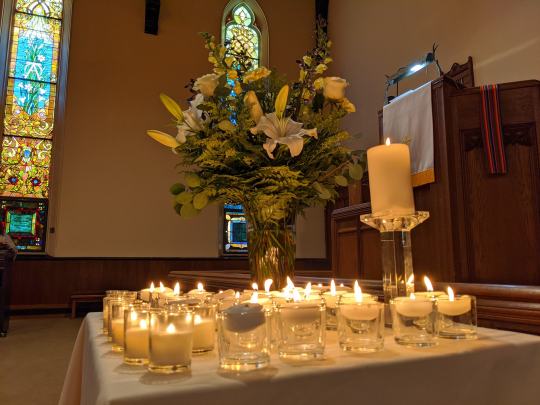
(Thanks to Kevin Kempf for the great picture!)


Have you heard of “thin
places?””  I’ve heard it described as places where the veil
between this world and the next is thinner – or where God’s
presence can be especially felt.  Ideologically, thin places don’t
make any sense to me.  I believe that God is all-present, so God
isn’t any more or less present anywhere.  

And yet… I have experienced
thin places.  I don’t understand them, but I know them.  You may be
needing some examples.  Mountaintops are commonly thin places, which
I suspect has less to do with the altitude and more to do with the
effort to get to them and the views they offer.  Things just feel
different at the top of a mountain, and many people have experienced
them to be thin places.  Sanctuaries are another common choice –
ones in churches or ones at camps.  I have often wondered if places
where many people have prayed are changed in some way by the
pervasiveness of the prayers – and thus made more holy.  (Again,
this doesn’t fit my understanding, but it fits my experience.)
Sometimes, I think, thin places are not places even, they are
moments.  I once had a chance to ask a church about when they’d most
strongly experienced God and a whole lot of them mentioned the births
of their children.  It is also very common (but not universal) for a
death to be a thin place.  

I
also suspect thin places might have a lot more to do with us being
open to the presence of God that is always with us than a change in
the amount of presence, but however it is, I think they ARE.  And,
further, one of those moments that has often been a thin place for me
is All Saints Sunday.  Over the course of my ministry, more years
than not, this has been the holiest worship service I’ve led.

This year, like every year, the
names we are about to read lie heavy on my heart.  Oh friends, the
saints who have gone on ahead of us taught us so much!  We are who we
are because of them!  It is an honor to read their names and remember
their lives, but it is also heavy to live without them.  One of our
traditions, in this church, is to also name the saints whose loss is
still especially heavy on our hearts, even if their departure was
more than a year ago.  The list of those names is also dear – and
beautiful and sad and heavy.

Today conjures in my mind that
simple line “the great cloud of witnesses” from Hebrews 12, which
is an incredibly comforting image.  Life can feel overwhelming at
times, and sometimes I have no idea where to turn, but remembering
that those who taught me, and loved me, and guided me – guide me
still and show us the way – is very powerful.  It is even better to
notice how many of there are!

So, indeed, All Saints Sunday
is, for me, a thin place, and the names we are about to read and the
lives they represent are an honor to remember and name.

Now,
the gospel passage may not seem terribly well connected to all of
that, perhaps because of the terrible Sunday School song that too
many of us learned about Zacchaeus.  (If you don’t know it, I beg
you, stay ignorant.)  The story itself, however, is not as trite as
the song.  There are surprises all over this story, if you pay
attention to them.  One is that a wealthy and powerful man was
particularly interested in Jesus, who aimed his ministry particularly
at people who were living in poverty and disempowered.  The second is
that the wealthy and powerful man was willing to forgo his dignity to
try to see Jesus, which seems to want to remind us just how exciting
Jesus was in real life and how worthy of seeking out he was (is).
Then there is the amazing turn in the story when Jesus decides to
focus his attention on Zaccheaus, this wealthy and powerful man,
which I think absolutely no one expected.  Zaccheaus, however, was
happy and gracious.  Then there is the unsurprising grumbling of the
crowd, who are peeved that Jesus is hanging out with this guy (tax
collectors being about as popular then as border patrol agents are
today).  And then there is the turn around where Zaccheaus, having
had this experience with Jesus, commits to a moral and fair life.
(I’m going to disregard my assumptions that he probably couldn’t
afford to pay back 4 times as much as he’d over taken…. that’s not
the point.)  It seems that being with Jesus was a thin place for
Zaccheaus, where he could access love, hope, and wonder, and be
changed by it.

The beautiful thing about the
Zaccheaus story is that sometimes we are ALL Zaccheaus, and the story
seems to say that’s OK.  Sometimes we have power, and sometimes we
use it wrong, but we’re still TRYING our hardest to know what’s right
and do it, and when we figure what what we’ve done wrong, there is a
chance to change it.

Now,
that’s where this fits in with our Saints today. Because none of the
Saints we celebrate today were actually perfect in their lives.  Not
a single one.  Our memories may get fuzzy around that, but all the
people we are remembering were fallible.  All of them, as well,
sometimes had power and sometimes used it wrong.  That’s human life.
What’s WONDERFUL is when people realize what they’ve done and seek to
change it.  That’s why they are our saints – because of their
willingness to grow, learn, and change.

Friends, this is an interesting
reminder for those of us trying to follow in their footsteps.  And it
is a two-fold reminder:  (1)  we are not expected to be perfect.
Really.  We can’t be, and trying just makes it all worse.  (2) And,
when we discover how we’ve erred, if we are willing and able to
change, it makes all the difference.  This is, often, a cycle we have
to keep on living.  I see it clearly in myself in working towards
anti-racism, a goal I yearn for.  However, every time I learn
something new, I have to realize how much I’ve erred in the past, and
change it.  AND THEN, you know what, the next thing I learn shows
that I’ve still been erring and I still need to change, and I’m not
there yet.  It feels AWFUL, and yet it would feel way worse to keep
messing up once I know what I’m doing.

The
Habbakuk passage feels a little bit too on point for a while, doesn’t
it?  It is bemoaning the injustices of the world, and THEN it totally
changes!!  The prophet’s concerns are met by GOD’s response, and God
says, “Write the vision; make it plain on tablets, so that a runner
may read it.  For there is still a vision for the appointed time; it
speaks of the end, and does not lie. If it seems to tarry, wait for
it; it will surely come, it will not delay.  Look at the proud! Their
spirit is not right in them, but the righteous live by their faith.”
Oh.  My.  So our work is to dream, and vision, and make the vision
for God’s goodness clear and visible to others.  A commentator
writes, “At at time when the wicked are in control, when the vision
describing God’s intention to reestablish justice has not yet become
a reality, Habakkuk is called in the interim to trust God’s
assurances and to remain faithful.”1
Not to lose hope, not to give up, not even to keep on bemoaning
reality, but to trust and share the vision.  

And the vision that has been
shared with all of us is why we are here.  We want to be part of
building God’s vision in the world into everyone’s reality.  And the
saints taught us it was possible and showed us the vision.  And their
lives have made this a thin place, where we are able to see, a little
more clearly, the beauty of the vision of God and the hope that is
the world for the present and the future. Thanks be to God.  Amen

Sermon Talkback Guiding
Questions:

  1. I talked about “thin”
    places in the beginning, does that idea make sense to you and if so,
    where have you found some?
  2. How are “Saints” related to
    learn, growing, changing – and admitting erring?
  3. What else do you see in the
    story of Zaccheaus that I didn’t bring out?
  4. Did the Habbakkuk reading
    switch too fast for you?  (Or not fast enough)
  5. How do you name God’s vision
    that we’re working on?
  6. Of the saints we celebrated
    today, or have celebrated previously, how did they teach you of
    God’s vision for the kindom?
  7. What helps you remember that
    you don’t have to be perfect?
  8. What helps you have the courage
    to change when you’ve erred?

1Theodore
Hiebert, “Habbakkuk” in The New Interpreter’s Bible Volume
VII,
ed. Leander E. Keck (Nashville: Abindon Press, 1996), p.
638)

–

Rev. Sara E. Baron
First United Methodist Church of Schenectady
603 State St. Schenectady, NY 12305
Pronouns: she/her/hers
http://fumcschenectady.org/

https://www.facebook.com/FUMCSchenectady

November 3, 2019

Sermons

“Afterlife?” based on Job 14 and Mark 12:18-27

  • October 13, 2019February 11, 2020
  • by Sara Baron

I want to start today by asking
for your trust – particularly from those who are here particularly
for the baptism.  I do know that the first hymn and the scriptures
have been an odd match for a baptismal Sunday so far, and it is going
to get worse before it gets better, but it IS going to get better, I
promise.

The question of “what happens
after we die” is relevant to us for two separate reasons.  One
reason is entirely personal: we want to know if we are simply mortal
and if we cease to exist when we die.  The other may be just as
personal, in a different way:  we want to know if the connects we
have to those who have died before us are still alive or if they only
feel that way.

Both of these are good reasons
to want to know, but nevertheless, we don’t know what happens after
death.  And our believes about it end up being profoundly personal.
If we are looking at afterlife through the lens of the Christian
Tradition, there are three big questions people to disagree over:

  1. Does afterlife exist?
  2. If there is an afterlife, do
    both heaven and hell exist, or just heaven?
  3. If both heaven and hell exist,
    how are people sorted between them?

While many people have deep
conviction about their answers to these questions, and believe their
answers to be the “normal” ones, the truth is that Christians
have disagreed about this for about as long as there have been
Christians.

For
centuries, Christianity has taught about afterlife and the existence
of heaven and hell, all while arguing about the means of sorting
people into each.  Yet,  there is also a large group of Biblical
Scholars who think that we’ve gotten those assumptions wrong.  They
say that 1st
century Jews, Jesus, and the earliest Christians did not believe in
heaven and hell the way we do.  At best, heaven and hell were
temporary resting places while waiting for bodily resurrection that
would come along with the Kindom of God on earth.1
 More commonly, people believed that there was nothing until the
moment of universal bodily resurrection, which they expected to come
within the first generation after Jesus.  For some others the
perspective of Job 14 was accurate:  humans die but at least God
doesn’t.

For
the most part, I think afterlife is an aside to Christianity.  The
goal is to build the kindom on earth, not in heaven.  However, the
reality of deaths of those we love and the looming reality of our own
deaths don’t let us go.  We really want to know, and for many people,
what they believe about afterlife profoundly connects to how they
understand God.  

Now,
this is the fifth and final sermon in a sermon series
comparing the salient points of Moralistic Therapeutic Deism, the
tradition of the Christian Right, and what I’ve been calling
“Jesus-followers”.  (That final group is us.)  Moralistic
Therapeutic Deism was discovered through sociological research on the
belief system on teenagers, and we have reason to believe it is the
default belief system of most Americans.  Unfortunately, as we’ve
found, its a rather problematic belief system, at least in my
opinion.  It consists of 5 intersecting assumptions:

  1. “A
    god exists who created and ordered the world and watches over human
    life on earth.”
  2. “God
    wants people to be good, nice, and fair to each other, as taught in
    the Bible and by most world religions.”
  3. “The
    central goal of life is to be happy and to feel good about oneself.”
  4. “God
    does not need to be particularly involved in one’s life except when
    God is needed to resolve a problem.”
  5. “Good
    people go to heaven when they die.”

Today we are looking at the 5th
and final point, “Good people go to heaven when they die.”

Of course, if you asked most
people what Christians think, that would be a key part of the answer,
“good people go to heaven when they die,” but – of course – our
tradition is far more complicated than is generally known.

Historically,
I think the concepts of heaven and hell came into clarity in the 3rd
or 4th
century, as that’s when the fights over who went where really picked
up.  So let’s look at our three questions:

  1. Does afterlife exist?

Christians
of good faith disagree about this one.  Some, including some in this
community, say, “no.  This life is all there is, so let’s make the
best of it instead of pretending there is more.”  Others, including
some in this community, say, “I think so.  I’ve had some
experiences that lead me to that conclusion and/or it just feels
right.”  Still others simply aren’t sure.  Because the “word on
the street” about Christianity so profoundly conflates belief in
God with belief in afterlife, I feel the need to say this explicit:
all of these are faithful statements that are congruent with knowing
a loving God through Jesus.

So, the second question, which
presumes an answer of “yes” to the first one about afterlife
existing.  The second question is:

2.  If there is an afterlife,
do both heaven and hell exist, or just heaven?

I’ll admit that I nuanced this
one to lead to a particular answer.  While I’m not always confident
about afterlife (and yet sometimes I am, it is a confusing place
inside my head), I never think there is a hell.  It just doesn’t make
the tiniest bit of sense to me that over the long run anything but
God’s grace could win out.  I read one time a suggestion that people
continue to have free will after death, and so if heaven is unity
with God, people can take AS LONG AS THEY WANT to get there, but in
the end, they will because grace wins.  Put another way, I simply
don’t believe in a God of eternal punishment, it is incomprehensible
to me.  That said, I think most modern Christians believe in a heaven
and a hell, and most of them think it is heresy not to.  (oh.  Well.)

I
think that for most people who believe that “good people go to
heaven when they die” and the unspoken but obvious corollary “bad
people go to hell when they die” there is a desire to believe that
there is fundamental justice in the world and that bad things are
punished and good things are celebrated and even if we don’t see
evidence of that on earth, it will get balanced out later.  I can
understand a desire to believe that!  

Now, for me the third question
is null and void, but since Christianity has spent the past 1600-1700
years fighting over it, I guess we should take a moment to hear the
arguments. 😉

3.  If both heaven and hell
exist, how are people sorted between them?

Possible answers:

  • In order to get into heaven you
    have to BELIEVE the right things ( “Justification by FAITH.”)
    This is the primary perspective of the Christian Right, although it
    intersects some with the next idea.
  • In order to get into heaven
    you have do DO the right things.  For many of those Christians there
    is a list of good things and a list of bad things to guide behavior.
    ( “Justification by WORKS” or “Works Righteousness.”)  
  • In order to get into heaven one
    must be baptized.  This is often even subconscious now.  This is one
    of the strongest arguments for infant baptism.  It is also one of
    the strongest arguments against it.  Some in this mindset will claim
    that only baptism in their PARTICULAR part of Christianity will
    matter.  However, when Christianity was much younger, this often
    resulted in people refusing to be baptized until the very last
    moment.  (I think, in fact, this is the historical basis for the
    Catholic ritual of last rites.) They thought that once baptized all
    their sins were forgiven, and if it was done late enough they
    wouldn’t have time to sin.  I’m not kidding.  This was very common
    practice.
  • In
    order to get into heaven we need God’s grace, and God’s grace given
    to us results in our ability to have faith.  (“Justification by
    grace alone though faith.”) UMC option
    Thus it is not what we do or do not do; nor what we believe or do
    not believe that results in our welcome into heaven.  It is simply
    God’s nature.  This does raise a rather large question about those
    who do not believe in God though.

As
a reminder of how complicated all of this is,  I do not think that
our Gospel lesson supports or disproves any of the schools of
thought.  Rather, it urges humility.  The Sadducees were trying to
trick up Jesus, and they brought him a tricky question in order to do
it.  The question supported their belief about what happens when
we die, but Jesus’ answer did not let them trip him up.  He says,
““Is
not this the reason you are wrong, that you know neither the
scriptures nor the power of God? For
when they rise from the dead, they neither marry nor are given in
marriage, but are like angels in heaven. And as for the dead being
raised, have you not read in the book of Moses, in the story about
the bush, how God said to him, ‘I am the God of Abraham, the God of
Isaac, and the God of Jacob’? He is God not of the dead, but of the
living; you are quite wrong.”

This
passage keeps me humble.  I don’t know what it means, I don’t know
what heaven is like,or if it exists, and that’s OK.  Many of us are
not same worldview as moralistic therapeutic deism who say  “good
people go to heaven when they die” or the Christian-Right who say
that and have clarity over who counts as “good.”  Many of us
simply don’t know what happens after death.

I
think that at the core, the questions of if afterlife exists or not
and whether there is cosmic justice are really questions about
existential anxiety.  That is, as beings who are conscious and who
know we are mortal, we struggle with the reality that someday we
won’t be (at least in this form) anymore.  

I
think that our shared, all the way back to Jesus, Christian Tradition
offers Jesus-followers two ways we can respond to existential anxiety
and the claims of the other traditions.  If we are about continuing
the work of Jesus – about building the kindom and inviting others
to be partners with us in building the kindom – then our work does
not end with our deaths any more than Jesus’ did.  This is not same
as individual afterlife, but is really powerful in a different way.
Certainly the ways that each of us work towards the kindom is unique,
but the end goal is shared, and after we are gone others will be
following up on our work with theirs … until the kindom comes.

The
other piece of our response to existential anxiety is simply trusting
in God.  Whether or not we cease to exist at the end of our lives,
God and God’s memory will still hold our lives, our loves, our
actions, our thoughts, and our feelings.  And, whatever is on the
other side of the proverbial curtain – God IS and God is GOOD and
what will be is possible to trust in.

And
that brings us full circle to say, that while I know it is awful to
acknowledge death while celebrating a new life, I am happy to say
that the kindom building and the goodness of God will outlast even the life of the baby baptized today life and thanks be to God for that!  Amen

1

(http://www.christianitytoday.com/ct/2008/april/13.36.html?paging=off)

Sermons

“Taking Refuge in God” based on  Psalm 91:1-2, 9-16…

  • April 15, 2019February 15, 2020
  • by Sara Baron

I find it terribly interesting to be human, particularly
the irrational parts of being human.  For instance, I am  quite
capable of articulating the difference between God and the Church.
Here, I’ll prove it to you:  God is the creator of all that is, and
the grounding source of love that universe is build on.  The Church
is a gathering of people who have learned about God largely through
Jesus of Nazareth and try to be responsive to God, including in
sharing in the effort to make the world more loving.

OK.  I know there is a difference.  I believe myself to
be rock solid on the difference.

Except that many, many, MANY times in my life, I’ve
gotten confused between the two.  When the Church (big C) has messed
up, has proven itself to be entirely too human, has broken my heart,
and has failed to be what I think it should be – I’ve responded by
getting distant with God, as if the failures of the Church are God’s
fault.  I’ve done this repeatedly in my life, and I don’t seem to be
capable of remembering the difference between the two, even though I
already know it (mentally).

This seems like a particularly good time to remember
that God is God, and the denomination, the Annual Conference, even
this local church are not.  God is dependable, steadfast, and loving;
even when God’s people “turn away and our love fails.”  Holiness
is present, even when we don’t feel loved or heard by God’s people.
The Spirit offers us rest, support, and abundance; even when life is
feeling frenetic, unhinged, and scarce.  The Divine calls us to
healing, to wholeness, to authenticity, to full life; even when at
the same time we hear voices telling us to form ourselves into
something we just aren’t.

God is God, and God is GOOD.  God’s steadfast love
endures forever, and it is enough.  

In the language of the Psalm, God is our refuge, our
fortress, our dwelling place, our shelter.  We are at home in God,
and we are safe.  We can relax with the Holy One, we can trust in
God’s love, and goodness, and desire for our well-being.  We don’t
have to fight to be “enough” or different than how we really are.
We aren’t competing against each other for God’s love, because it is
not a finite quality.  Our natural state is “beloved by God.”  We
don’t have to earn it or compete for it.  It already is.

That, dear ones, is how grace works.  Just in case it
has been a while since you’ve remembered the nuances of grace, grace
is a word for God’s unconditional love for all of creation, and it is
God’s nature to be loving, to be full of grace.  Grace isn’t earned,
it just is, because it is God’s essence.  As followers of John
Wesley, even talk about various forms of grace including previenent
grace, the grace that comes before (like someone wearing too much
scent).  Previenent grace is God’s love for a person that comes
before that person is aware of God, or of God’s love.  

Wesleyan theology says that later on, if we become aware
of God, and of God’s love, and decide to work with God for good in
the world, we are impacted by “sanctifying grace”, also known as
the process of sanctification.   This is the process by which things
that are not loving in us are allowed to wilt away, while love takes
deeper and deeper root in us.  It is the process of letting our lives
be defined by God’s grace for us and for others.  It is letting love
take over.  The idea of John Wesley is that the work of Christians in
their own lives is to be sanctified, to become every more loving
until love is all that is left.  

I like that part 😉  

Deuteronomy is … it is many things at once.  Walter
Bruggemann, in his commentary on Deuteronomy, often talks about how
the text criss-crosses generations.  He says, “The rhetoric works
so that the speaker who is a belated rememberer of an old event
becomes a present tense participant in that old event.  In
‘liturgical time,’ the gap between past time and present time is
overcome, and present-tense characters become involved in remembered
events.”1
This gets even more criss-crossed when we attempt to put this text
into context.

Deuteronomy places itself on the far side of the river
from the Promised Land, it is a series of speeches by Moses to the
people before they finally enter the Land.  So, from that
perspective, this series of instructions of what to do with the first
fruits of the land – the promised land – is a future tense
reality.  Within the text, the people are dreaming of living in the
land, and haven’t gotten there yet.  Yet, the instructions are for
what people will say with their tithes, and the words people are
saying reflect back on the process of getting to (and into the land)
which in the story hasn’t happened yet.

If you want to add more layers (which clearly I do),
think about the fact that this was likely written down during the
exile – so a person who once lived in the land  but did no longer,
was writing down the  words of one who never lived in the land, to
those who would enter the land, about what they would say when they
got produce out of the land, about their history before they got to
the land.   Which is to say, I think Brueggemann is right, and there
are ways that time gets messy in these texts 😉

I’m interested, as well, in the fact that re-telling in
this liturgical way of the entrance into the Promised Land doesn’t
talk about the wandering in the desert.  It is huge theme in
Deuteronomy, where it is said time and time again that the people
needed to learn that they could rely on God before they could be
ready to deal with the abundance of life in the Promised Land, so
they wouldn’t think it had come to them from their own doing.  It
also functioned to led the old generation pass away, so that those
who had known the oppression of slavery were not the ones who build a
new thing. However, none of that is mentioned in this particular
piece, even though the rest of the history is.

Bishop Karen Oliveto posted on Facebook this week, “You
can take people out of Egypt but the main task of liberation is to
take Egypt out of the people. Perhaps this is why wilderness
wandering is necessary in our journey?”  That was when I noticed
that this particular text glosses over the wandering.  Perhaps it
doesn’t have to be named here, because in the idea that the person is
giving first fruits, we know they haven’t forgotten the lessons of
the wandering.  In any case, remembering that the wandering exists to
teach us liberation is definitely of use!

I’m struck by the way the Promised Land is constructed
as being itself a refuge, throughout the Bible.   Granted, just like
churches, it is an often broken one, and just like churches it gets
confused with God.  When the people lost the land they took it to
mean they’d lost God’s favor.  Yet, it might be easier to read this
text with awareness that land IS sacred, and that means land is HOLY,
and certainly for those who have been without land, land is a refuge
onto which they can build a life.  Space can become home, it can
reflect God’s own home-like attributes.

Did you hear the end of the passage?  After the first
fruits have been given and the past has been remembered, it says,
“Then you, together with the Levites and the aliens who reside
among you, shall celebrate with all the bounty that the LORD your God
has given to you and to your house.”  I LOVE this part.  After all
the labor of growing and harvesting the food, after all the
remembering (and bouncing around in time) the end game is a feast of
bounty to which ALL are invited.   All, including those without land.
All, including those who don’t know or worship God.  Those with
plenty, those without, those set aside to do God’s work, those who
are doing normal daily work, those who don’t have work – ALL the
people are coming to the feast.  The work that is given to God is
meant to be redistributed so that everyone can access it together.  

That Promised Land, the one the people were waiting to
enter?  It wasn’t meant to just be a refuge for them.  It was meant
to be a refuge for all.  The “law” of the Torah seeks to ensure
that widows, and orphans, those without someone powerful to care for
them, will still have enough.  The Torah seeks to ensure that
outsiders – the foreigners, the immigrants, the refugees –  will be
welcome and cared for. The Torah OBSESSES over the poor, and puts in
place practices that will prevent long term poverty and allow people
to be lifted up.  The land isn’t meant to be a refuge for some, or
for the lucky, or for those who do right.  It was designed to be a
refuge for all – a refuge that reflects God’s nature.

Now, after fussing over these texts sufficiently, I want
to get a bit practical.  God IS our refuge, and an excellent refuge
at that, but we are not always prepared to receive the goodness of
God’s gifts because we tend not to pay attention them.  We are
something, maybe too busy, too distracted, or too scared.  (Scared
because we’ve been around broken humans enough to be afraid that God
isn’t as loving as we’d hope, since humans often aren’t.)

However, the rest, the refuge, the HOME that God IS for
us, is a gift to us that we can receive if we make time and space to
do so.  I, personally, am best able to connect with this gift when I
practice Centering Prayer.  Centering Prayer is “just” being,
breathing in and out, and letting thoughts float away without
judgment or attachment.  It is a type of prayer that takes practice,
but it is transformative.  Other times, to access the rest, the
refuge, the home that God IS, I need to be in physical places where I
feel safe; other times I need to be with those with whom I can laugh.
Still other times, a quiet walk in the woods, a good deep cry, or
some time coloring mandalas will make space within me to let God’s
gifts in.  What helps you?  Are you doing it?  Do you need help
finding new or different ways to let God’s rest, refuge, offer of
home take hold in you?  If you do, let’s talk.

Because the world doesn’t need us exhausted, aimless,
and scared.   God and the world most need people being sanctified by
grace, and I think we should make space to let God help us be those
people!   Amen

1Walter
Brueggemann, Deuteronomy
(Nashville:
Abingdon Press, 2001)

Rev. Sara E. Baron
First United Methodist Church of Schenectady
603 State St. Schenectady, NY 12305
Pronouns: she/her/hers
http://fumcschenectady.org/

https://www.facebook.com/FUMCSchenectady

March 10, 2019

Posts pagination

1 2 3
  • First United Methodist Church
  • 603 State Street
  • Schenectady, NY 12305
  • phone: 518-374-4403
  • alt: 518-374-4404
  • email: fumcschenectady@yahoo.com
  • facebook: https://www.facebook.com/FUMCSchenectady
  • bluesky: @fumcschenectady.bluesky.social
Theme by Colorlib Powered by WordPress